
Plumbing & site utilities estimator · Updated September 2026
Sewer Line Replacement Cost Calculator
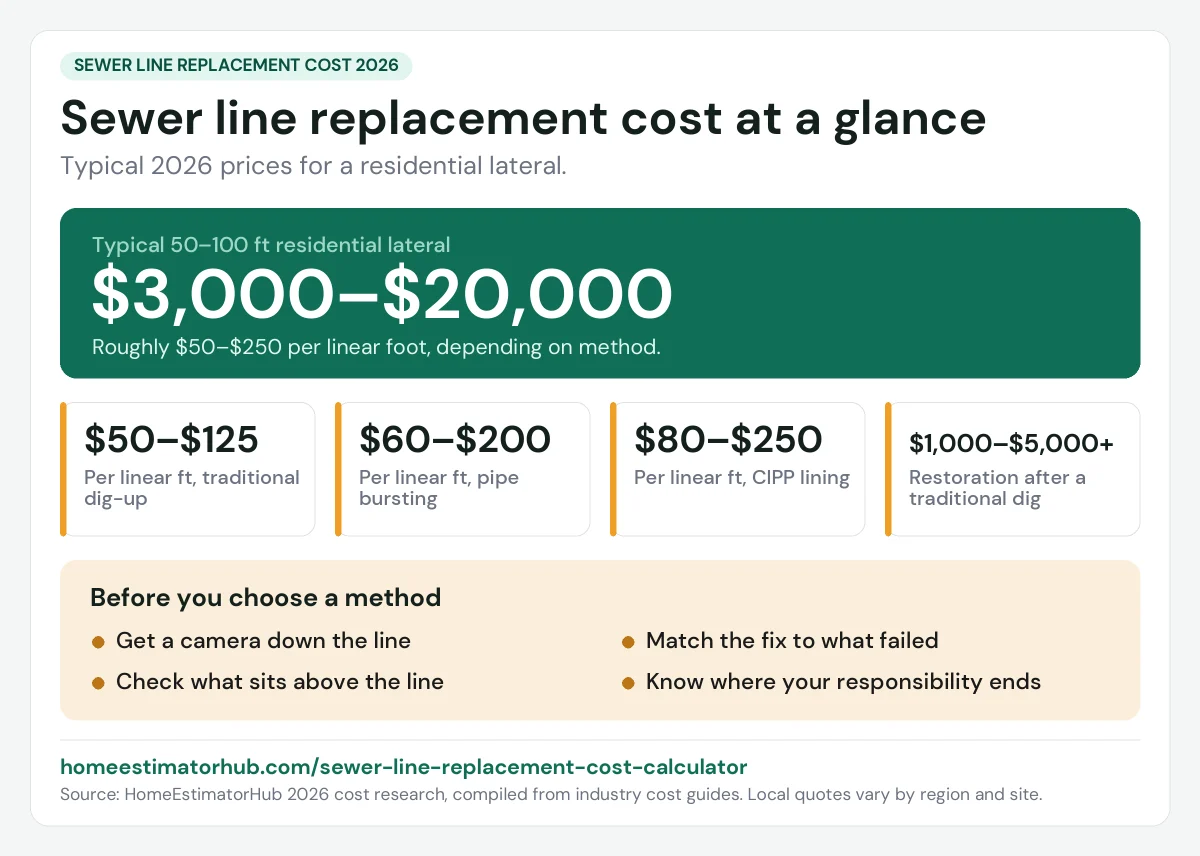
Sewer line replacement costs $3,000 to $20,000 for a typical 50–100 ft residential lateral, running $50 to $250 per linear foot depending on method. Use our free calculator to compare traditional dig-up against trenchless pipe bursting or CIPP lining for your exact setup.
Enter your sewer line details
Enter your sewer line length
Enter the distance from your home to the street connection to calculate your instant estimate.
- Most residential sewer lines run 40–75 feet from house to street
- A camera inspection should always come before any replacement bid
- Lines under a driveway can cost 2–3x more than the same length under open lawn
- Trenchless methods cost more per foot but often less in total once restoration is included
What affects sewer line replacement cost?
- Method — Traditional dig-up is cheapest per foot but often costliest overall once restoration is included.
- What's above the line — A driveway or patio can double or triple restoration cost versus open lawn.
- Depth — Deeper lines require more excavation, shoring and labor time.
- Line length — Every additional foot adds material and labor cost directly.
- Obstacles — Tree roots and utility conflicts add clearing time and cost.
- State & metro — Premium metros like Boston, NYC and San Francisco run 20–35% above national averages.

How much does sewer line replacement cost in 2026?
Sewer line replacement costs $3,000 to $20,000 for a typical 50–100 ft residential lateral — the pipe run from your home to the street connection. On a per-foot basis, expect $50 to $250 per linear foot depending on method, with a national average project cost around $2,900 to $3,319 for simpler jobs. Deep lines under a driveway can push per-foot costs to $300–$350 once restoration is factored in. Use our free calculator above to compare methods for your specific setup.
Sewer line replacement cost calculator — by method
The three main replacement methods trade off per-foot cost against disruption and restoration expense. A camera inspection is what actually determines which methods are viable for your pipe's condition.
| Method | Cost per linear ft | 50 ft lateral (pipe work only) |
|---|---|---|
| Traditional dig-up | $50–$125 | $2,500–$6,250 |
| Pipe bursting (trenchless) | $60–$200 | $3,000–$10,000 |
| CIPP pipe lining (trenchless) | $80–$250 | $4,000–$12,500 |
Traditional vs. trenchless sewer line replacement
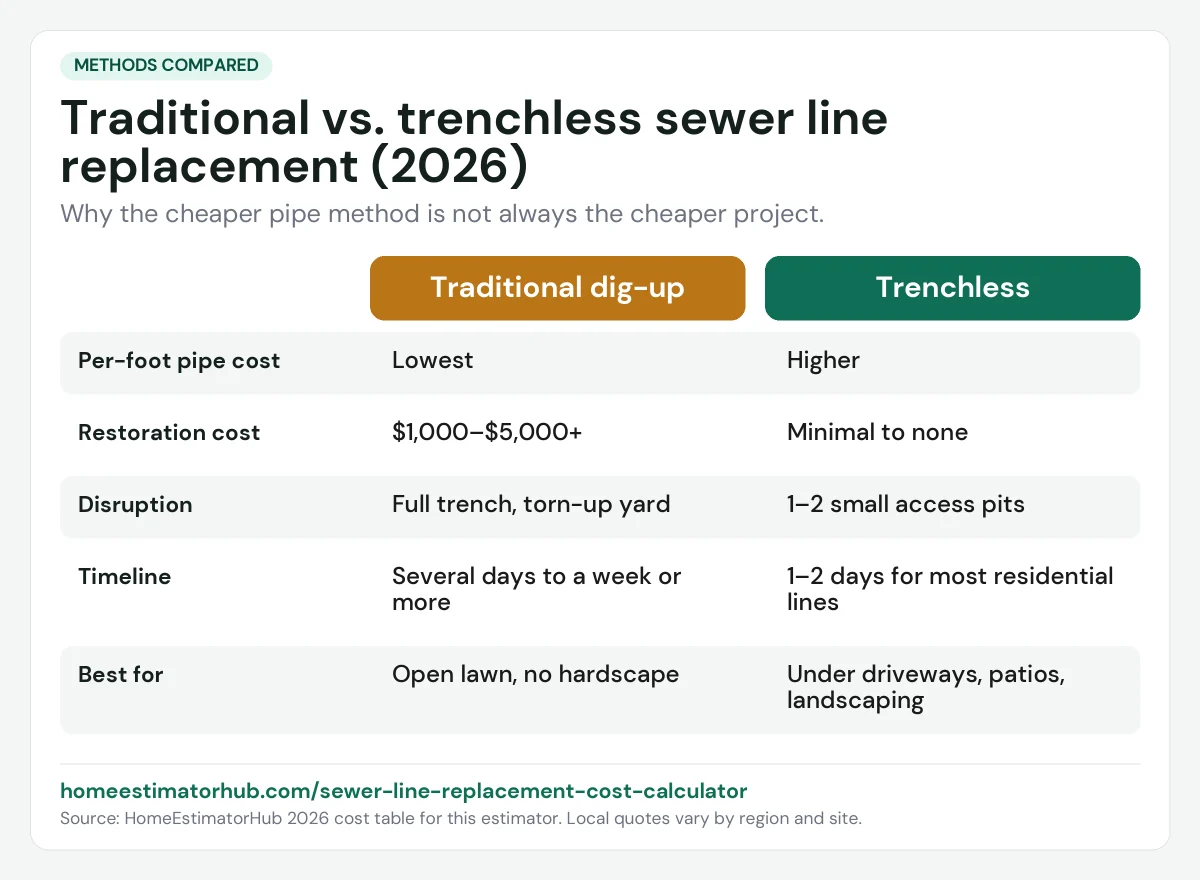
Traditional excavation looks cheaper per foot, but total project cost often closes the gap or reverses once yard, driveway and landscaping restoration are added. Trenchless methods use just one or two small access pits.
| Factor | Traditional dig-up | Trenchless (bursting/CIPP) |
|---|---|---|
| Per-foot pipe cost | Lowest | Higher |
| Restoration cost | $1,000–$5,000+ | Minimal to none |
| Disruption | Full trench, torn-up yard | 1–2 small access pits |
| Timeline | Several days to a week+ | 1–2 days for most residential lines |
| Best for | Open lawn, no hardscape | Under driveways, patios, landscaping |
What's above the line matters more than length
A 50-foot run under an asphalt driveway can cost roughly two to three times more than the same length run across open lawn — because breaking up and repouring concrete or asphalt is often more expensive than the sewer work itself. On lines running under a slab or driveway, all-in per-foot cost can reach $300 to $350 once concrete removal ($2–$25/sq ft) and repouring are included. This is exactly why trenchless methods, which need only small access pits rather than a full trench, often end up cheaper in total even at a higher per-foot rate once a driveway or patio is involved.
Sewer line replacement cost in Boston, MA
Boston is one of a handful of premium US metros — alongside NYC, San Francisco, Seattle and DC — where sewer line replacement runs roughly 20% to 35% above the national average, driven by higher labor rates and stricter municipal permitting. Massachusetts overall also sits well above the national baseline for construction labor. A homeowner in Boston should expect a typical 50 ft lateral replacement to land toward the higher end of national ranges — budget accordingly and get local, written quotes rather than relying on national averages alone. Select Massachusetts in the calculator above for a state-adjusted estimate.
Does homeowners insurance cover sewer line replacement?
Usually not. Standard homeowners insurance typically excludes sewer line failure caused by gradual wear, age, corrosion, or tree root intrusion — these are treated as maintenance issues. Coverage may apply if the damage is sudden and accidental, such as a tree falling and crushing the line. Many insurers offer an optional "service line coverage" endorsement for a modest additional premium that specifically covers underground utility line failures — worth asking your agent about before you need it.
Get a camera down the line first
No competent sewer quote is written without a video inspection. A camera pushed down the line shows what failed, where it failed and how far out it sits — and that combination is what determines which repair methods are even available to you.
Ask for two things from the inspection: the recorded footage, and a locate marking the depth and position of the problem on the surface. Both are standard practice, and both let you take competing bids on identical information rather than on each contractor's description of what they saw.
What failed determines what can fix it
Trenchless methods are not universally applicable, and a contractor who says so without looking is guessing. The failure mode governs:
| What the camera finds | What it means | Usual options |
|---|---|---|
| Root intrusion at joints | Roots entered at a joint and are now blocking flow | Lining or bursting, depending on remaining pipe condition |
| A belly — a sagging low section | The pipe has settled; waste pools rather than draining | Excavation, since neither lining nor bursting corrects grade |
| Offset or displaced joints | Sections no longer aligned | Bursting or excavation; lining is unsuitable if displacement is severe |
| Collapsed pipe | No continuous path remains | Excavation — bursting needs a path to follow |
| Deteriorated but continuous pipe | Structurally weak, still intact | Lining is a candidate where meaningful structural integrity remains |
On cost: traditional excavation runs roughly $50 to $200 per linear foot, pipe bursting about $60 to $200, and cured-in-place lining about $80 to $250. A 50-foot residential lateral commonly totals somewhere near $8,900 to $16,300 open-trench, $6,000 to $13,000 for pipe bursting, or $7,000 to $15,000 for lining.
The figure that flips the comparison is restoration. Open-trench work commonly adds $3,000 to $8,000 in putting the surface back — driveway, walkway, landscaping, sometimes a section of street. Trenchless largely avoids that, which is why a trenchless quote with a higher per-foot rate can still be the cheaper project. Our asphalt driveway cost estimator gives a sense of what replacing a dug-up driveway involves.
Know where your responsibility ends
The pipe from the house to the municipal main is the lateral, and in most jurisdictions the homeowner owns and maintains it — often including the portion running under the sidewalk and out to the connection at the main. That is why a failure near the street can still be entirely your bill.
Three things worth confirming before committing to a scope:
- Where the boundary of responsibility actually sits in your city. Rules vary, and some municipalities take over at the property line.
- Whether a permit and municipal inspection are required — for work in the right of way, they generally are, and that time belongs in the schedule.
- Whether you carry a service line endorsement. Standard homeowners policies typically exclude gradual failure of buried pipes, but many insurers sell a separate service line rider, and some utilities offer coverage programs. Check before you need it, not after.
If the house is on septic rather than a municipal connection, the failure modes and costs are different — our septic tank installation cost calculator covers that system instead.
Frequently asked questions
How do I estimate sewer line replacement cost?
Measure the distance from your home's cleanout to the street connection, choose a replacement method, and note what's above the line (open lawn vs. driveway or patio) and how deep it runs. Multiply length by the per-foot rate for your method, then adjust for obstacles above the line. Our calculator does this automatically — always confirm with a camera inspection before budgeting a final number.
How accurate is this sewer line replacement cost calculator?
There is no validated accuracy figure for this estimator, and we will not invent one. Its rates come from published 2026 cost data and are maintained by hand, but they have not been measured against a body of real quotes. Soil conditions, pipe depth and hidden obstacles cannot be confirmed without a camera inspection and site visit. Treat the result as a planning figure and the range as the realistic spread, then require a camera scope before comparing quotes.
What is the average cost of sewer line replacement?
Most homeowners pay $3,000 to $15,000 for a full residential sewer line replacement, with simpler jobs averaging around $2,900 to $3,319. Complex projects — long runs, deep excavation, or replacement under a driveway — can exceed $20,000.
Is trenchless sewer replacement cheaper than traditional?
Per linear foot, trenchless methods (pipe bursting, CIPP lining) cost more than traditional dig-up. But total project cost is often comparable or lower once you factor in restoration — trenchless methods avoid most of the yard, driveway and landscaping repair that traditional excavation requires.
How do I know if I need repair or full replacement?
A camera inspection is the deciding factor. Full replacement is typically warranted when the camera shows a collapsed or severely bellied pipe, extensive root intrusion eating 30% or more of the pipe's cross-section, or multiple failure points along the line. A single isolated crack or clog often only needs a spot repair.
Sources & standards
Primary references behind the standards, code requirements and safety guidance cited on this page. Cost ranges shown here are HomeEstimatorHub estimates, not contractor quotes — see how these are calculated, and always confirm against written bids and your local building department.
More free estimators
Explore more home cost estimators
Free cost estimators for every home improvement project — updated for 2026, no signup required.
Disclaimer: All sewer line replacement cost estimates are for informational purposes only based on average 2026 US contractor rates. Actual costs vary based on soil conditions, pipe depth, obstacles, local permit requirements and contractor availability. A camera inspection and in-person site visit are required for an accurate, binding quote. Always obtain multiple quotes from licensed plumbing contractors before proceeding with any project.