
Insurance estimator · Updated September 2026
Home Replacement Cost Calculator
Free home replacement cost calculator for homeowners insurance. Estimate what it would cost to rebuild your home from the ground up by size, quality and US state — then check whether your current dwelling coverage meets the 80% rule.
Enter your home details
Enter your home's square footage
Enter your home's total living area to calculate your instant replacement cost estimate.
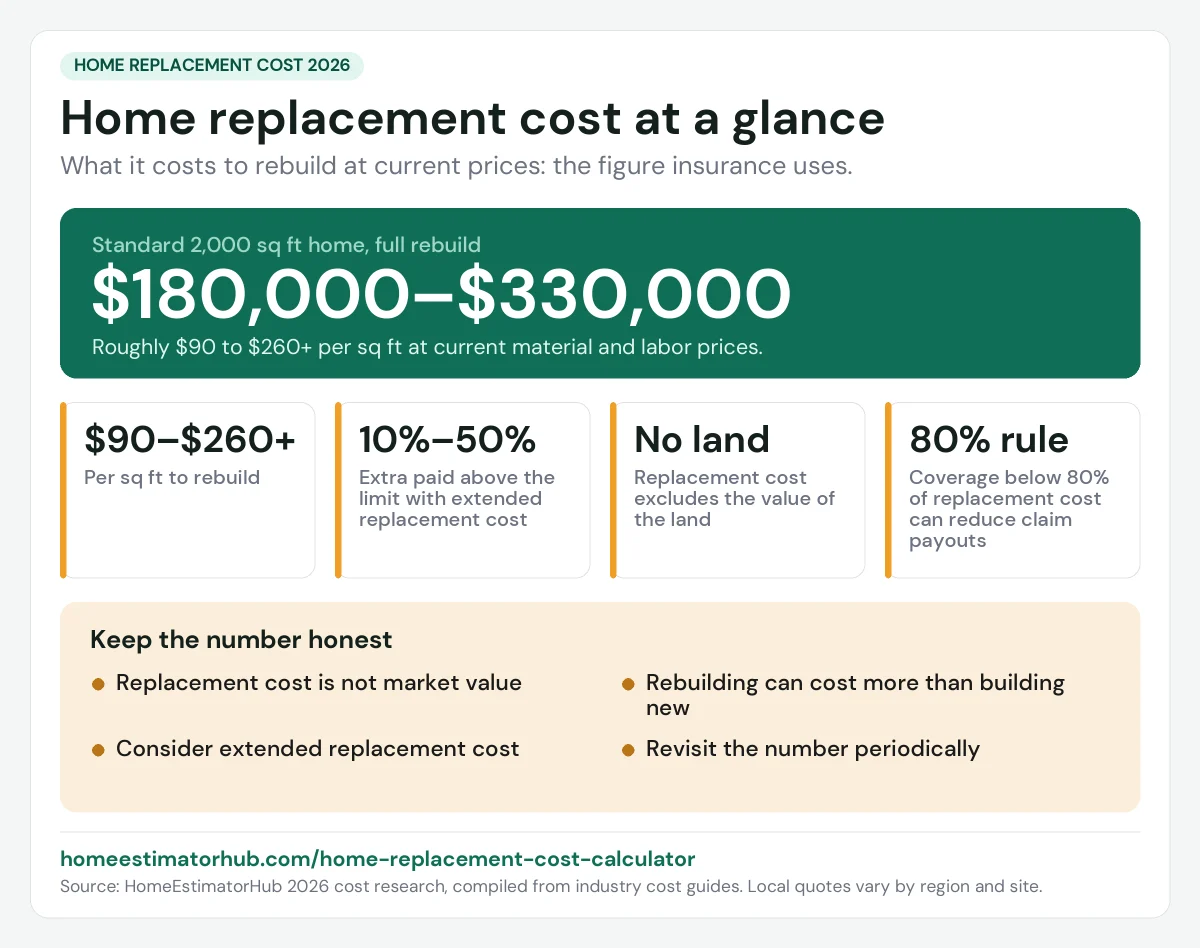
- Most 2,000 sq ft homes cost $180,000–$330,000 to fully rebuild
- Replacement cost excludes land value — it's the rebuild cost only
- Insurers generally require coverage of at least 80% of replacement cost
- Older homes with custom detail can cost more to rebuild than to buy new
What affects home replacement cost?
- Size — The primary driver. More square footage means more materials and labor to rebuild.
- Construction quality — Premium finishes and custom materials cost significantly more to replicate.
- Age & character — Older homes with plaster, custom molding or millwork can cost more to rebuild than a comparable new home.
- Number of stories — Single-story homes use more roof and foundation per square foot than multi-story homes.
- Special features — Attached garages, finished basements, fireplaces and pools add to rebuild cost.
- State & local labor costs — Material and labor pricing varies significantly by region.

How much does it cost to replace a home in 2026?
The cost to replace a home in 2026 typically runs $90 to $260+ per square foot, depending on construction quality, location and home age. A standard 2,000 sq ft home costs roughly $180,000 to $330,000 to fully rebuild at current materials and labor prices. This is your home's replacement cost value (RCV) — the figure homeowners insurance uses to set your dwelling coverage limit, not your home's market value. Use our free calculator above to get an instant, personalized replacement cost estimate.
Home replacement cost calculator — by size
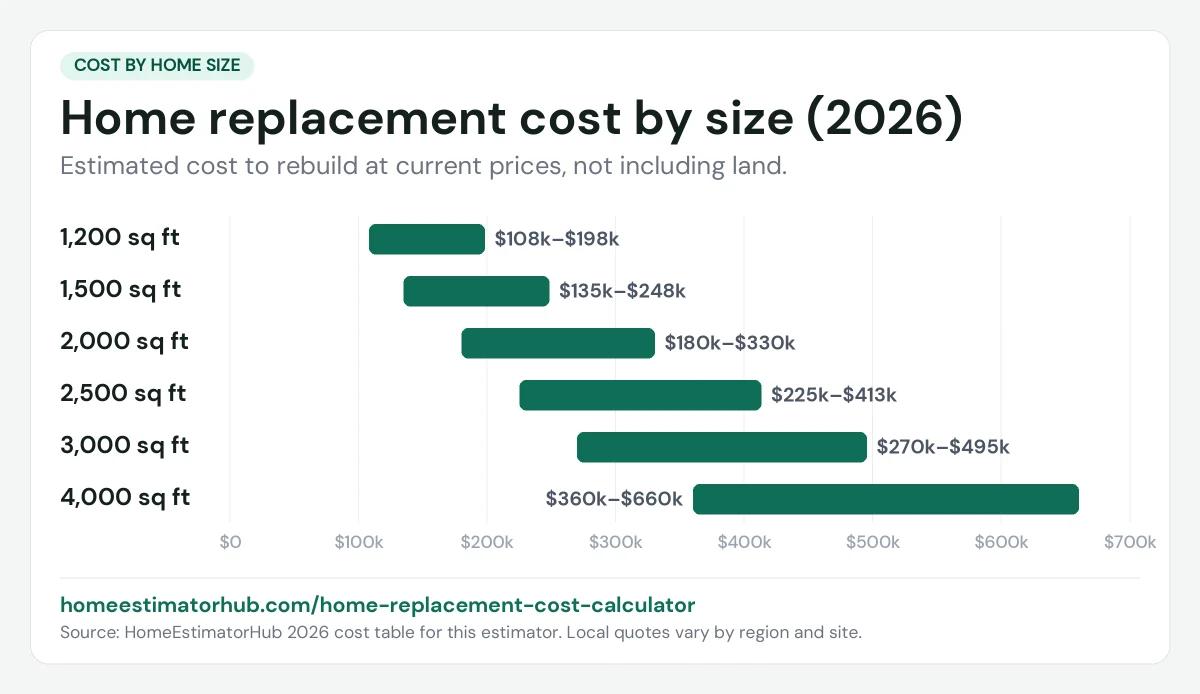
Our home replacement cost calculator updates your estimate in real time as you select size, construction quality, age, special features and US state. The table below shows typical replacement cost ranges at a standard quality level.
| Home size | Estimated replacement cost |
|---|---|
| 1,200 sq ft | $108,000–$198,000 |
| 1,500 sq ft | $135,000–$248,000 |
| 2,000 sq ft | $180,000–$330,000 |
| 2,500 sq ft | $225,000–$413,000 |
| 3,000 sq ft | $270,000–$495,000 |
| 4,000 sq ft | $360,000–$660,000 |
How to calculate the replacement cost of your home
The simplest way to calculate your home's replacement cost is with this formula: home square footage × local rebuild cost per square foot = replacement cost value. For example, a 2,000 sq ft home in an area where rebuild costs average $135 per square foot would have an estimated replacement cost of $270,000. This basic formula gives a reasonable starting estimate, but it doesn't account for construction quality, special features, or local permit and demolition costs — which is why our calculator above layers in those adjustments automatically.
Beyond the basic formula, there are a few other ways to determine your home's replacement cost, each with a different level of accuracy:
- Online calculator (this tool) — Fast, free, and useful for a ballpark figure before talking to your insurer.
- Insurance company estimate — Most insurers use specialized software (such as Marshall & Swift/Verisk 360Value) that factors in your home's exact specifications.
- Licensed appraiser or contractor — The most accurate method, since it involves an in-person inspection of materials, finishes, and local building codes.
Remember: replacement cost should never include the value of your land, since land doesn't need to be "rebuilt" after a covered loss.
Replacement cost vs. market value vs. actual cash value
These three numbers are easy to confuse, but they answer very different questions. Replacement cost is what your insurer uses to set your dwelling coverage — it has nothing to do with what your home would sell for.
| Value type | What it measures | Includes land? |
|---|---|---|
| Replacement cost (RCV) | Cost to rebuild with similar materials at current prices | No |
| Market value | What a buyer would pay on the real estate market | Yes |
| Actual cash value (ACV) | Replacement cost minus depreciation for age and wear | No |
The 80% rule — am I underinsured?
Most homeowners insurance policies require you to carry dwelling coverage equal to at least 80% of your home's replacement cost to receive full payment on a claim. This is known as the 80% rule or coinsurance clause. If your coverage falls below that threshold, your insurer will only pay a proportional share of any claim — even for partial damage, not just a total loss.
The formula insurers use is: payout ratio = coverage carried ÷ (80% × replacement cost). For example, if your replacement cost is $400,000, you'd need at least $320,000 in dwelling coverage. If you only carry $280,000, your payout ratio drops to 87.5% — meaning a $50,000 claim would only pay out $43,750, leaving you responsible for the remaining $6,250 before your deductible. Enter your current dwelling coverage limit in the calculator above to see your own coinsurance position.
Why rebuilding costs more than building new
A common assumption is that rebuilding a destroyed house should cost about what the same house costs to build on an empty lot. It routinely costs more, and the reasons are worth knowing before a policy limit is set:
- Demolition and debris removal. Before anything is built, what remains has to be cleared, sorted and hauled away — a cost that simply does not exist on a vacant lot.
- Building to current code. A house built decades ago was built to the code of its time. Rebuilding happens under today's requirements, which can mean upgraded electrical, insulation, structural connections, egress and more.
- One house at a time. Production builders spread costs across many homes. A single rebuild carries its own mobilization, supervision and procurement, with none of that efficiency.
- Demand surge. After a widespread event, local contractors and materials are in short supply across a whole region at once, and prices move accordingly.
- Site constraints. An established lot with mature landscaping, tight access and neighboring houses is harder to work than open ground.
For context on the base construction figure, national residential construction costs have been running near $162 per square foot before land and contractor overhead, and our home building cost estimator covers how that varies by size and specification.
The endorsement that decides whether you can actually rebuild
Dwelling coverage is a number, and a total loss is an event. If the number was set too low, or costs rose after it was set, the gap is yours. Two optional endorsements exist precisely for this:
| Coverage | What it does |
|---|---|
| Extended replacement cost | Pays above the dwelling limit if a claim exceeds it — commonly an extra 10% to 50% |
| Guaranteed replacement cost | Covers the full cost to rebuild regardless of the stated limit, where a carrier offers it |
| Ordinance or law coverage | Pays for the additional cost of rebuilding to current codes rather than to the original specification |
That third one is easy to overlook and frequently decisive on an older home, because a standard policy may pay to replace what was there rather than what code now requires. Ask your agent specifically whether you carry it and at what limit.
The scale of the underlying problem is substantial: industry estimates put roughly three in four US homes below what it would actually cost to rebuild them. That is not usually the result of anyone choosing to be underinsured — it is a limit set years ago that construction costs have since overtaken.
When to revisit the number
Replacement cost is not a figure to set once. Review it when any of these happen:
- You finish a basement, add a room, or convert an attic or garage into living space — new square footage has to be insured square footage.
- You upgrade materially: a kitchen, bathrooms, flooring, or replacing builder-grade finishes with something better.
- Construction costs in your region move sharply, which they have repeatedly in recent years.
- You add structures — a detached garage, workshop or substantial outbuilding, which may fall under a separate limit.
- At renewal, as a matter of routine. An annual inflation adjustment applied by the carrier is a blunt instrument and may not track your local market.
Keep documentation that would help you prove what was there: photographs of each room, receipts for major upgrades, and a record of improvements. After a fire or storm, reconstructing that from memory is difficult — our fire damage restoration cost calculator covers what the claim process involves when the loss is partial rather than total.
Frequently asked questions
How do I calculate the replacement cost of my home?
Multiply your home's total square footage by the local rebuild cost per square foot for your area. For a more accurate number, adjust for construction quality, home age, special features like an attached garage or finished basement, and your state's labor costs — which is exactly what our calculator does automatically.
How accurate is this home replacement cost calculator?
There is no validated accuracy figure for this calculator, and we will not invent one. Its rates come from published 2026 construction cost data and are maintained by hand, but they have not been checked against appraisals or insurer software. Use it for budgeting and coverage checks only; it is not a substitute for a carrier-approved replacement cost estimate, an appraisal, or an underwriting requirement.
Is replacement cost the same as market value?
No. Market value is what your home would sell for, including land and local real estate demand. Replacement cost is only the cost to rebuild the structure with similar materials — it excludes land value entirely and is typically a different number than what you paid for or could sell your home for.
What happens if my home is underinsured?
If your dwelling coverage is below 80% of your home's replacement cost, your insurer applies a coinsurance penalty to any claim — even for partial damage. You'd receive a reduced payout proportional to how underinsured you are, leaving you to cover the difference out of pocket.
How often should I update my replacement cost estimate?
Review your replacement cost at least once a year, and any time you renovate, finish a basement, add square footage, or notice significant increases in local material and labor prices. Rebuilding costs can rise faster than your policy's automatic inflation adjustment.
Sources & standards
Primary references behind the standards, code requirements and safety guidance cited on this page. Cost ranges shown here are HomeEstimatorHub estimates, not contractor quotes — see how these are calculated, and always confirm against written bids and your local building department.
More free estimators
Explore more home cost estimators
Free cost estimators for every home improvement and insurance question — updated for 2026, no signup required.
Disclaimer: This calculator provides a directional estimate for informational purposes only, based on average 2026 construction cost data and published insurance industry guidance. It is not a carrier-approved replacement cost estimate (RCE), professional appraisal, or insurance recommendation, and should not be used as the sole basis for a coverage decision. Always confirm your dwelling coverage amount with a licensed insurance agent, your insurer, or a professional appraiser.