
Windows & exterior estimator · Updated September 2026
Window Replacement Cost Estimator
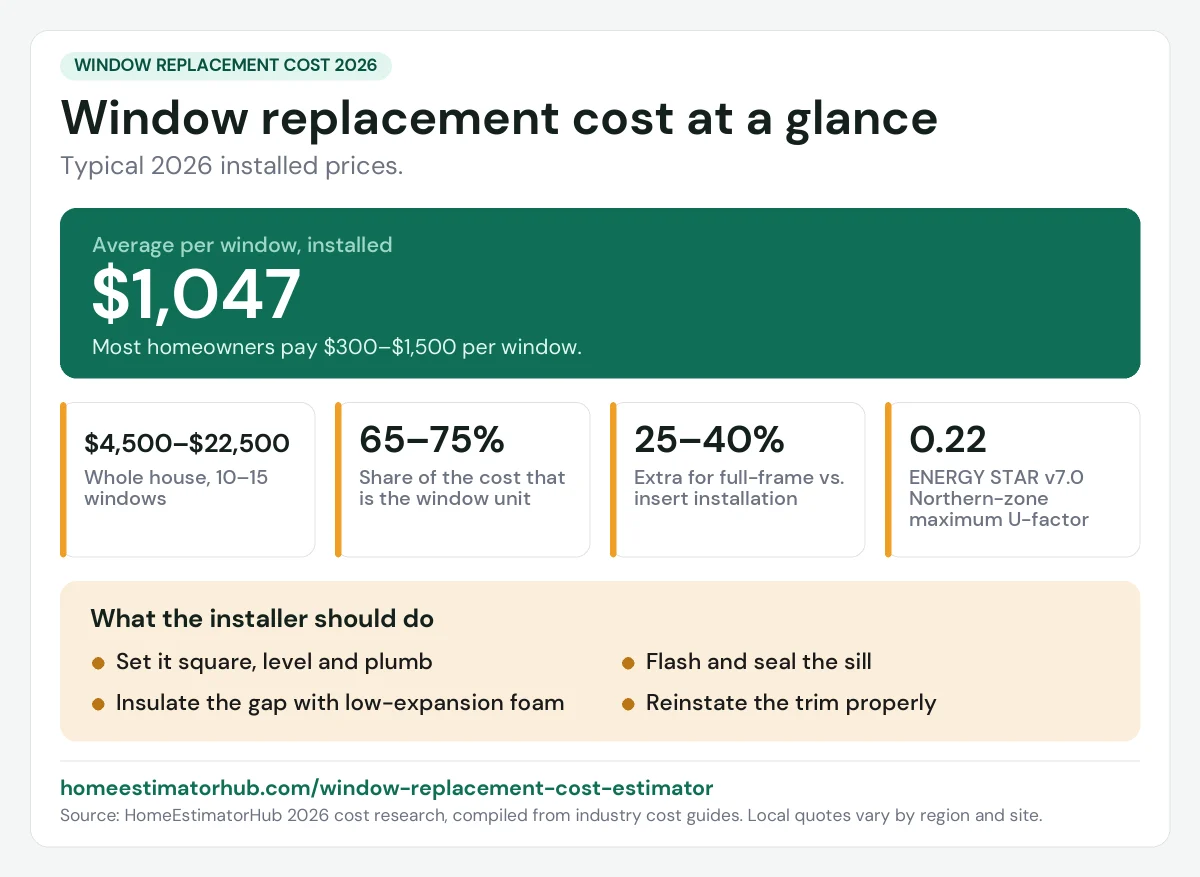
Window replacement costs $1,047 per window on average, with most homeowners paying $300 to $1,500 per window installed. A whole-house project (10–15 windows) typically runs $4,500 to $22,500. Use our free calculator to price full replacement by frame, glass and style — or just get a glass-only repair estimate.
What do you need?
Estimated window replacement cost
Typical range for your configuration
Cost breakdown
What affects window replacement cost?
- Frame material — Vinyl is the budget baseline; wood and premium composites cost significantly more.
- Glass package — Triple-pane Low-E costs more than standard double-pane but improves energy efficiency.
- Installation method — Insert (pocket) replacement is cheaper; full-frame is required for rotted or resized openings.
- Window style — Bay and bow windows cost far more than standard hung or slider styles.
- Quantity — Replacing multiple windows at once typically earns a 10–25% bulk discount per window.
- State — Labor costs in California and the Northeast run 25–30% higher than Midwest and Southern states.

How much does window replacement cost in 2026?
Window replacement costs $1,047 per window on average, based on real 2026 homeowner project data, with most homeowners paying between $300 and $1,500 per window installed. A whole-house project replacing 10–15 windows typically runs $4,500 to $22,500. The window unit itself makes up roughly 65–75% of the cost, with labor covering the rest. Use our free calculator above for an instant estimate based on style, frame, glass and installation method.
Window replacement cost calculator — by frame material
| Frame material | Cost per window (installed) |
|---|---|
| Vinyl | $400–$850 |
| Aluminum | $450–$950 |
| Fiberglass | $600–$1,300 |
| Wood / wood-clad | $1,000–$1,800 |
Window replacement cost by style
| Style | Cost per window (installed) |
|---|---|
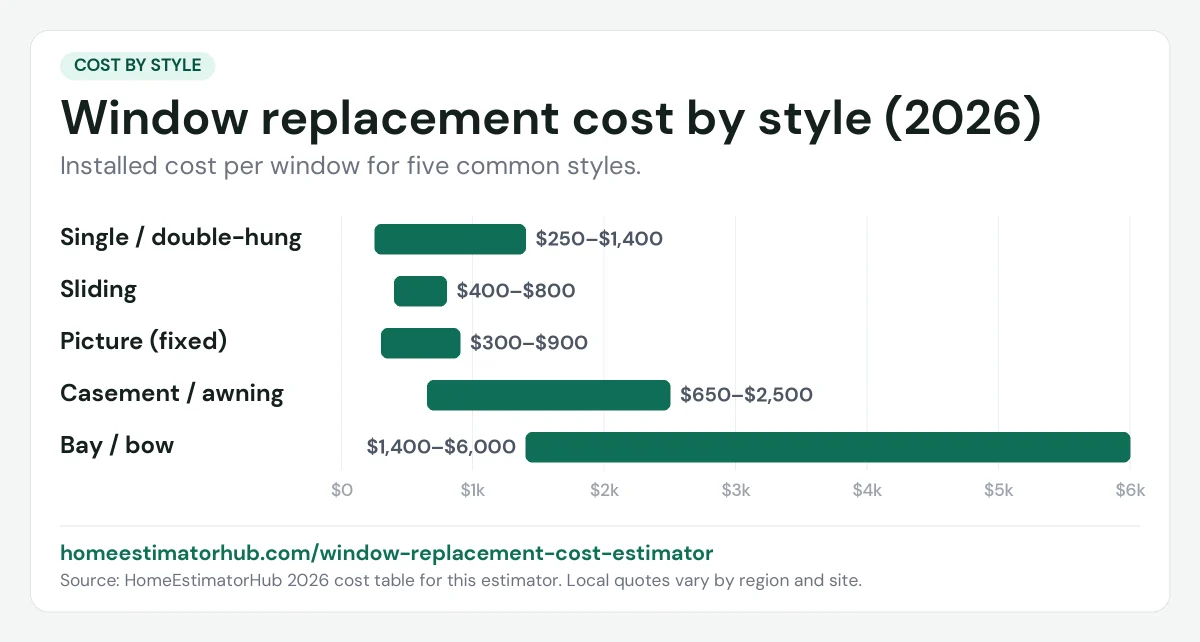
| Single/double-hung | $250–$1,400 |
| Sliding | $400–$800 |
| Casement / awning | $650–$2,500 |
| Picture (fixed) | $300–$900 |
| Bay / bow | $1,400–$6,000 |
Insert (pocket) vs. full-frame window replacement
This is the single biggest cost decision — and the most misunderstood by homeowners — in any window project.
| Factor | Insert (pocket) | Full-frame |
|---|---|---|
| Relative cost | Baseline | 25–40% more |
| What's replaced | Sash & hardware inside existing frame | Entire unit down to rough opening |
| Best for | Frames that are square, sound, undamaged | Rotted frames, resizing, or major upgrades |
| Siding/exterior work | Minimal to none | Required — trim, flashing, casing |
| Permit typically needed | Rarely | Often, especially if opening size changes |
Window glass replacement cost
If only the glass pane is damaged — cracked, fogged between panes, or broken — and the frame itself is in good shape, glass-only replacement is a much cheaper fix than a full window replacement. Glass-only replacement typically costs $150 to $650 per pane, depending on glass type: standard double-pane runs $150–$400, Low-E coated glass costs more, and triple-pane or impact-rated specialty glass sits at the higher end. This is the right call for isolated glass failures on otherwise healthy windows — replacing the whole unit when only the glass has failed is money you don't need to spend. Use the "Glass-only replacement" option in the calculator above for an instant estimate.
Are there tax credits for window replacement?
Yes. The federal Energy Efficient Home Improvement Credit (25C) offers 30% of qualifying window material costs, capped at $600 per year, for windows installed on your primary residence. Labor costs don't qualify — only the window materials themselves. Windows must be ENERGY STAR certified and meet U-factor and solar heat gain coefficient (SHGC) requirements for your climate zone. Claim the credit using IRS Form 5695. Many states and utility companies also offer additional rebates — check energystar.gov/rebates for programs in your area.
How to read the NFRC label
Every certified replacement window carries a white NFRC sticker, and the four numbers on it describe the product far more reliably than the brand name or the showroom pitch does.
| Rating | What it measures | Which direction is better | Typical range |
|---|---|---|---|
| U-factor | How fast heat escapes through the whole window | Lower | 0.25–0.32 double pane with low-E; 0.15–0.22 triple pane |
| Solar heat gain coefficient | How much of the sun's heat the glass admits | Depends on your climate | Roughly 0.20–0.60 |
| Visible transmittance | How much daylight comes through | Higher, in most rooms | Roughly 0.30–0.70 |
| Air leakage | Air passing through the assembly itself | Lower | 0.3 or below is common on quality units |
Which number you optimise for depends on where you live. In heating-dominated climates, U-factor is the one that decides your winter bills. In cooling-dominated ones, solar heat gain coefficient matters more, because keeping summer heat out of the room is the harder job. A window advertised as “energy efficient” without these figures attached has told you nothing specific.
What ENERGY STAR version 7.0 changed
The certification tightened, and it changed the maths in cold climates in particular. Under version 7.0, windows qualifying in the Northern zone need a U-factor of 0.22 or lower — a level that is difficult to reach with conventional double glazing, which is pushing Northern-zone products toward triple pane or more advanced glazing packages.
The practical consequence for a 2026 quote is that in northern states, “ENERGY STAR certified” can now mean a materially more expensive window than the same label implied a few years ago. Double pane with a low-E coating and argon fill still meets or exceeds the requirement across most other climate zones, and remains the value sweet spot there, while triple pane adds roughly 30% or more to the unit price in this estimator.
What you are paying the installer for
The unit is only half of what determines whether a window performs. The labor line covers work that is invisible once the trim goes back on:
- Removing the old unit without wrecking the surrounding trim, siding or plaster.
- Shimming the new one square, level and plumb — a racked window never operates smoothly and never seals properly, no matter what the label says.
- Flashing and sealing at the sill, which is the path water actually takes when a window leaks.
- Insulating the perimeter gap with low-expansion foam rather than stuffed fiberglass, which compresses and leaves a thermal bypass.
- Reinstating interior and exterior trim to a finished standard.
This is also the reason insert installation costs less. Keeping the existing frame and replacing the sash assembly avoids the 25% to 40% premium that full-frame replacement carries, and it is a sound choice when the existing frames are square, solid and dry. When they are not — rot at the sill, out-of-square openings, suspect flashing — full-frame is not an upgrade you are being upsold, it is the only method that lets the installer see and fix what is behind the frame.
Whole house at once, or phase it?
On the figures on this page, a whole-house project of 10 to 15 windows typically runs $4,500 to $22,500. Phasing almost always costs more per window, because each visit carries its own mobilization, and small orders lose the volume pricing that a full-house order attracts.
When the budget forces phasing anyway, sequence by consequence rather than by room. Failed seals, rotted sills and windows that no longer close come first, because those are active damage. The elevation facing prevailing weather comes next, since it drives both comfort and deterioration. Purely cosmetic replacements go last. If rot has already reached the framing around an opening, price that work through our vinyl siding cost estimator before committing to a window order, and the HVAC cost estimator is worth revisiting afterwards — a tighter envelope can change what system the house needs.
Frequently asked questions
How do I estimate window replacement cost?
Count your windows, choose a style and frame material, select a glass package, and decide between insert or full-frame installation based on your existing frame condition. Our calculator combines all of these automatically — as a rule of thumb, budget $400–$1,200 per window for a standard insert replacement.
What is the average cost to replace a window?
The national average is $1,047 per window based on real 2026 project data, though most standard vinyl insert replacements fall in the $400–$850 range. Premium materials, full-frame installation, or specialty styles like bay windows push costs significantly higher.
How much does it cost to replace window glass only?
Glass-only replacement — repairing a cracked or fogged pane without replacing the whole window — typically costs $150 to $650 depending on glass type, compared to $400 or more for a full window replacement. This only works if the frame itself is still in good condition.
Is insert or full-frame window replacement better?
Insert (pocket) replacement is cheaper and less disruptive, and is the right choice whenever your existing frame is square, level, and free of rot — which describes most homes built after 1980. Full-frame replacement costs 25–40% more but is necessary when frames are damaged, out of square, or you're changing window size.
Do I need a permit to replace windows?
Usually not for like-for-like replacement in the same opening size. A permit — typically $50 to $200 — is generally required if you're changing the size of the opening, since that involves reframing.
Sources & standards
Primary references behind the standards, code requirements and safety guidance cited on this page. Cost ranges shown here are HomeEstimatorHub estimates, not contractor quotes — see how these are calculated, and always confirm against written bids and your local building department.
More free estimators
Explore more home cost estimators
Free cost estimators for every home improvement project — updated for 2026, no signup required.
Disclaimer: All window replacement cost estimates are for informational purposes only based on average 2026 US contractor rates. Actual costs vary based on window brand, frame condition, site accessibility, permit requirements and contractor availability. Always obtain multiple quotes from licensed window installers before proceeding with any project. Tax credit eligibility depends on IRS rules current at time of filing — consult a tax professional.