
Structural repair estimator · Updated September 2026
Foundation Repair Cost Calculator
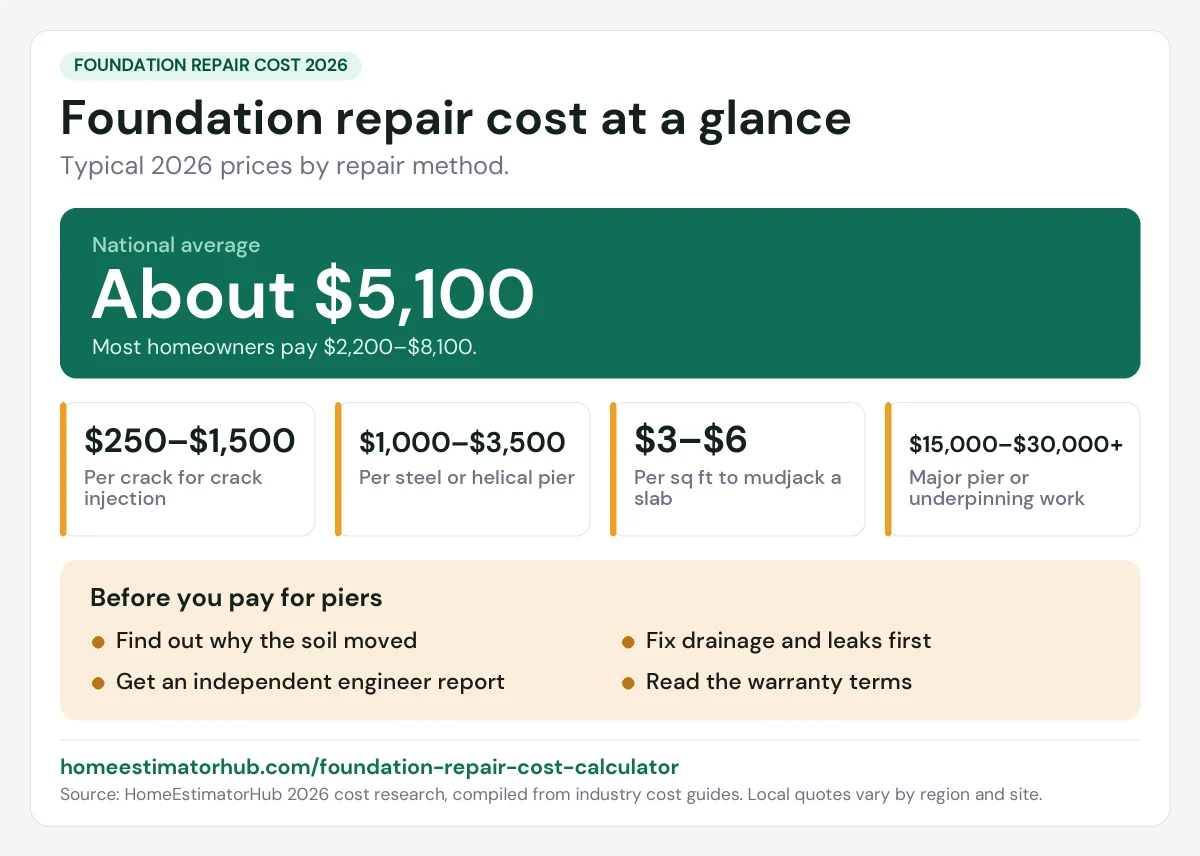
Foundation repair costs $5,100 on average, with most homeowners paying $2,200 to $8,100. A simple crack injection can run as little as $300, while full underpinning with piers can exceed $30,000. Use our free calculator to get an instant estimate by repair method, quantity and foundation type.
Enter your foundation repair details
Estimated foundation repair cost
Typical range for your configuration
Cost breakdown
What affects foundation repair cost?
- Repair method — The single biggest cost driver. A crack injection costs a fraction of a full pier installation.
- Quantity — More cracks, straps, piers, or affected square footage directly increases cost.
- Foundation type — Basements and finished spaces are harder to access than open crawl spaces.
- Damage severity — Minor cosmetic cracks cost far less than active, ongoing structural settlement.
- Soil conditions — Expansive clay soils (common in Texas and Oklahoma) often require deeper, more numerous piers.
- State & metro — High-cost-of-living metros like San Francisco, New York and Boston run 20–40% above national averages.

How much does foundation repair cost in 2026?
Foundation repair costs $5,100 on average, with most homeowners paying between $2,200 and $8,100. Minor fixes like crack sealing can run as little as $300, while major structural work involving piers or full underpinning can exceed $15,000 to $30,000 or more. Foundation repair covers five very different procedures at wildly different price points — the trick is matching the right method to your actual damage, not just picking the cheapest option. Use our free calculator above for an instant estimate by method, quantity and foundation type.
Foundation repair cost calculator — by method
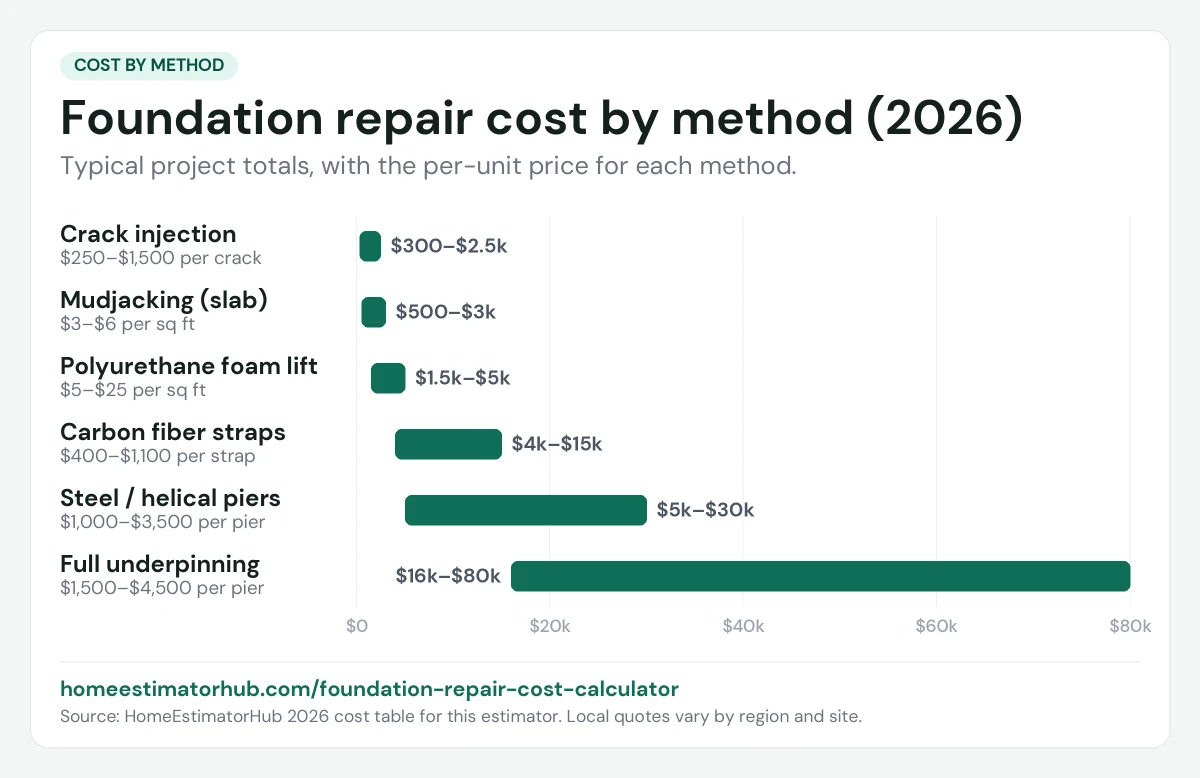
| Method | Cost per unit | Typical total |
|---|---|---|
| Crack injection | $250–$1,500 per crack | $300–$2,500 |
| Carbon fiber straps | $400–$1,100 per strap | $4,000–$15,000 |
| Mudjacking (slab) | $3–$6 per sq ft | $500–$3,000 |
| Polyurethane foam lift | $5–$25 per sq ft | $1,500–$5,000 |
| Steel / helical piers | $1,000–$3,500 per pier | $5,000–$30,000 |
| Full underpinning | $1,500–$4,500 per pier | $16,000–$80,000 |
Which foundation repair method do I need?
The method your foundation needs depends entirely on what's actually happening structurally — not on which one is cheapest. A structural engineer's assessment is the only reliable way to know for sure, but these general patterns hold:
- Hairline, non-moving crack in a poured wall — Crack injection seals it against water but doesn't address structural movement.
- Bowing basement wall — Carbon fiber straps or steel wall anchors arrest further inward movement.
- Sunken concrete slab, driveway, or garage floor — Mudjacking or polyurethane foam lifts it back to grade.
- House settling unevenly, sticking doors, sloping floors — Steel or helical piers lift and stabilize the structure.
- Severe differential settlement across the whole foundation — Full underpinning with 8–16+ piers is typically required.
Warning signs you need foundation repair
- Diagonal cracks from window or door corners — A classic sign of differential settling.
- Doors and windows sticking — Frame shifting means the structure is moving.
- Gaps between walls and ceiling or floor — Even a quarter-inch gap can indicate movement.
- Sloping or uneven floors — A marble that rolls on its own suggests settling.
- Bowing basement walls — Horizontal cracking with inward bowing is a structural emergency.
Does homeowners insurance cover foundation repair?
Generally, no. Most homeowners insurance policies exclude foundation damage caused by soil movement, settling, or gradual deterioration — these are treated as maintenance issues. Coverage typically applies only to sudden, accidental damage from a named peril, like a burst pipe flooding a slab. Earthquake damage is excluded unless you carry a separate earthquake endorsement, and flood-related foundation damage requires separate flood insurance. Some policies cover resulting cosmetic damage (like cracked drywall) if the underlying cause was a covered event, but the foundation repair itself is rarely covered.
The soil moves before the foundation does
Foundations rarely fail on their own. In most cases the ground underneath changed, and the structure followed it. Understanding which mechanism is at work matters financially, because the repair that stabilizes the house and the repair that stops the problem recurring are often two different invoices.
| Cause | What happens | What it points toward |
|---|---|---|
| Expansive clay soil | Swells when wet, shrinks when dry, lifting and dropping the foundation seasonally | Moisture management around the perimeter, and piers if movement has become permanent |
| Poor drainage | Water pooling against the wall saturates and softens bearing soil | Grading, gutters and downspout extensions — often the cheapest effective fix |
| Mature trees close to the house | Roots draw large volumes of moisture out of the soil, causing localised shrinkage | Root barriers or managed removal, alongside any structural work |
| Undetected plumbing leaks | A slow leak under a slab washes out or saturates the soil beneath one area | Leak detection first — repairing the foundation over a live leak repeats the failure |
| Poorly compacted fill | Ground placed during construction consolidates under load over years | Underpinning down to competent bearing soil |
This is why a reputable contractor asks about drainage, irrigation and trees before quoting piers. If water management is the whole problem, correcting it is dramatically cheaper than underpinning, and our french drain installation calculator and basement waterproofing calculator price that route.
What each repair method is actually for
Method selection is driven by the failure, not by preference. Typical 2026 pricing, with most whole-house projects landing between $2,200 and $8,100 and a national average near $5,100:
- Epoxy crack injection, roughly $250 to $1,500 per crack. Seals non-structural cracks in poured concrete walls. It is not a fix for a crack that is still moving — injecting a live crack simply relocates the next one.
- Steel push piers, roughly $1,000 to $3,500 each installed. Driven to load-bearing soil using the weight of the house itself. Suited to settlement under a substantial structure.
- Helical piers, priced in the same per-pier range. Screwed into place rather than driven, which makes them the choice for lighter structures and for soils where a push pier cannot develop resistance.
- Slab jacking, roughly $500 to $3,000. Lifts a settled slab by injecting material beneath it. It addresses the slab, not the structure carrying the house.
Most homes needing underpinning take three to eight piers, which puts full projects in the $5,000 to $15,000 band, with severe cases running $15,000 to $30,000 and beyond. Pier count is set by where the movement is and how the loads travel, not by the size of the house.
Get the diagnosis from someone who is not selling the repair
Foundation work is one of the few household repairs where an independent opinion routinely changes the scope. A licensed structural engineer, engaged directly and paid a flat fee, has no stake in how many piers end up in the ground. Their report gives you a scope that competing contractors can bid against on identical terms — which is the only way to compare foundation quotes meaningfully.
Two details to settle in writing before work begins. First, the warranty: ask whether it is transferable to a future owner, whether it covers the whole foundation or only the piers installed, and who honours it if the contractor closes. Second, what recovery is promised — piers can stabilize a foundation against further movement, and may lift it partway back, but a full return to original elevation is not guaranteed and a contractor promising one is overselling.
On price expectations: foundation costs have risen roughly 10% since 2019, tracking inflation in concrete, steel and skilled labor, with specialist rates around $200 per hour. An old quote is not a useful benchmark for a current one.
Frequently asked questions
How do I estimate foundation repair cost?
Identify the repair method your damage requires (crack injection, carbon fiber, mudjacking, piers, or underpinning), estimate the quantity needed (cracks, straps, square footage, or pier count), and factor in your foundation type. A structural engineer's assessment gives the most accurate quantity — our calculator provides a ballpark once you have that number.
How accurate is this foundation repair cost calculator?
There is no validated accuracy figure for this estimator, and we will not invent one. Its rates come from published 2026 cost data and are maintained by hand, but they have not been measured against a body of real quotes. Pier count and soil conditions cannot be confirmed without an in-person structural assessment, and prices vary widely between contractors. Treat the result as a planning figure and the range as the realistic spread, then get at least 3 quotes.
What is the average cost of foundation repair?
The national average is around $5,100, with most homeowners paying between $2,200 and $8,100. Minor crack repairs can cost as little as $300, while major structural work like piering or underpinning can exceed $15,000 to $30,000.
How many piers does my foundation need?
Most homes need 3 to 12 piers for moderate settlement, while severe differential settlement across a whole foundation can require 8 to 16 or more. A structural engineer's report specifies exact pier locations and count — never accept a pier count from a contractor without independent verification.
Can I do foundation crack repair myself?
Small, hairline vertical cracks under 1/8 inch wide can often be sealed with a DIY epoxy kit. Anything larger, actively leaking, or showing signs of ongoing movement should be assessed by a structural engineer — foundation work affects your home's structural integrity and resale value, and a botched DIY repair can cost far more to fix later.
Sources & standards
Primary references behind the standards, code requirements and safety guidance cited on this page. Cost ranges shown here are HomeEstimatorHub estimates, not contractor quotes — see how these are calculated, and always confirm against written bids and your local building department.
More free estimators
Explore more home cost estimators
Free cost estimators for every home improvement project — updated for 2026, no signup required.
Disclaimer: All foundation repair cost estimates are for informational purposes only based on average 2026 US contractor rates. Actual costs vary based on soil conditions, foundation type, damage severity, accessibility and contractor availability. A structural engineer's in-person assessment is strongly recommended before committing to any repair method. Always obtain multiple quotes from licensed foundation repair contractors before proceeding with any project.