
Insulation & energy estimator · Updated September 2026
Attic Insulation Cost Calculator
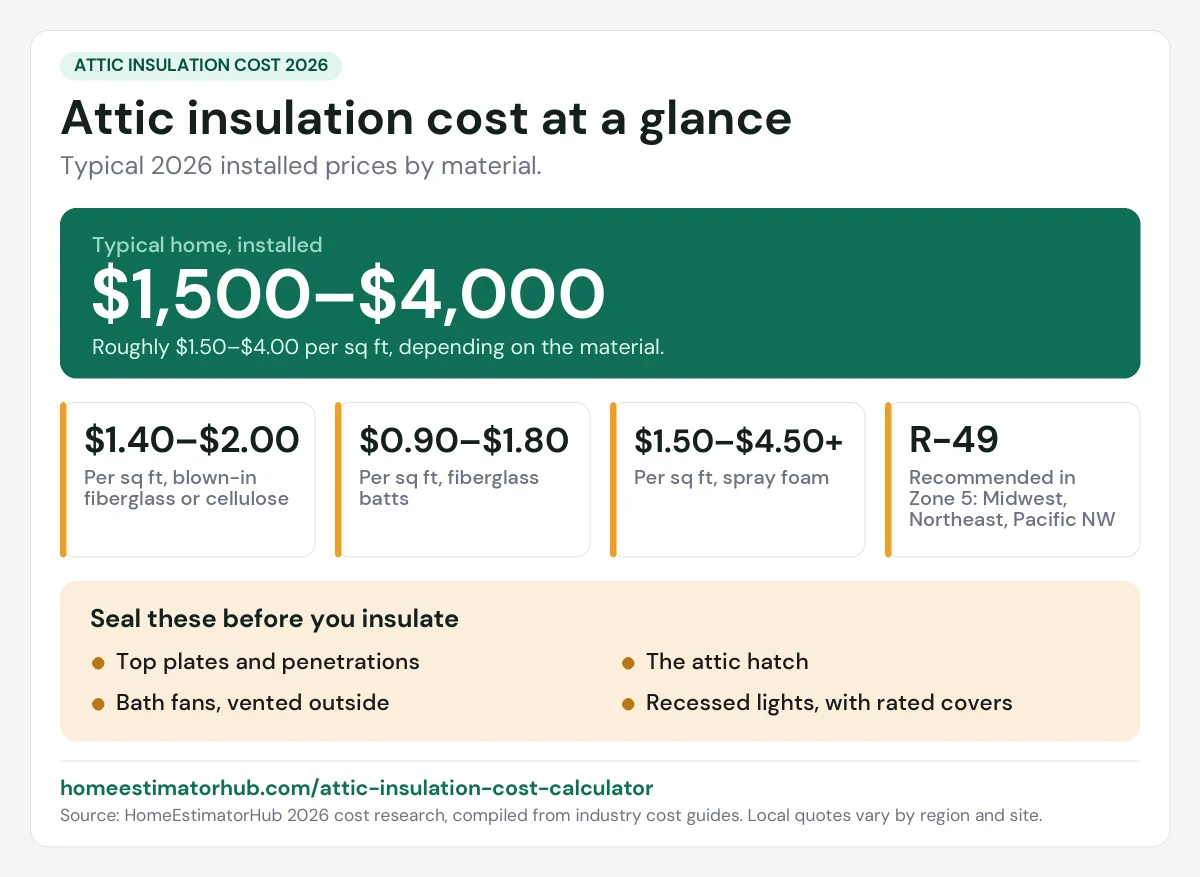
Attic insulation costs $1,500 to $4,000 for a typical home, or $1.50 to $4.00 per square foot installed. Use our free calculator to price your project by material and target R-value — and see your estimated energy savings and payback period.
Enter your attic details
Enter your attic's square footage
Enter your attic floor area to calculate your instant cost estimate and energy savings.
- Most attics cost $1,500–$4,000 to fully insulate
- The DOE recommends R-49 to R-60 for most of the US
- Attic insulation has the fastest energy payback of any home upgrade — often just 3–5 years
- A federal tax credit covers 30% of cost, up to $1,200/year
What affects attic insulation cost?
- Material — Blown-in fiberglass/cellulose is the affordable standard; spray foam costs 2–4x more but air-seals as it insulates.
- Target R-value — Higher R-values require more material, though savings show diminishing returns above R-60.
- Existing insulation — Topping up existing insulation costs far less than starting from bare joists.
- Removal — Damaged, moldy, or pest-contaminated insulation must be removed before new material goes in.
- Air sealing — Closing gaps around lights, plumbing and top plates before insulating often doubles your energy savings.
- State — Labor costs in California and the Northeast run 25–30% higher than Midwest and Southern states.

How much does attic insulation cost in 2026?
Attic insulation costs $1,500 to $4,000 for a typical home, or roughly $1.50 to $4.00 per square foot installed depending on material. Blown-in fiberglass and cellulose — the most popular attic options — run about $1.40 to $2.00 per square foot, while spray foam runs $1.50 to $4.50 or more per square foot depending on open-cell vs. closed-cell. Use our free calculator above for an instant estimate, plus your projected energy savings and payback period.
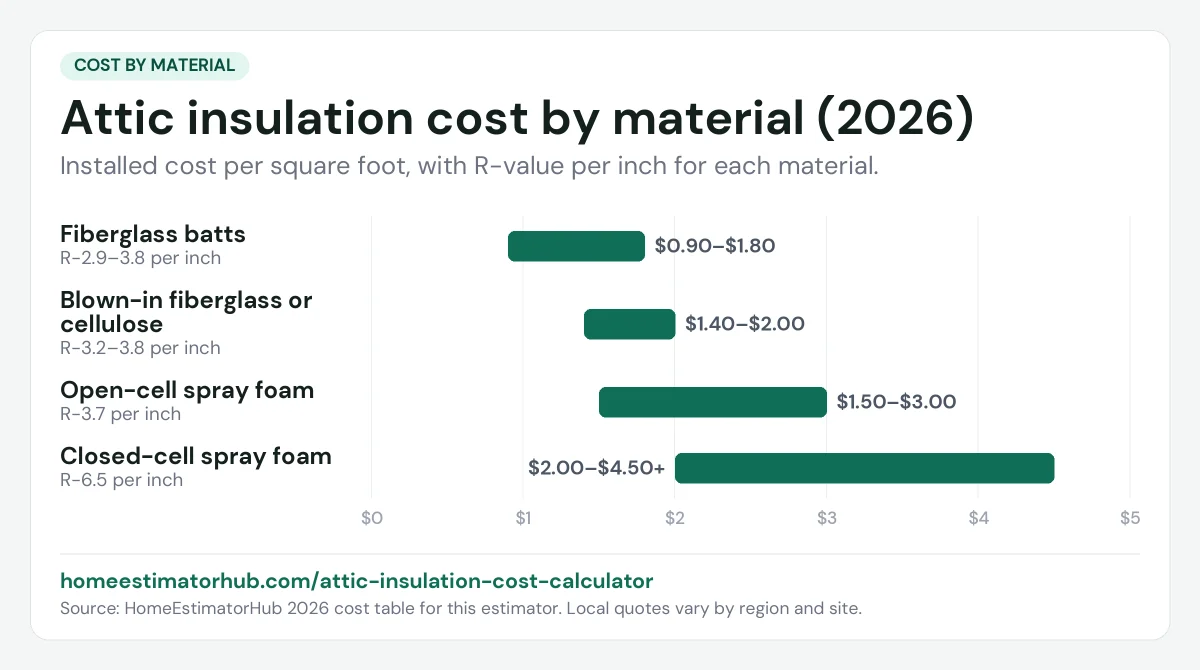
Attic insulation cost calculator — by material
| Material | Cost per sq ft installed | R-value per inch |
|---|---|---|
| Fiberglass batts | $0.90–$1.80 | R-2.9–3.8 |
| Blown-in fiberglass/cellulose | $1.40–$2.00 | R-3.2–3.8 |
| Open-cell spray foam | $1.50–$3.00 | R-3.7 |
| Closed-cell spray foam | $2.00–$4.50+ | R-6.5 |
What R-value do I need for my attic?
The US Department of Energy recommends different attic R-value targets depending on your climate zone. As a rule of thumb, most attics benefit from R-38 to R-49; colder regions should target R-60.
| Climate zone / region | Recommended R-value |
|---|---|
| Zone 1–2: Florida, Hawaii, deep South | R-30 minimum |
| Zone 3: Southeast, Texas, Arizona | R-38 |
| Zone 4: Mid-Atlantic, Appalachia | R-38–49 |
| Zone 5: Midwest, Northeast, Pacific NW | R-49 |
| Zone 6–7: Upper Midwest, Mountain West | R-49–60 |
| Zone 8: Alaska | R-60+ |
How much will attic insulation save me?
The EPA estimates that homeowners who air seal and add attic insulation save an average of 15% on heating and cooling costs — often more for homes that were severely under-insulated. For a typical 1,000–1,200 sq ft attic going from bare joists to R-49, that translates to roughly $300 to $500 per year in energy savings. Attic insulation delivers the fastest payback of any home energy upgrade — typically just 3 to 5 years — since uninsulated attics can account for 25–30% of a home's total heat loss. Our calculator above estimates your specific annual savings and payback period based on your inputs.
Is there a tax credit for attic insulation?
Yes. The federal Energy Efficient Home Improvement Credit (Section 25C) covers 30% of insulation costs — including installation — up to $1,200 per year through 2032. Unlike windows and doors, where only material costs qualify, insulation credits under 25C cover labor too. Air sealing work also qualifies. Claim it using IRS Form 5695. Many states and utility companies offer additional rebates on top of the federal credit — check energystar.gov/rebates for programs in your area.
Blown-in vs. batt insulation for attics
| Factor | Blown-in | Batts |
|---|---|---|
| Best for | Irregular joists, obstructions, most attics | Evenly-spaced, accessible joists |
| DIY-friendly | Moderate — rentable blower machines | Yes — easiest DIY option |
| Coverage of gaps | Excellent — conforms around everything | Fair — requires precise cutting |
| Best choice when | Attic isn't regularly accessed | Attic is used for storage/equipment access |
Air sealing comes before insulation
Insulation slows heat moving through materials. It does nothing about air moving around them. An attic given a full R-49 blanket over unsealed top plates, open wall chases and uncovered recessed lights will underperform its rating, because warm indoor air keeps rising straight past the insulation and out through the gaps.
This is why the widely quoted figure — that going from R-11 to R-49 cuts heating and cooling bills by roughly 15% to 25% — assumes an attic that was sealed first. The sealing work is unglamorous and usually cheap relative to the insulation itself:
- Top plates where interior walls meet the attic floor, plus any open stud bays below them.
- Plumbing stacks, wiring penetrations and duct boots, sealed with caulk or foam.
- Chimney and flue chases, which need sheet metal and high-temperature sealant rather than ordinary foam.
- The attic hatch or pull-down stair — usually the single largest hole in the ceiling plane, and usually the last one anyone thinks of.
- Bathroom exhaust fans, which must terminate outside the roof or wall rather than dumping humid air into the attic.
- Recessed lights, which need rated covers before anything is blown over them.
How many inches reach your target R-value
The US Department of Energy recommends roughly R-30 to R-49 in attic floors across southern climates and R-49 to R-60 in northern ones. The depth needed to get there depends entirely on the material:
| Material | R-value per inch | Depth for about R-49 | Worth knowing |
|---|---|---|---|
| Blown cellulose | Roughly 3.2–3.8 | About 13 inches | Settles over time, so installed depth is set higher than the final figure |
| Blown fiberglass | Roughly 2.2–2.7 | About 20 inches | Lowest per inch of the mainstream options, so it needs the most depth |
| Fiberglass batts | 3.0–4.3 | Varies by product | Performance depends on a gap-free fit around wiring and framing |
That table explains something homeowners often find confusing: two quotes for “the same R-49” can produce visibly different attics, one filled to the joist tops and one buried well above them. Both can be correct. It also explains the price spread — blown cellulose top-ups commonly run around $0.85 to $1.50 per square foot installed against roughly $1.20 to $2.10 for blown fiberglass, with whole-attic projects frequently landing between $900 and $3,600.
Stepping the target up is cheaper than most people expect. Taking a 1,500 square foot attic from an R-49 target to R-60 typically adds only a few hundred dollars in material, because you are paying for additional depth rather than a second mobilization.
Top up, or tear out first?
Adding new insulation over old is normally fine, and it is the cheaper path. Removal becomes necessary when the existing material is compromised:
- Water staining or compaction — wet insulation has already lost its R-value and may be hiding a roof leak that needs fixing first.
- Rodent contamination — a containment and disposal job, not an insulation job.
- Vermiculite — loose, pebble-like gray-brown granules. Some vermiculite sold for attics contains asbestos. Do not disturb it; have it tested and handled by a qualified contractor.
- Knob-and-tube wiring — this older wiring is generally not permitted to be buried in insulation, so the electrical work comes before the insulation work.
Removal is priced as its own line item and can rival the cost of the new material. If a leak is what drove the inspection in the first place, our roof replacement cost calculator is the place to start, and the HVAC cost estimator is worth running afterwards — a properly sealed and insulated attic often reduces the system size the house needs.
Frequently asked questions
How do I estimate attic insulation cost?
Measure your attic floor square footage, assess your current insulation level, choose a target R-value based on your climate zone, and select a material. Our calculator combines all of these automatically — as a rule of thumb, budget $1.50 to $4.00 per square foot depending on material.
How accurate is this attic insulation cost calculator?
There is no validated accuracy figure for this estimator, and we will not invent one. Its rates come from published 2026 cost data and are maintained by hand, but they have not been measured against a body of real quotes. Attic complexity, obstructions and whether old insulation must be removed all change the price. Treat the result as a planning figure and the range as the realistic spread, then get 3 quotes from insulation contractors.
What is the average cost to insulate an attic?
Most homeowners pay $1,500 to $4,000 to insulate a typical attic, or $1,800 to $3,500 for a standard 1,000–1,200 sq ft attic at R-38 to R-49 with blown-in insulation.
How much can I save on energy bills with attic insulation?
The EPA estimates a 15% average reduction in heating and cooling costs from air sealing and adding attic insulation, often translating to $300–$500 per year in savings for a typical home, with a payback period of 3 to 5 years.
Should I remove old insulation before adding new?
Only if it's damaged, water-stained, moldy, or pest-contaminated. If existing insulation is still in decent shape, you can typically add new material on top to reach your target R-value without removing anything.
Sources & standards
Primary references behind the standards, code requirements and safety guidance cited on this page. Cost ranges shown here are HomeEstimatorHub estimates, not contractor quotes — see how these are calculated, and always confirm against written bids and your local building department.
More free estimators
Explore more home cost estimators
Free cost estimators for every home improvement project — updated for 2026, no signup required.
Disclaimer: All attic insulation cost and savings estimates are for informational purposes only based on average 2026 US contractor rates and published EPA/ENERGY STAR/DOE data. Actual costs and savings vary based on attic condition, climate, existing air sealing, energy usage and contractor availability. Tax credit eligibility depends on current IRS rules — consult a tax professional. Always obtain multiple quotes from certified insulation contractors before proceeding with any project.