
Construction estimator · Updated September 2026
Pole Barn Cost Estimator
Find out how much a pole barn costs before calling a single contractor. Enter your size, materials and US state to get an instant estimate based on real 2026 contractor rates.
Enter your pole barn details
Enter your building width and length above to get your instant cost estimate.
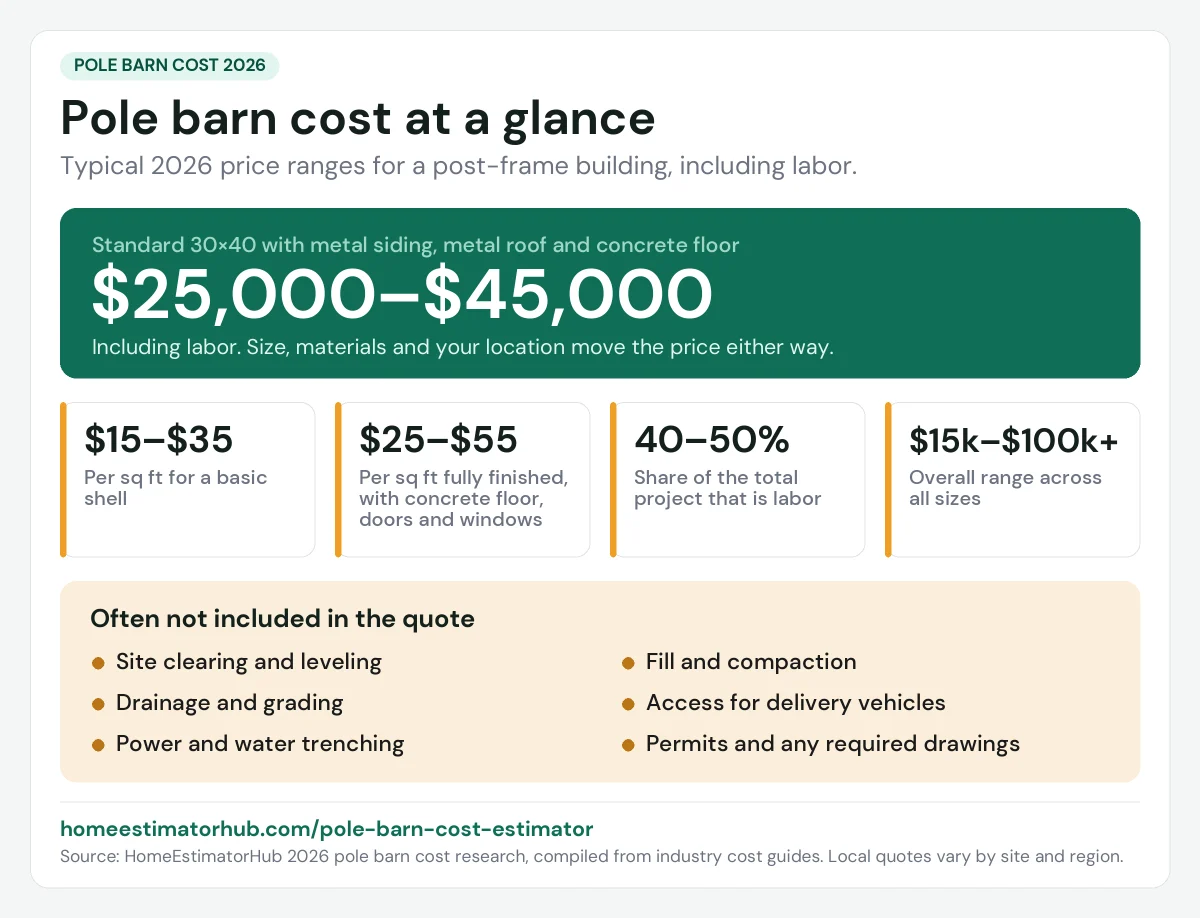
- Most 30×40 pole barns cost $25,000–$45,000
- Metal siding is the most cost-effective choice
- Concrete floor adds $6,000–$15,000 on average
- Labor costs vary significantly by state
What affects pole barn cost?
- Size — The biggest factor. A 30×40 costs roughly half of a 40×60.
- Siding — Steel is cheapest. Hardie board adds 20–30% to siding cost.
- Roofing — Standing seam metal costs 2× more than standard metal panels.
- Overhangs — Larger overhangs add material and labor but protect the building.
- Concrete — A 4-inch slab typically adds $4–$8 per square foot.
- State — Labor in California or New York runs 25–30% higher than Midwest.
- Wall height — Each extra 2 ft adds roughly 5–8% to total framing cost.

How much does a pole barn cost in 2026?
A pole barn typically costs between $15,000 and $100,000+ depending on size, materials and your location. Most homeowners building a standard 30×40 pole barn with metal siding, metal roof and a concrete floor spend between $25,000 and $45,000 including labor.
The cost per square foot ranges from $15 to $35 per sq ft for a basic shell, or $25 to $55 per sq ft fully finished with concrete floor, doors and windows. Labor typically makes up 40–50% of the total project cost and varies significantly by state.
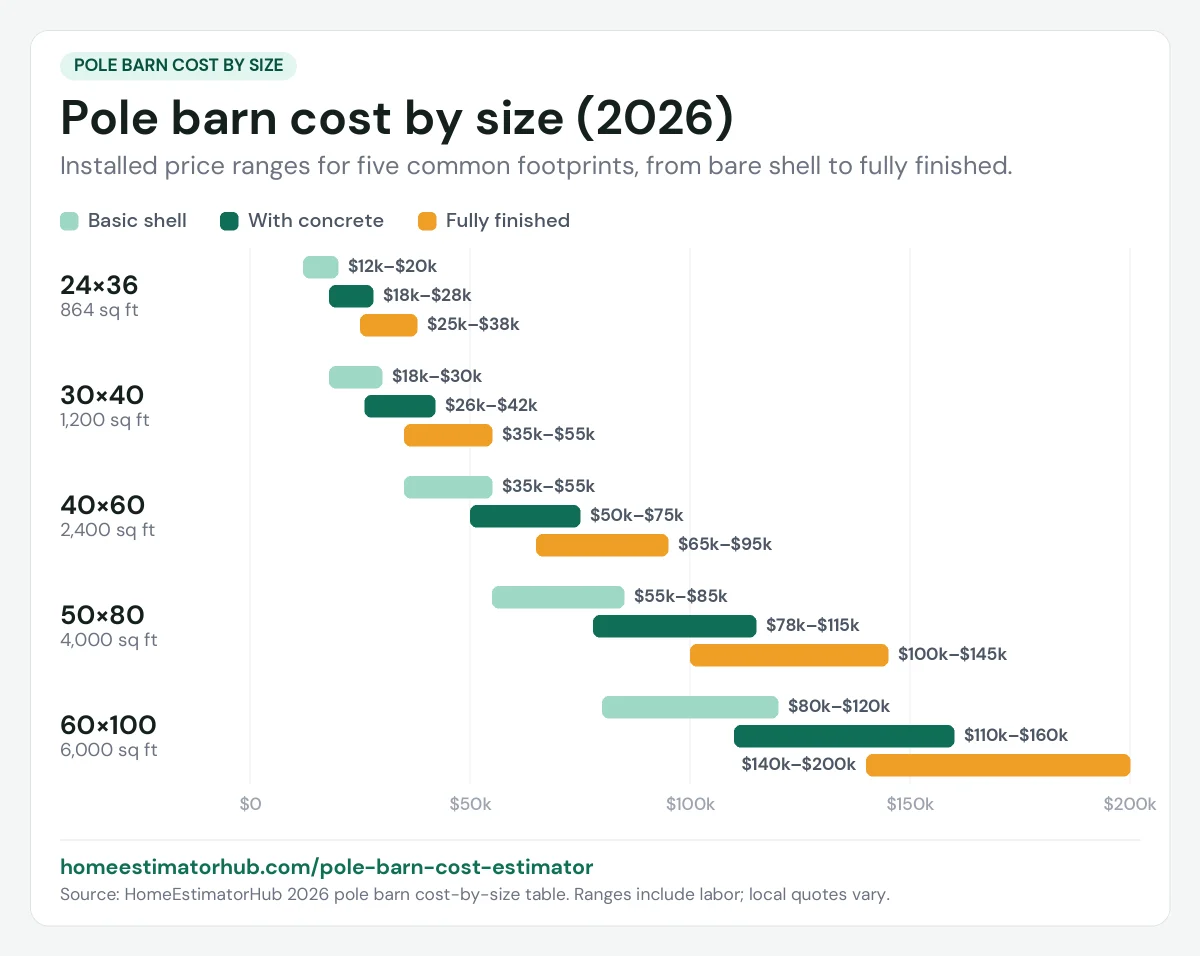
Pole barn cost by size (2026)
| Size | Sq Ft | Basic shell | With concrete | Fully finished |
|---|---|---|---|---|
| 24×36 | 864 | $12,000–$20,000 | $18,000–$28,000 | $25,000–$38,000 |
| 30×40 | 1,200 | $18,000–$30,000 | $26,000–$42,000 | $35,000–$55,000 |
| 40×60 | 2,400 | $35,000–$55,000 | $50,000–$75,000 | $65,000–$95,000 |
| 50×80 | 4,000 | $55,000–$85,000 | $78,000–$115,000 | $100,000–$145,000 |
| 60×100 | 6,000 | $80,000–$120,000 | $110,000–$160,000 | $140,000–$200,000 |
30×40 pole barn cost estimator
The 30×40 pole barn is the most popular size in the US, giving you 1,200 square feet — enough for 2–3 vehicles, a workshop, or farm equipment storage. A basic 30×40 pole barn shell costs around $18,000–$30,000. Adding a 4-inch concrete floor brings that to $26,000–$42,000. A fully finished 30×40 with concrete, doors, windows and interior work runs $35,000–$55,000 depending on your state.
What you are actually paying for
A pole barn is not a cheaper version of a normal building. It is a different structural system, and understanding that is what makes the quotes make sense.
Conventional construction carries the roof load on closely spaced wall studs sitting on a continuous foundation. Post-frame carries it on a handful of large posts spaced 8 to 12 feet apart, with the walls doing almost no structural work. Fewer, bigger load paths means far less material below ground and far less labor setting it.
That is where the 30–50% saving against stick-built comes from. It is also where the trade-offs come from: the post spacing that saves you money is the same post spacing that limits where you can put a wide door, and the shallow foundation that saves you money is the reason the next section matters more than anything else on this page.
The foundation decision most people get wrong
Ask three builders for a pole barn quote and you may get three different foundation methods without anyone explaining the difference. It is the single biggest decision you will make, because it determines how long the building lasts.
| Method | How it works | Trade-off |
|---|---|---|
| Direct embedment | Treated posts set straight into the ground, usually on a concrete footing pad | Cheapest and fastest. The wood is in the soil, so rot is the long-term failure mode |
| Concrete piers | Posts sit on top of poured piers rather than in the soil | Costs more up front. Keeps timber out of standing water |
| Post brackets | Steel brackets anchor the post to concrete — wet-set during the pour, or drilled into cured concrete | Wet-set gives the strongest connection. Drill-set suits an existing slab |
| Precast concrete columns | Precast columns go in the ground, timber posts bolt on above grade | Highest cost. The timber never touches soil at all |
There is a practical rule buried in this: if you are pouring a concrete floor now or think you might later, bracket-mounted posts are usually the better choice. Direct embedment is cheaper and quicker, but retrofitting a slab around posts already buried in the ground is awkward work.
Wet climates push the same way. A post standing in soil that holds water after every storm is on a different timeline from one on a pier above grade, regardless of how well the timber was treated.
Condensation: the cost that arrives three winters later
This is the failure people do not price, and it is the one that ruins the contents rather than the building.
Warm humid air inside rises, meets the underside of a cold metal roof, and turns back into water. It then drips on whatever is parked underneath. Builders call it inside rain, and in an uninsulated metal building in a cold climate it is not an edge case — it is what happens.
There are three defenses and they work together rather than instead of one another:
- A vapor barrier under the roof panels. Fitted on the warm side of the insulation, before the steel goes on. Doing it during the build costs a fraction of retrofitting it.
- A thermal break. Closed-cell spray foam applied directly to the underside of the steel both insulates and removes the cold surface the moisture was condensing on.
- Ventilation. Vented soffits at the eaves and an outlet at the ridge let humid air leave instead of accumulating.
The detail that decides whether any of it works is continuity. A vapor barrier with torn seams, unsealed electrical penetrations or a gap where the wall meets the roof gives moisture a path through, and one gap is enough to undo the rest of the installation.
If you are weighing insulation options, our spray foam insulation calculator prices open-cell against closed-cell by area and thickness.
The costs that are not in the quote
Post-frame quotes usually cover the building. They often do not cover getting the site ready for it, and that is where budgets slip.
- Site clearing and levelling. A flat, clear pad is assumed. A sloped or wooded site is extra, sometimes substantially.
- Fill and compaction. Low ground needs building up, and it needs compacting properly or the slab moves later.
- Drainage. Water that collects around the base is the enemy of any timber in contact with soil. Grading away from the building is cheap now and expensive retrofitted.
- Access for the crew. Posts, trusses and steel arrive on large vehicles. If they cannot reach the pad, material gets moved by hand and the labor line rises.
- Power and water runs. Distance from the house to the barn is billed by the foot, and trenching is its own job.
- Permit fees and any required drawings. Some jurisdictions want an engineer stamp for a structure this size.
If a slab is in scope, our concrete slab calculator prices it separately by area, thickness and finish so you can see that line on its own.
Permits, and why post-frame sits awkwardly in the code
Post-frame occupies an unusual regulatory position. Many jurisdictions have no prescriptive code path written specifically for it, which means plan review can be slower and more variable than for conventional construction, and an engineer’s drawings are more often requested.
The triggers are the ones you would expect. Structure almost always needs a permit regardless of size. Running power to the building brings electrical inspection into scope. A slab may bring its own requirement. Agricultural exemptions exist in some counties and are narrower than people assume — storing a tractor is not the same as genuine agricultural use in the eyes of most building departments.
Our guide on when a project needs a permit covers the four-system test in more detail, and your local building department is the only authority that actually counts.
How to read three quotes that look different
Post-frame quotes are unusually hard to compare, because two builders can price genuinely different buildings under the same heading. Before you compare totals, check these line by line:
- Post spacing and truss spacing. Wider spacing uses fewer, larger members. It is not automatically worse, but it is a different building.
- The foundation method. Embedded, pier, bracket or precast — from the table above. This is the most common invisible difference between two quotes.
- Steel gauge and coating. Thinner gauge and a shorter paint warranty both lower the price today.
- Whether a vapor barrier is included. Frequently an add-on, and cheap now against retrofitting.
- Who pours the slab. Sometimes in scope, sometimes assumed to be your separate concrete contractor.
- Site prep responsibility. Whose job is levelling, fill and drainage.
- Door sizes and how many are included. Large sliding and overhead doors move the total significantly.
A gap of several thousand dollars between two quotes is more often a scope gap than a labor-rate gap. Find the difference before you decide anyone is expensive.
Frequently asked questions
How accurate is this pole barn cost estimator?
There is no validated accuracy figure for these tools, and this page will not invent one. The rate tables are researched and maintained by hand but have not been measured against a body of collected quotes. Treat the headline number as a planning figure and the range as the realistic spread, then get at least three quotes from local post-frame builders for a firm price.
Is a pole barn cheaper than a regular building?
Yes — pole barns typically cost 30–50% less than conventional stick-built buildings of the same size. The post-frame construction method requires fewer materials and less labor.
Do I need a permit to build a pole barn?
In most US counties, yes. Requirements vary by county and state. Permit costs typically run $500–$2,500 depending on size and location. Always check with your local building department first.
What is a wood pole barn cost estimator?
A wood pole barn uses treated lumber posts and T1-11 or board-and-batten wood siding instead of steel. Select the Wood / T1-11 option in our estimator above to see wood pole barn pricing.
Sources & standards
Primary references behind the standards, code requirements and safety guidance cited on this page. Cost ranges shown here are HomeEstimatorHub estimates, not contractor quotes — see how these are calculated, and always confirm against written bids and your local building department.
More free estimators
Explore more home cost estimators
Free cost estimators for every home improvement project — updated for 2026, no signup required.
Disclaimer: All estimates are for informational purposes only based on average 2026 US contractor and material costs. HomeEstimatorHub is not a licensed contractor and does not guarantee accuracy. Actual costs will vary. Always obtain multiple quotes from licensed, insured contractors before proceeding with any construction project.