
HVAC estimator . Updated September 2026
HVAC Cost Estimator
Get a free HVAC cost estimate before calling a single contractor. Enter your home size, system type and US state to get an instant HVAC replacement cost estimate based on real 2026 contractor rates.
Enter your HVAC details
Enter your home square footage above to get your instant HVAC cost estimate.
- Most 3-ton AC replacements cost $4,500-$8,000
- Heat pumps cost 15-25% more than AC-only units
- New ductwork adds $2,000-$6,000 to the total
- Labor rates vary up to 30% by state
HVAC cost factors
- Home size -- Determines the tonnage needed. Oversizing wastes money; undersizing causes failure.
- System type -- Heat pumps cost more upfront but save on energy bills long-term.
- Brand tier -- Premium brands offer better efficiency ratings (SEER2) and longer warranties.
- Ductwork -- Leaky or old ducts reduce system efficiency and must be addressed.
- State -- Labor rates in California and New York run 25-30% higher than Midwest states.
- Season -- Installing in spring or fall (off-peak) can save $300-$800 vs summer.

How much does HVAC replacement cost in 2026?
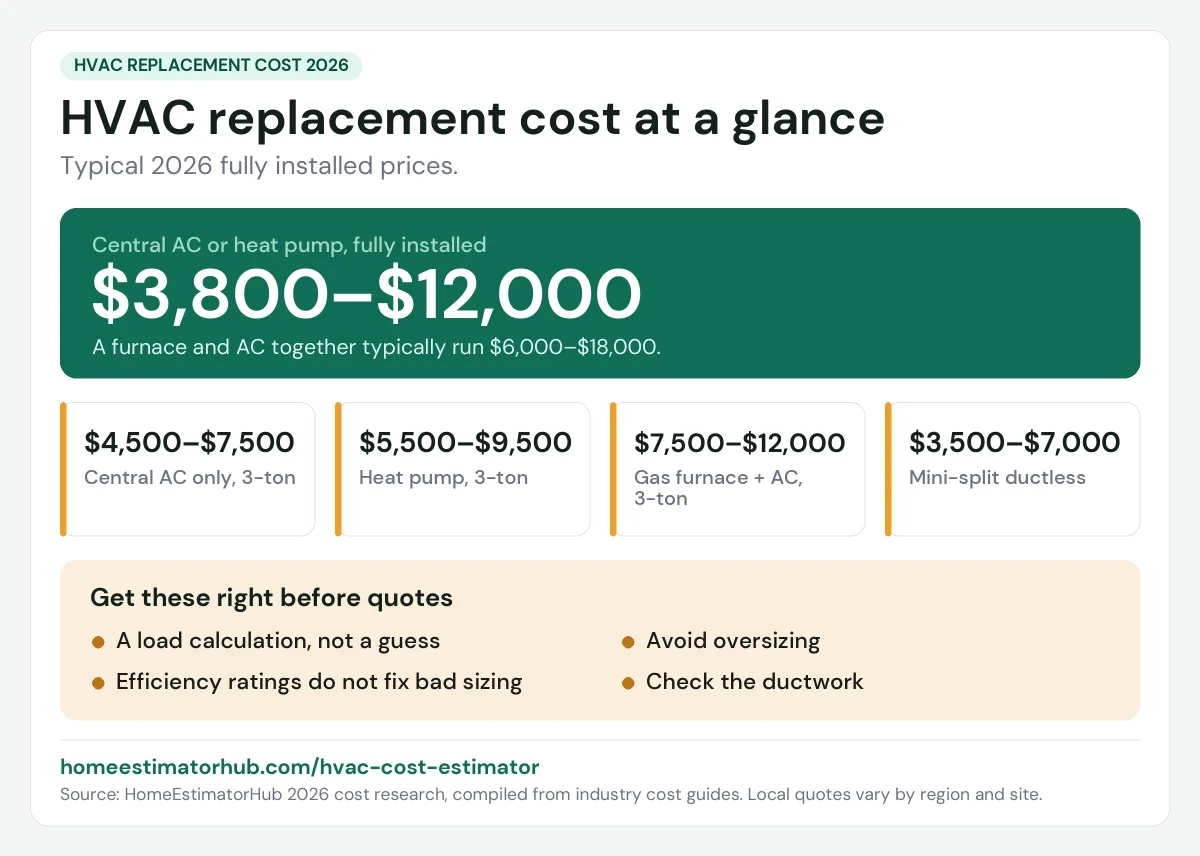
The average HVAC replacement cost in 2026 ranges from $3,800 to $12,000 for a standard central AC or heat pump system, fully installed. A complete HVAC system replacement including furnace and AC typically costs $6,000 to $18,000 depending on home size, brand and your US state.
Use our free HVAC cost estimator above to get an instant HVAC installation cost estimate for your specific home size and location. Our HVAC replacement cost calculator uses real 2026 contractor rates and adjusts for labor costs in all 50 states.
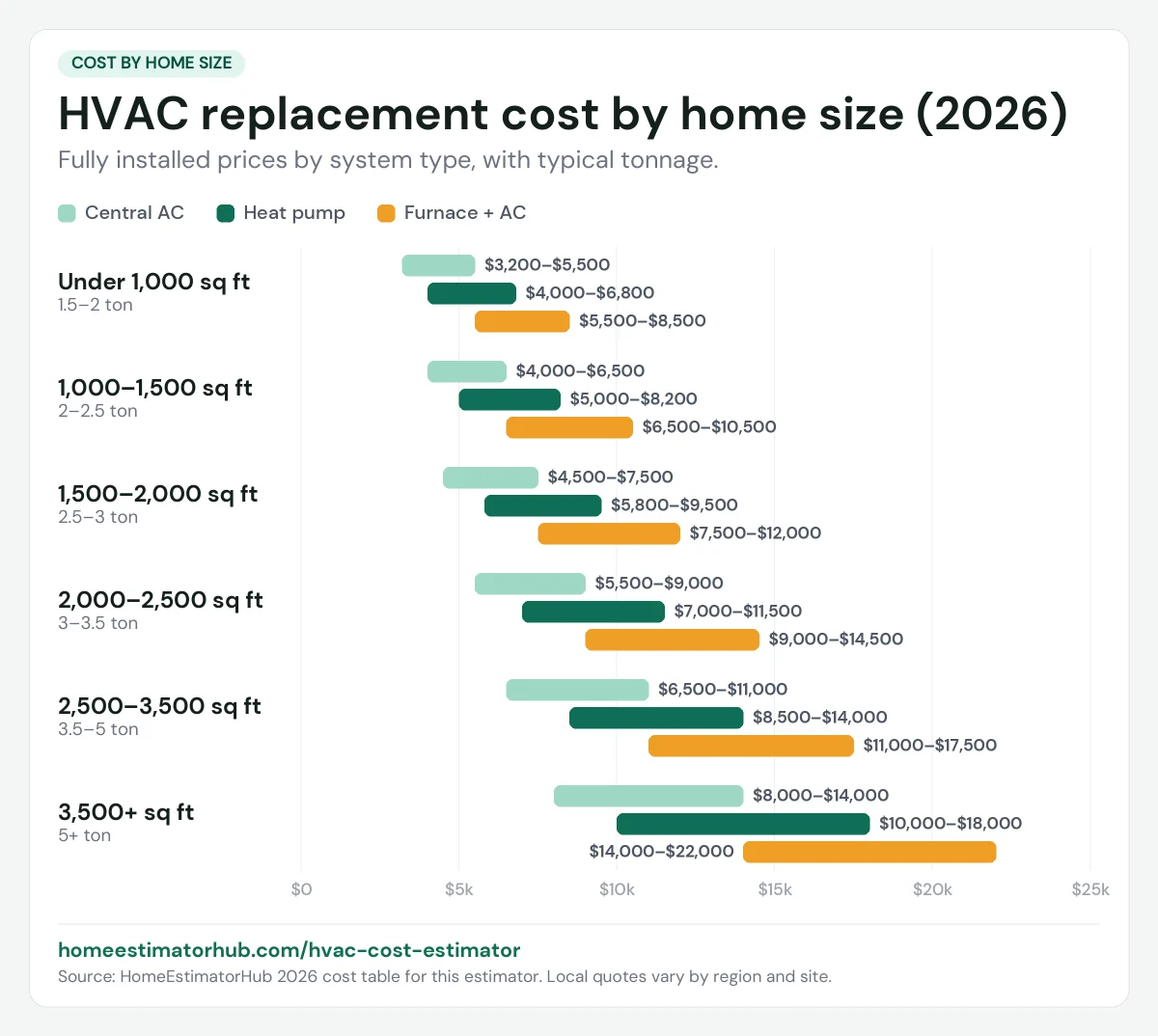
HVAC cost by home size (2026)
| Home Size | Tonnage | Central AC | Heat Pump | Furnace + AC |
|---|---|---|---|---|
| Under 1,000 sq ft | 1.5-2 ton | $3,200-$5,500 | $4,000-$6,800 | $5,500-$8,500 |
| 1,000-1,500 sq ft | 2-2.5 ton | $4,000-$6,500 | $5,000-$8,200 | $6,500-$10,500 |
| 1,500-2,000 sq ft | 2.5-3 ton | $4,500-$7,500 | $5,800-$9,500 | $7,500-$12,000 |
| 2,000-2,500 sq ft | 3-3.5 ton | $5,500-$9,000 | $7,000-$11,500 | $9,000-$14,500 |
| 2,500-3,500 sq ft | 3.5-5 ton | $6,500-$11,000 | $8,500-$14,000 | $11,000-$17,500 |
| 3,500+ sq ft | 5+ ton | $8,000-$14,000 | $10,000-$18,000 | $14,000-$22,000 |
HVAC replacement cost by system type
The type of HVAC system you choose is one of the biggest factors in your total HVAC installation cost estimate. Here is how the main system types compare:
| System Type | Average cost (3-ton) | Best for | Lifespan |
|---|---|---|---|
| Central AC only | $4,500-$7,500 | Mild climates with existing heat | 15-20 years |
| Heat pump | $5,500-$9,500 | Moderate climates, energy savings | 15-20 years |
| Gas furnace + AC | $7,500-$12,000 | Cold climates, reliable heating | 15-25 years |
| Mini-split ductless | $3,500-$7,000 | Additions, older homes, zone control | 20-25 years |
HVAC installation cost estimate -- what's included?
Our HVAC cost estimator calculates the main components of a full HVAC replacement:
- Equipment cost -- The outdoor condenser unit, indoor air handler or furnace, and refrigerant.
- Labor and installation -- Removal of old system, installation of new unit, electrical connections and system startup.
- Ductwork -- Repair, sealing or full replacement if needed.
- Add-ons -- Smart thermostat, air purifier, dehumidifier and permit fees if selected.
The estimate does not include structural modifications, gas line upgrades, electrical panel upgrades, or repairs to walls and ceilings after installation.
Sizing is the decision that outlives the equipment
Most HVAC conversations are about brand, efficiency rating and price. The variable that determines whether you are comfortable and what the system costs to run is none of those — it is whether the equipment is correctly sized for the house.
The industry method for establishing that is a Manual J load calculation. It accounts for insulation levels, window area and orientation, air leakage, ceiling heights and layout — not just floor area. Two houses of identical square footage in the same town can need genuinely different capacity.
The shortcut version, sizing from square footage alone or simply matching whatever was there before, is how most systems end up wrong. Replacing like-for-like carries forward whatever mistake was made last time, plus any insulation or window work done since.
Why oversizing is the common failure
Undersized equipment announces itself — the house never quite gets there on the worst day. Oversized equipment feels fine at first, which is exactly why it persists.
An oversized air conditioner cools the air to temperature quickly and shuts off. That sounds efficient and is the opposite. Short runtimes mean the system never runs long enough to pull moisture out, so the house ends up cool and clammy rather than comfortable. The constant stopping and starting — short cycling — also wears the compressor, and is commonly cited as cutting efficiency by something in the range of 15 to 25 percent while shortening equipment life.
There is a defined window for this. ACCA Manual S sets selection at roughly 90 to 115 percent of the Manual J cooling load for single-stage equipment, and around 115 to 130 percent for variable-capacity systems. “A bit bigger to be safe” is not a margin; it is a specification error.
SEER2 and AFUE do not rescue a bad size
Efficiency ratings describe how well equipment performs when it runs as intended. A high-SEER2 system that short-cycles does not deliver its rated figure, because it spends its life in the least efficient part of its operating curve rather than settling into a long steady run.
This is the most common way people overspend on HVAC: buying up the efficiency ladder to solve a comfort problem that is actually a sizing problem. The correctly sized mid-tier system will usually outperform the oversized premium one in the house you actually live in.
The ductwork question almost nobody asks
A correctly sized system still cannot deliver air through ducts that cannot carry it. Undersized, leaky or badly laid-out ductwork throttles the whole installation, and it is invisible in every quote that only lists equipment.
Manual J is normally followed by Manual D, which sizes the duct system to match. If you are replacing equipment in a house where some rooms have never been comfortable, the ducts are the first thing to question — new equipment on old ducts reproduces the old complaint at a higher price.
Worth asking any contractor quoting your job: did you perform a Manual J, and can I see it? A contractor who has done one will hand it over. One who sized from floor area will change the subject.
What to have ready before you take quotes
- The age and type of what you are replacing, and whether the same fuel is staying.
- Any insulation, window or air-sealing work done since the last system went in — it changes the load, usually downward.
- Rooms that have never been comfortable. That is duct information, and it matters.
- Whether you want to keep or change fuel type, since a heat pump conversion changes the electrical scope — our electrical panel upgrade calculator covers that side if the panel needs work.
Our guide on repair or replace covers the 50% rule and the $5,000 rule if you are still deciding whether replacement is the right call at all.
Frequently asked questions
How accurate is this HVAC cost estimator?
There is no validated accuracy figure for this estimator, and we will not invent one. Its rates come from published 2026 cost data and are maintained by hand, but they have not been measured against a body of real quotes. Treat the result as a planning figure and the range as the realistic spread, then get at least 3 quotes from licensed HVAC contractors in your area for a firm price.
What size HVAC system do I need?
As a general rule, you need approximately 1 ton of cooling capacity for every 400-600 square feet of home, depending on your climate, insulation and home design. Our HVAC replacement cost calculator automatically estimates the correct tonnage for your home size.
How much does HVAC repair service cost?
HVAC repair service costs typically range from $150 to $600 for common repairs such as refrigerant recharge, capacitor replacement or contactor repair. Major repairs like compressor replacement can cost $1,200-$2,800. If your system is over 10 years old, replacement is often more cost-effective than major repairs.
Is it cheaper to repair or replace an HVAC system?
A common rule of thumb is the 5,000 rule: multiply the age of the system by the repair cost. If the result exceeds $5,000, replacement is usually the better investment. For example, a 12-year-old system needing a $500 repair = $6,000, suggesting replacement is the smarter choice.
How can I get a free HVAC cost estimate?
Our HVAC cost estimator above provides a free instant estimate based on your home size, system type and state. For a formal quote, contact 3 or more licensed HVAC contractors in your area. Many offer free in-home estimates.
Sources & standards
Primary references behind the standards, code requirements and safety guidance cited on this page. Cost ranges shown here are HomeEstimatorHub estimates, not contractor quotes — see how these are calculated, and always confirm against written bids and your local building department.
More free estimators
Explore more home cost estimators
Free cost estimators for every home improvement project — updated for 2026, no signup required.
Disclaimer: All HVAC cost estimates are for informational purposes only based on average 2026 US contractor and equipment costs. Actual costs will vary based on your specific home, local market conditions, chosen contractor and equipment availability. HomeEstimatorHub is not a licensed HVAC contractor. Always obtain multiple quotes from licensed, insured HVAC professionals before proceeding with any installation or replacement.