
Insulation & energy estimator · Updated September 2026
Spray Foam Insulation Cost Calculator
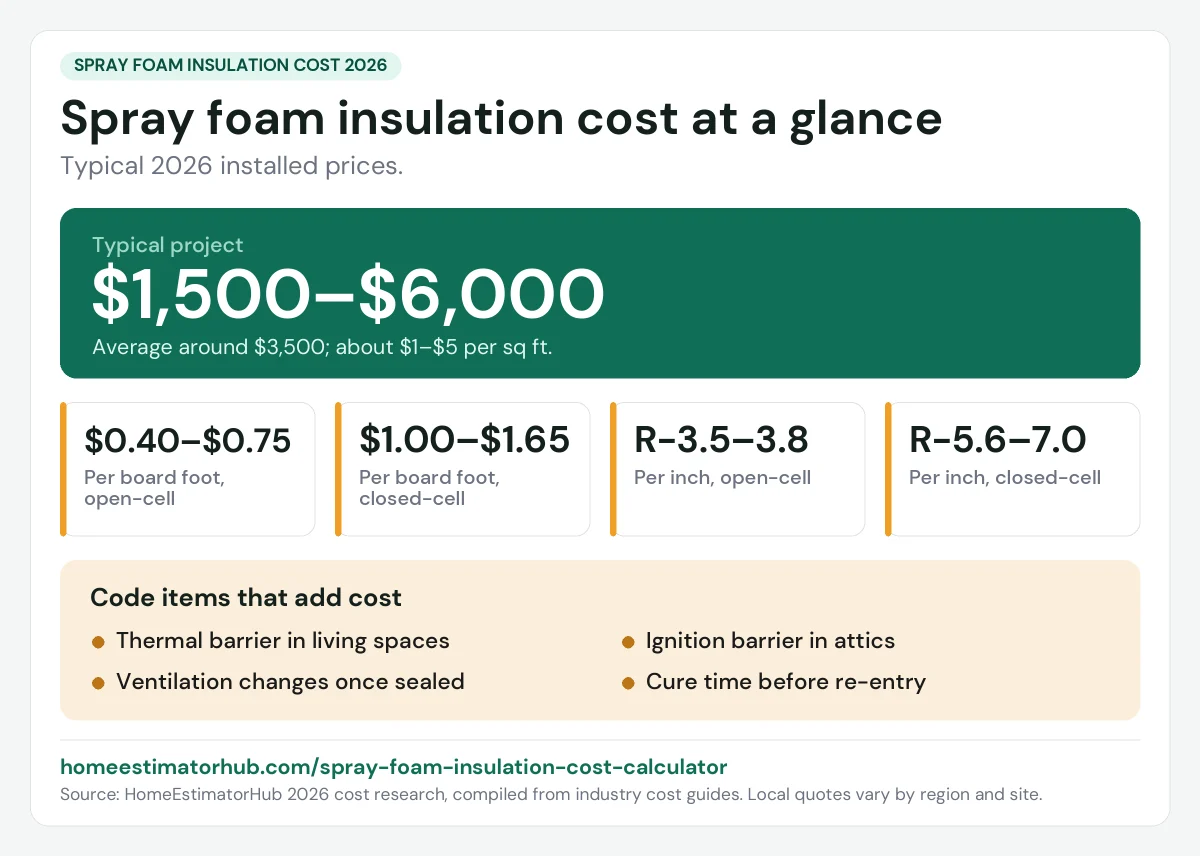
Spray foam insulation typically costs $1,500 to $6,000 per project, averaging around $3,500. Pricing runs $1 to $5 per square foot depending on open-cell or closed-cell foam and thickness. Use our free calculator to get an instant estimate using the same board-foot method contractors use to quote real jobs.
Enter your spray foam project details
Enter your project's surface area
Enter the total wall, ceiling or floor area to be sprayed to calculate your instant cost estimate.
- Most spray foam projects cost $1,500–$6,000, averaging around $3,500
- Closed-cell foam costs roughly double open-cell per board foot
- Spray foam is priced by the "board foot" — area × thickness in inches
- Contractors typically have a $1,500–$2,000 minimum job charge
What affects spray foam insulation cost?
- Foam type — Closed-cell costs roughly double open-cell per board foot but offers a much higher R-value per inch.
- Thickness — Spray foam is priced by the board foot (area × thickness), so every added inch increases material cost directly.
- Application area — Open attics are cheaper to spray than existing walls, which require drilling and injection.
- Removal & prep — Removing old fiberglass or cellulose insulation adds labor and disposal cost.
- Code requirements — Ignition or thermal barrier coatings are often required in living spaces by local building code.
- State — Labor costs in California and the Northeast run 25–30% higher than Midwest and Southern states.

How much does spray foam insulation cost in 2026?
Spray foam insulation typically costs $1,500 to $6,000 per project, averaging around $3,500. On a per-square-foot basis, pricing runs $1 to $5 depending on foam type and thickness. Open-cell foam costs $0.40 to $0.75 per board foot, while closed-cell costs $1.00 to $1.65 per board foot. Use our free calculator above for an instant estimate using the same board-foot method professional installers use.
Spray foam insulation cost calculator — by project size
| Project size | Typical cost |
|---|---|
| Small (500 sq ft) | $1,500–$2,500 |
| Medium (1,200 sq ft) | $2,500–$4,000 |
| Large (2,500 sq ft) | $4,500–$6,000 |
Open-cell vs. closed-cell spray foam insulation cost
The choice between open-cell and closed-cell foam is the single biggest cost driver after project size. Closed-cell costs nearly double, but delivers a much higher R-value per inch and doubles as a moisture barrier.
| Foam type | Cost per board foot | R-value per inch | Best for |
|---|---|---|---|
| Open-cell | $0.40–$0.75 | R-3.5–3.8 | Interior walls, attics, soundproofing |
| Closed-cell | $1.00–$1.65 | R-5.6–7.0 | Roof decks, basements, exterior walls, moisture-prone areas |
Closed-cell spray foam insulation cost
Closed-cell spray foam costs $3.00 to $5.00 per square foot installed at standard wall thickness, roughly double the cost of open-cell for the same coverage. It's denser, rigid, and moisture-resistant, making it the standard choice for basements, crawl spaces, metal buildings, and roof decks where water resistance and structural rigidity matter. Because it delivers R-6 to R-7 per inch — nearly double open-cell — closed-cell foam often needs less thickness to hit the same R-value target, which can partially offset its higher per-board-foot price.
How spray foam is priced: the board foot explained
Unlike most insulation, spray foam isn't priced by square footage alone — it's priced by the board foot, a volume measurement equal to 1 square foot sprayed 1 inch thick. To calculate board feet, multiply your square footage by the thickness in inches: a 1,000 sq ft attic sprayed 6 inches thick equals 6,000 board feet. This matters because two quotes for the "same square footage" can differ enormously if one contractor is spraying 2 inches and another is spraying 6 — always confirm the thickness (and target R-value) behind any quote, not just the square footage.
Spray foam vs. fiberglass vs. blown-in insulation
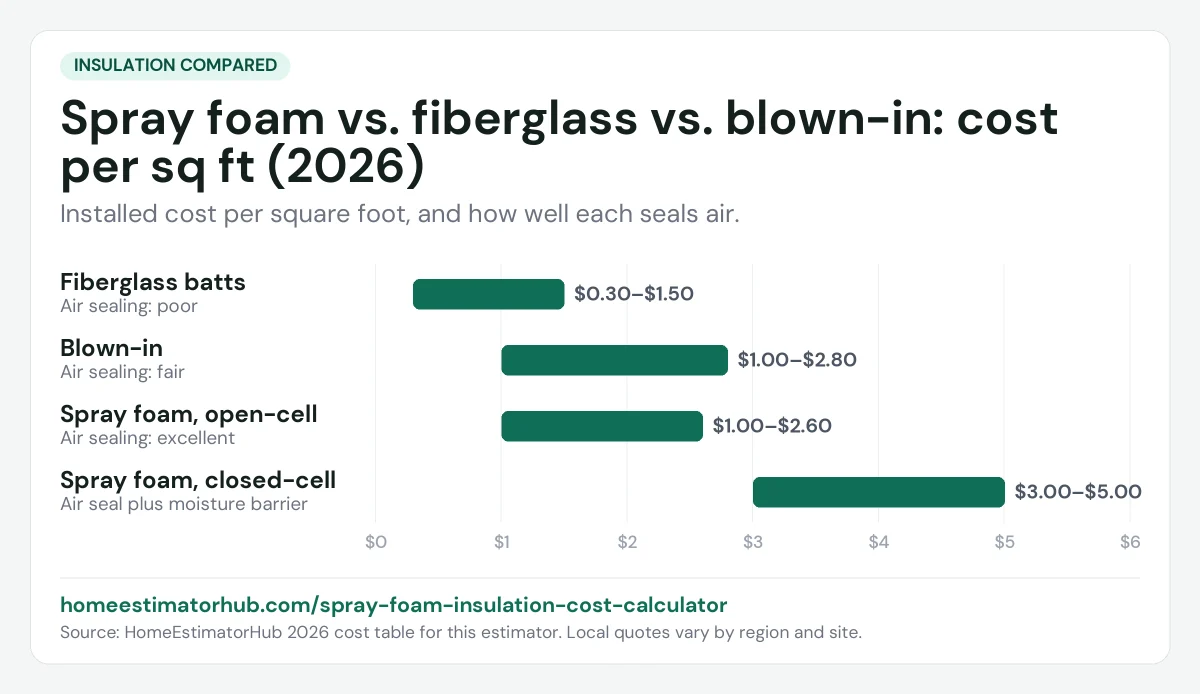
| Insulation type | Cost per sq ft | Air sealing |
|---|---|---|
| Fiberglass batts | $0.30–$1.50 | Poor — leaves gaps |
| Blown-in | $1.00–$2.80 | Fair — fills cavities, no seal |
| Spray foam (open-cell) | $1.00–$2.60 | Excellent — full air seal |
| Spray foam (closed-cell) | $3.00–$5.00 | Excellent — air seal + moisture barrier |
Where each type of foam belongs in the house
Use closed-cell where moisture or structure is part of the job, and open-cell where you only need R-value and quiet inside a protected cavity. Paying closed-cell prices to fill an interior partition wall is the most common way homeowners overspend on foam.
| Assembly | Usual choice | Reason |
|---|---|---|
| Crawl space walls and rim joists | Closed-cell | Acts as its own vapor retarder against ground moisture |
| Unvented roof deck or conditioned attic | Closed-cell, or a hybrid assembly | Controls condensation on the underside of the sheathing |
| 2×6 exterior walls | Either | Closed-cell reaches roughly R-33 to R-38.5 from cavity fill alone |
| Interior partitions, floors over garages | Open-cell | Sound damping is the goal, not vapor control |
| Vented attic floor | Usually neither | Blown cellulose or fiberglass costs far less per unit of R |
The price gap is the reason to be deliberate about it. Open-cell generally runs about $0.40 to $0.75 per board foot installed; closed-cell runs roughly $1.00 to $1.65. Closed-cell costs two to three times more because it is denser and delivers around R-5.6 to R-7.0 per inch against open-cell's R-3.5 to R-3.8 — so it needs fewer inches, but the inches cost more. For a vented attic floor, our attic insulation calculator prices the cheaper route.
The code requirements that add line items
Spray foam is a plastic, and building codes treat it as one. Three requirements turn up on real jobs and none of them are invented by the contractor:
- Thermal barrier. Foam in a living space generally has to be separated from the interior by a thermal barrier, and half-inch gypsum board is the usual way it is satisfied. If the foam is going into a space you were planning to leave unfinished, budget for the drywall too.
- Ignition barrier. In attics and crawl spaces entered only for servicing equipment, a lighter ignition barrier coating may be accepted instead. Which one applies is an inspector's call, so it belongs in the quote rather than in a conversation on install day.
- Ventilation strategy. Foaming a vented attic or crawl space at the roofline converts it into a conditioned space. Existing soffit and ridge vents get sealed, and the space becomes part of the building envelope — which has implications for any combustion appliance sitting in it.
What install day actually looks like
Foam is mixed at the nozzle from two components and cures in place, which makes it more sensitive to conditions than a material that arrives finished:
- The cavity has to be open, dry and clean. Foam sprayed over damp sheathing traps the moisture behind it permanently.
- Substrate temperature matters. Cold surfaces affect how the foam rises and adheres, which is why winter jobs sometimes get rescheduled rather than rushed.
- There is a re-entry window. Occupants and other trades stay out while the foam cures and ventilates — commonly around 24 hours, but follow the installer and the product manufacturer rather than a rule of thumb.
- Overspray gets trimmed. Foam that swells past the framing is cut back flush so drywall can sit flat. A tidy job has shaved studs; a rushed one has lumps.
If you are weighing foam against a conventional assembly for a whole-house project, the HVAC cost estimator is the other half of the arithmetic — a tighter envelope often means a smaller, cheaper system.
Frequently asked questions
How do I estimate spray foam insulation cost?
Measure the total square footage to be sprayed, decide on open-cell or closed-cell foam, and determine your target thickness (which depends on your desired R-value). Multiply square footage by thickness in inches to get board feet, then multiply by the per-board-foot rate for your foam type. Our calculator does this automatically.
What is the cost of spray foam insulation per square foot?
Spray foam insulation costs $1.00 to $5.00 per square foot on average, with open-cell foam at the lower end ($1.00–$2.60) and closed-cell foam at the higher end ($3.00–$5.00) for a standard 3.5-inch wall cavity.
How accurate is this spray foam insulation cost calculator?
There is no validated accuracy figure for this estimator, and we will not invent one. Its rates come from published 2026 cost data and are maintained by hand, but they have not been measured against a body of real quotes. Access, removal of old insulation and local ignition-barrier requirements all change the price. Treat the result as a planning figure and the range as the realistic spread, then get 3 or more quotes from experienced spray foam installers.
Is spray foam insulation worth the cost?
For most homeowners, yes. Spray foam can meaningfully reduce heating and cooling costs where existing insulation is minimal or degraded, because it seals air leaks as well as insulating, and it also improves comfort and moisture control. How quickly it pays back depends on your climate, energy prices and what it replaces.
How thick does spray foam insulation need to be?
Thickness depends on your target R-value: reaching R-38 in an attic requires about 10 inches of open-cell foam or about 5.5 inches of closed-cell foam, since closed-cell delivers roughly double the R-value per inch.
Sources & standards
Primary references behind the standards, code requirements and safety guidance cited on this page. Cost ranges shown here are HomeEstimatorHub estimates, not contractor quotes — see how these are calculated, and always confirm against written bids and your local building department.
More free estimators
Explore more home cost estimators
Free cost estimators for every home improvement project — updated for 2026, no signup required.
Disclaimer: All spray foam insulation cost estimates are for informational purposes only based on average 2026 US contractor rates. Actual costs vary based on access difficulty, existing insulation removal needs, local building codes and contractor availability. Always obtain multiple quotes from certified spray foam insulation contractors before proceeding with any project.