
Exterior estimator - Updated September 2026
Vinyl Siding Cost Estimator
Use our free vinyl siding cost estimator and calculator to get an instant estimate before calling a contractor. Select your home size, siding style and US location to calculate vinyl siding installation cost based on real 2026 contractor rates.
Enter your siding details
Enter your home exterior size
Enter your total exterior wall square footage above to calculate your vinyl siding cost.
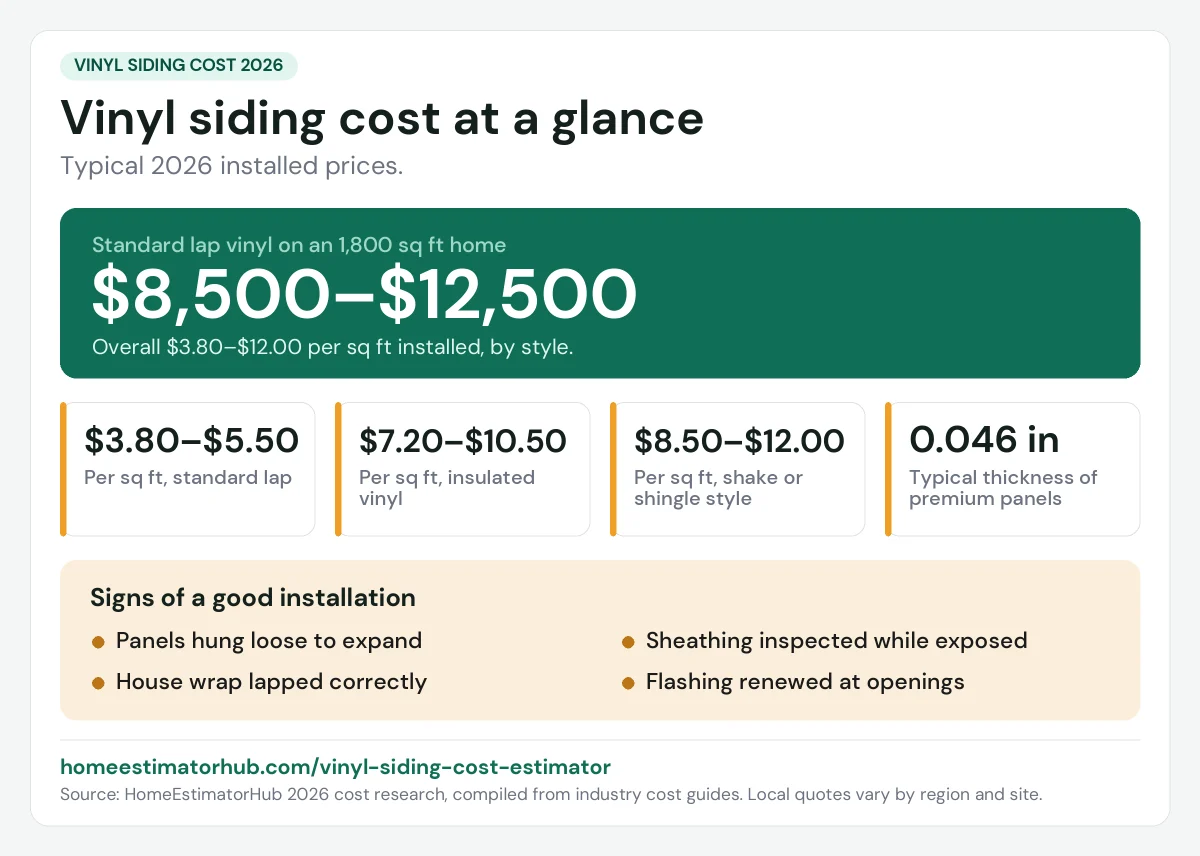
- Most 1800 sqft homes cost $8,500-$12,500 for standard lap vinyl siding
- Insulated vinyl costs roughly 90% more than standard lap but improves energy efficiency
- Tear-off of old siding adds $1.40 per sq ft on average
- Labor rates vary up to 30% depending on your state
What affects vinyl siding cost?
- Style - Standard lap is most affordable. Shake style costs 2x more due to detailed texture and installation time.
- Thickness - Premium thickness vinyl resists wind, hail and fading better but costs 15-20% more.
- Tear-off - Removing old siding adds labor and disposal costs but is required in most renovations.
- Home shape - Homes with many corners, dormers or angles require more cutting and trim work.
- State - Labor costs in California and New York run 25-30% higher than Midwest states.
- Insulation - Adding rigid foam insulation under siding improves R-value but adds to material cost.

How much does vinyl siding cost in 2026?
The average vinyl siding cost in 2026 ranges from $3.80 to $12.00 per square foot installed, depending on style, thickness and location. A standard 1800 sq ft home costs about $8,500 to $12,500 for standard lap vinyl siding, with tear-off of old siding adding roughly $1.40 per square foot. Use our free vinyl siding cost estimator above to get an instant, personalized estimate based on your home size, siding style and US state.
Vinyl siding cost calculator - by style
Our vinyl siding cost calculator updates your estimate in real time as you select siding style, thickness and tear-off requirements. The calculator applies state-specific labor multipliers and adjusts for rural, suburban and major metro markets.
| Siding style | Cost per sq ft | 1500 sq ft | 1800 sq ft | 2500 sq ft |
|---|---|---|---|---|
| Standard Lap | $3.80-$5.50 | $7000-$10500 | $8500-$12500 | $11500-$17000 |
| Dutch Lap | $4.60-$6.50 | $8500-$12500 | $10000-$15000 | $14000-$20500 |
| Board and Batten | $5.40-$7.50 | $10000-$14500 | $12000-$17500 | $16500-$24000 |
| Insulated Vinyl | $7.20-$10.50 | $13500-$19500 | $16000-$23500 | $22000-$32000 |
| Shake / Shingle Style | $8.50-$12.00 | $16000-$22500 | $19000-$27000 | $26000-$37500 |
Vinyl siding installation cost calculator - what is included
Our vinyl siding installation cost calculator covers the main components of a complete siding job:
- Tear-off and disposal - Removal of existing siding and proper disposal if selected
- House wrap - Moisture barrier installed under the new siding to prevent water damage
- Vinyl panels - Your selected style and thickness, including starter strips and J-channel
- Labor and installation - All carpentry labor, typically 35-45% of total project cost
- Basic trim - Standard corner posts and trim pieces in matching color
The estimate does not include structural sheathing repairs, window or door replacement, or significant home reshaping. Premium trim packages, insulation upgrades and shutters are available as add-ons in our calculator above.
Vinyl siding cost per square foot calculator
Vinyl siding cost per square foot in 2026 ranges from $3.80 to $12.00 depending on style and thickness. Standard lap siding is the most economical at $3.80 to $5.50 per square foot installed. Premium shake-style siding runs $8.50 to $12.00 per square foot due to its detailed texture and more complex installation process. Insulated vinyl siding costs more upfront ($7.20 to $10.50 per sq ft) but can reduce energy bills by improving wall insulation.
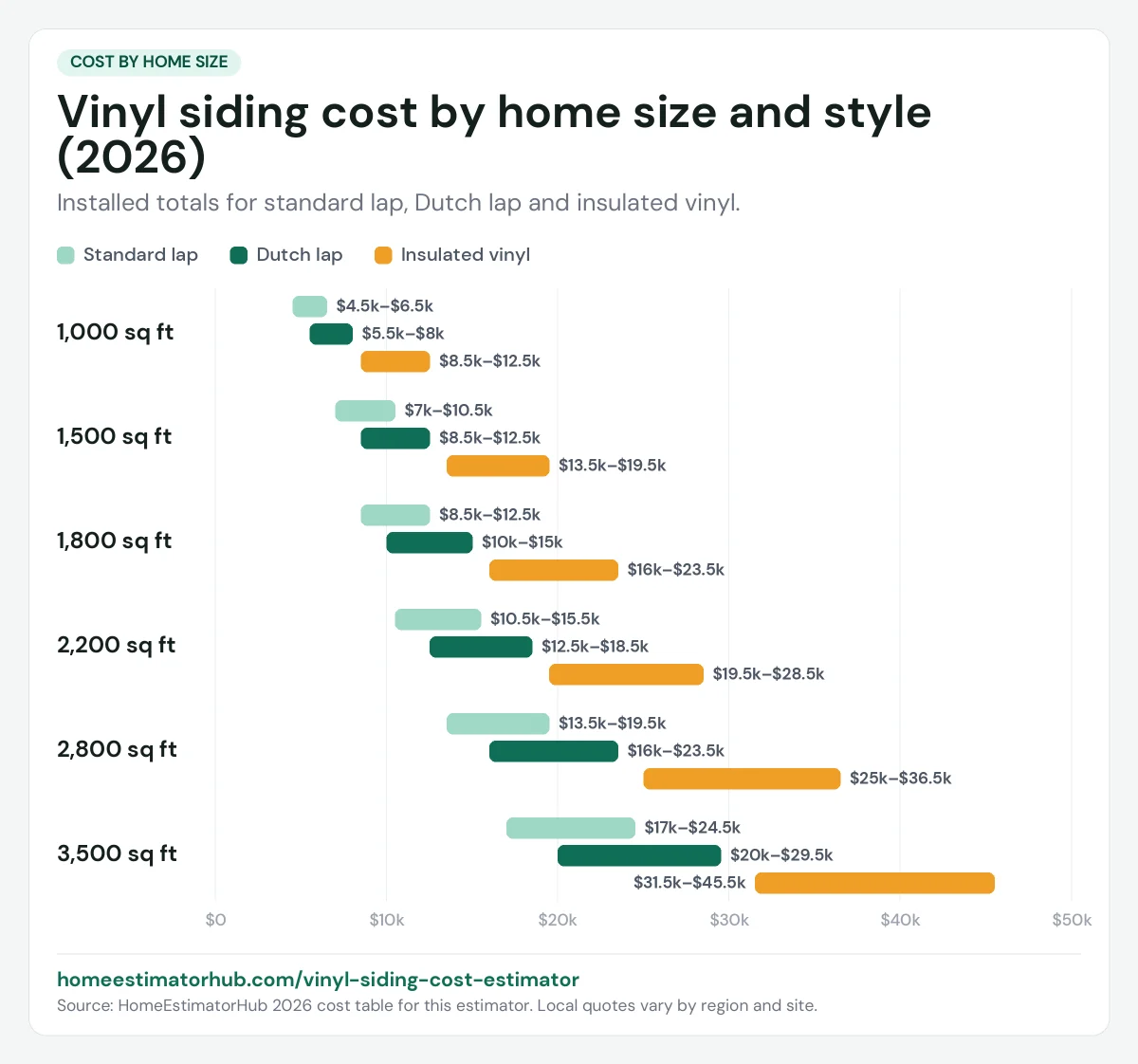
Estimate cost of vinyl siding by home size
| Home size | Standard lap | Dutch lap | Insulated vinyl |
|---|---|---|---|
| 1000 sq ft | $4500-$6500 | $5500-$8000 | $8500-$12500 |
| 1500 sq ft | $7000-$10500 | $8500-$12500 | $13500-$19500 |
| 1800 sq ft | $8500-$12500 | $10000-$15000 | $16000-$23500 |
| 2200 sq ft | $10500-$15500 | $12500-$18500 | $19500-$28500 |
| 2800 sq ft | $13500-$19500 | $16000-$23500 | $25000-$36500 |
| 3500 sq ft | $17000-$24500 | $20000-$29500 | $31500-$45500 |
Panel thickness is the spec that predicts how it ages
Vinyl siding is sold by profile and color, but the number that decides how it performs is the panel thickness, measured in thousandths of an inch. Economy panels start around 0.040 inch; premium panels are typically 0.046 inch or a little more.
The difference shows up in three ways. Thicker panels resist impact better, so hail and stray baseballs are less likely to crack them. They hold their shape across temperature swings instead of oil-canning into visible waves. And they lock together more positively, which matters in wind. Premium-thickness panels add roughly 15–20% to the price of the same style, and insulated vinyl — where a contoured foam backing is bonded behind the panel — runs about $7.20 to $10.50 per square foot installed on the figures above.
That foam backing adds roughly $1.50 to $3.00 per square foot to the material cost. It buys some insulation value, but its more noticeable effect for most homeowners is rigidity and a flatter, more substantial-looking wall, plus a modest reduction in outside noise.
What happens behind the panels
Siding is a rain screen, not a seal. Water gets behind it by design, and the layers underneath are what keep it out of the structure. Re-siding is the one moment in a house's life when those layers are accessible, which makes it worth understanding what should be happening:
- Old siding comes off. Labor usually includes removal and haul-away, and this is the step that exposes the sheathing.
- Sheathing gets inspected. Soft or rotted areas are found now or not at all. Repairs are an extra, and an honest contractor tells you they cannot be priced before the wall is open.
- House wrap goes on. The weather-resistive barrier is what actually stops water reaching the structure, and it must be lapped so upper courses shed over lower ones.
- Flashing is renewed at windows, doors and any roof-to-wall junction — the specific places where leaks start.
If you are replacing windows in the same period, doing it while the siding is off is substantially cheaper and produces a better-flashed result than doing it afterwards. Our window replacement cost estimator covers that side of the timing decision.
Trim and accessories are where two quotes diverge
Labor commonly runs $2 to $5 per square foot, and much of the variation between bids is not in the field panels but in the pieces around them. Corner posts, J-channel around openings, starter strip, soffit, fascia and light blocks all get priced separately, and a house with many windows, gables and corners needs far more of them per square foot of wall than a simple box does.
When comparing quotes, confirm which of these are included, whether soffit and fascia are in scope or quoted separately, and what happens to gutters — they often have to come down and go back up.
The installation detail that separates good work from callbacks
Vinyl expands and contracts significantly with temperature. Correct installation hangs the panels loosely so they can move: nails centerd in the slots, driven straight, and left slightly loose rather than pulled tight against the wall. Panels are also cut short of channels to leave a gap for expansion, and that gap is set larger in cold weather because the material will grow.
Siding nailed tight is the most common vinyl installation fault, and the result is buckling and waviness that appears on the first hot afternoon and never goes away without redoing the wall. It is worth asking a bidder directly how they handle expansion — the answer tells you a good deal about the crew. For upkeep afterwards, vinyl is cleaned with low-pressure soft washing rather than a high-pressure jet, which our pressure washing cost calculator explains, and if part of the house is stucco, the stucco repair calculator prices that separately.
Frequently asked questions
How accurate is this vinyl siding cost estimator?
There is no validated accuracy figure for this estimator, and we will not invent one. Its rates come from published 2026 cost data and are maintained by hand, but they have not been measured against a body of real quotes. Treat the result as a planning figure and the range as the realistic spread, then get at least 3 quotes from licensed siding installers in your area for a firm price.
How do I calculate vinyl siding cost?
To calculate vinyl siding cost, measure your total exterior wall square footage, choose your siding style and thickness, then factor in tear-off if you have existing siding. Our calculator does this automatically based on your selections, applying state-specific labor rates. Multiply your home perimeter by wall height for a rough square footage estimate, then subtract for windows and doors.
What is the vinyl siding installation cost per square foot?
Vinyl siding installation costs $3.80 to $12.00 per square foot installed in 2026, including both materials and labor. Standard lap siding is the most affordable option. Labor typically makes up 35-45% of the total cost, with the remainder going to materials, house wrap and trim.
Does vinyl siding installation include removing old siding?
Tear-off is usually a separate line item but is included as an option in our calculator above. Most siding contractors recommend tear-off rather than installing over existing siding, since it allows inspection of the sheathing for rot or damage and ensures a flatter, more durable installation surface.
Is insulated vinyl siding worth the extra cost?
Insulated vinyl siding costs roughly 90% more than standard lap vinyl but adds R-value to your home walls, which can reduce heating and cooling costs over time. It also provides better impact resistance and a straighter, more substantial appearance. For homes in colder climates or with poor existing wall insulation, insulated vinyl is often worth the additional investment.
Sources & standards
Primary references behind the standards, code requirements and safety guidance cited on this page. Cost ranges shown here are HomeEstimatorHub estimates, not contractor quotes — see how these are calculated, and always confirm against written bids and your local building department.
More free estimators
Explore more home cost estimators
Free cost estimators for every home improvement project - updated for 2026, no signup required.
Disclaimer: All vinyl siding cost estimates are for informational purposes only based on average 2026 US contractor rates. Actual costs vary based on home shape, existing wall condition, local permit requirements and contractor availability. Always obtain multiple quotes from licensed, insured siding contractors before proceeding with any project.