
Home repair estimator · Updated September 2026
Mold Remediation Cost Calculator
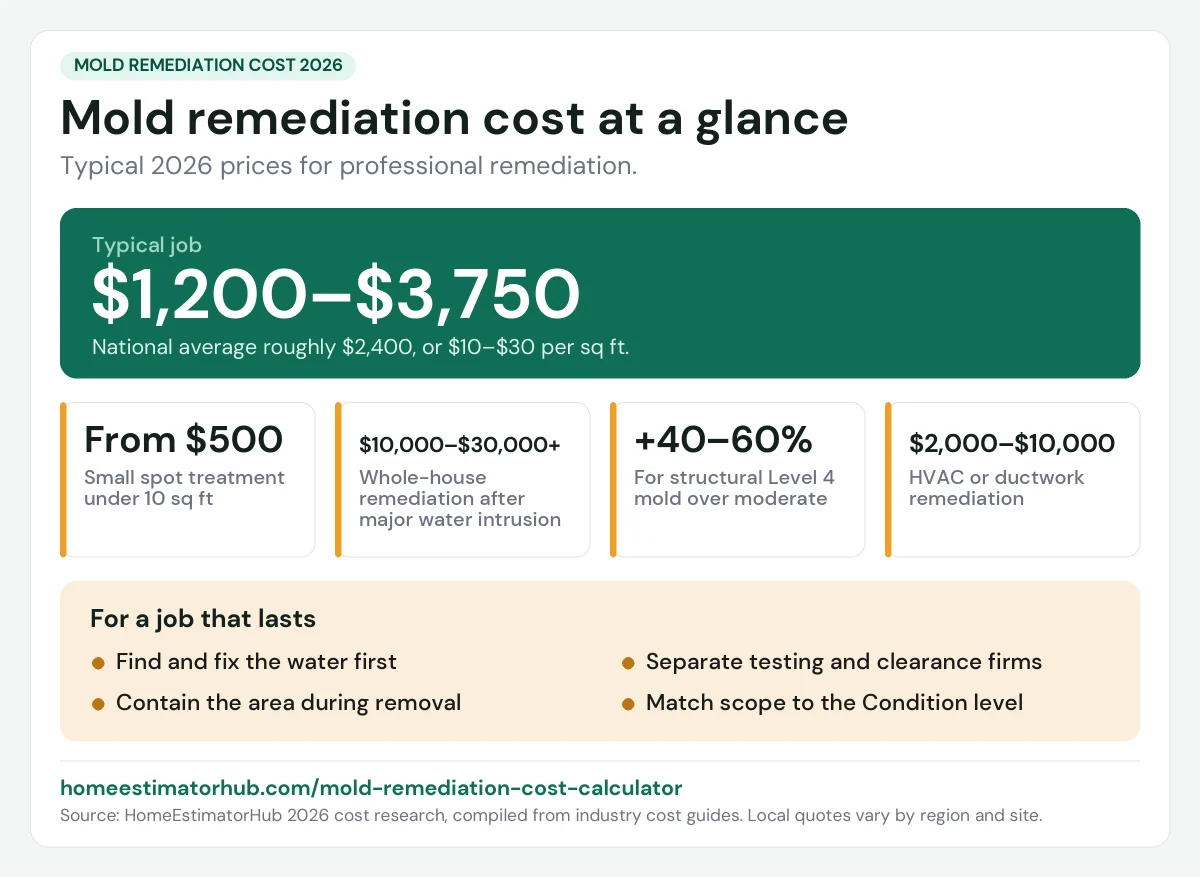
Mold remediation costs $10 to $30 per square foot, or $1,200 to $3,750 for a typical job. Use our free calculator to get an instant estimate by affected area, location in your home, severity and mold type.
Enter your mold remediation details
Enter the affected square footage
Enter the size of the visible or suspected mold area to calculate your instant remediation estimate.
- Most mold remediation jobs cost $1,200–$3,750, averaging around $2,400
- Attic, crawl space and HVAC jobs cost more due to restricted access
- Black mold (Stachybotrys) typically costs 25–50% more to remediate
- The EPA recommends professional help for any area over 10 sq ft
What affects mold remediation cost?
- Affected area — The primary cost driver, priced per square foot of contaminated surface.
- Location — Attics, crawl spaces and HVAC systems cost more due to restricted access and full PPE requirements.
- Severity — Surface mold is far cheaper to treat than mold that's penetrated drywall, wood or insulation.
- Mold type — Black mold (Stachybotrys) requires stricter containment and typically costs 25–50% more.
- Underlying repairs — Drywall, flooring or HVAC cleaning needed after removal adds to the total.
- State — Labor costs in California and the Northeast run 25–30% higher than Midwest and Southern states.

How much does mold remediation cost in 2026?
Mold remediation costs $10 to $30 per square foot, with most homeowners paying between $1,200 and $3,750 for a typical job — a national average of roughly $2,400. Small spot treatments under 10 sq ft can run as little as $500, while a whole-house remediation after major water intrusion can reach $10,000 to $30,000 or more. Use our free calculator above to get an instant estimate based on your affected area, location, severity and mold type.
Mold remediation cost calculator — by location
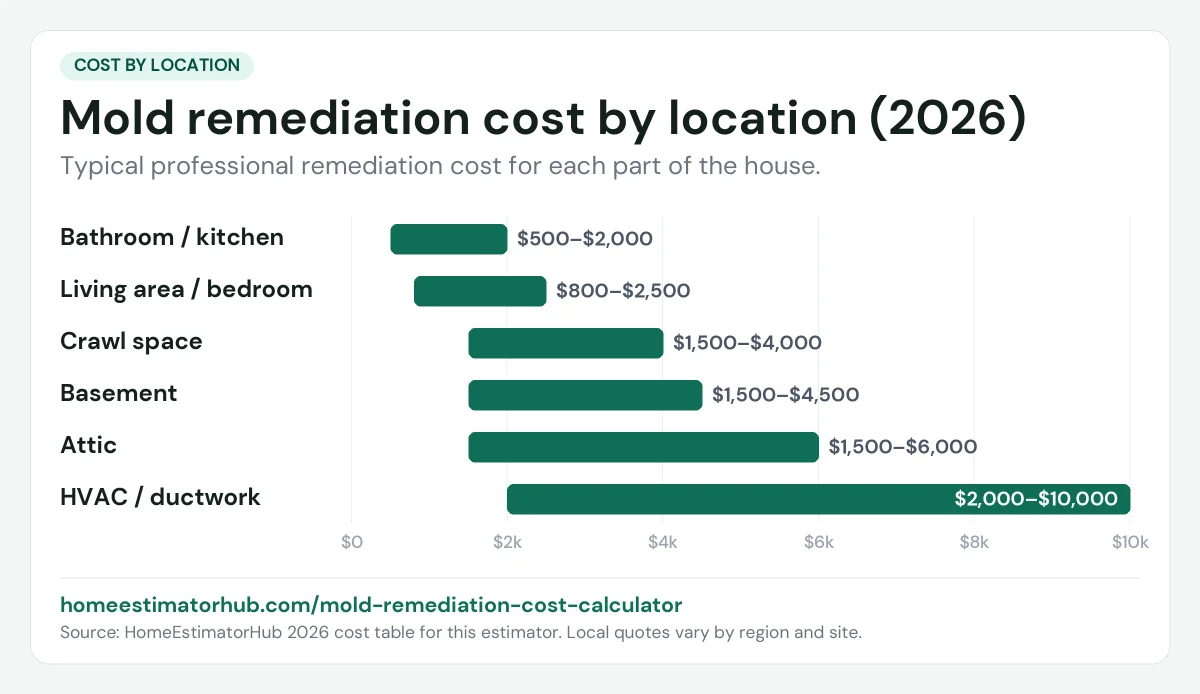
Where the mold is located in your home has a major effect on price. Accessible areas like bathrooms cost less to remediate than attics, crawl spaces or HVAC systems, which require full PPE, negative air containment and more labor time.
| Location | Typical cost |
|---|---|
| Bathroom / kitchen | $500–$2,000 |
| Living area / bedroom | $800–$2,500 |
| Basement | $1,500–$4,500 |
| Attic | $1,500–$6,000 |
| Crawl space | $1,500–$4,000 |
| HVAC / ductwork | $2,000–$10,000 |
Mold remediation cost by severity level
Remediation professionals classify mold damage in levels, from surface growth that can be scrubbed and treated to structural contamination that requires demolition and rebuilding.
| Severity | What it means | Cost impact |
|---|---|---|
| Level 1 — Surface | Scrubbed and treated, no material removal | Lowest cost |
| Level 2–3 — Moderate | Penetrated drywall, wood or insulation | Standard pricing |
| Level 4 — Structural | Demolition and rebuilding required | +40–60% over moderate |
Does homeowners insurance cover mold remediation?
Usually only if the mold resulted from a sudden, covered peril — like a burst pipe, appliance failure, or storm damage — rather than from gradual leaks, high humidity, or deferred maintenance. When mold is tied to a covered water-damage claim, remediation is typically handled as part of that claim. Many policies also cap mold-specific coverage at $5,000 to $10,000 regardless of the actual remediation cost, so always check your specific policy details and document the source of moisture as soon as it's discovered.
DIY vs. professional mold remediation
The EPA recommends handling mold yourself only for areas smaller than 10 square feet of surface-level growth on non-porous materials, using basic protective gear and commercial cleaners. For anything larger — or if mold has spread into drywall, insulation, HVAC systems, or hidden cavities — professional remediation is strongly recommended, since improper handling can spread spores throughout the home rather than contain them.
What professional remediation actually involves
The gap between a cleaning job and a remediation job is engineering controls — and that is most of what you are paying for.
Work done to the IICRC S520 standard isolates the affected area behind physical containment barriers and holds it under negative air pressure, so that spores disturbed during removal cannot travel into the rest of the house. The industry benchmark for that pressure differential is around 0.02 inches of water column. Air inside the containment runs through HEPA filtration.
None of that is visible in the finished result, which is exactly why cheap quotes can look identical to thorough ones on paper. A quote that does not mention containment or negative air is quoting a different job.
The three Conditions, and why they change the scope
S520 classifies contamination into three Conditions, and the distinction drives the price more than square footage does:
- Condition 1 — normal fungal ecology. What a building is supposed to look like.
- Condition 2 — settled spores or trace growth that migrated from a Condition 3 source. Often cleanable in place.
- Condition 3 — actual growth on surfaces. Porous materials generally come out rather than get cleaned.
Two jobs of identical area can differ substantially because one is surface settlement and the other is established growth in drywall and insulation.
Testing before, clearance after — and why they should be different people
Inspection and testing sit outside the remediation itself. An assessment commonly runs somewhere in the region of $300 to $1,000, with air or surface sampling adding a few hundred more.
At the other end, clearance testing is the step that confirms the work actually succeeded before containment comes down. Under S520 it is a required final step, and it typically costs a few hundred dollars paid separately to an independent assessor.
That separation matters. A contractor who tests their own work, declares it passed, and invoices for both has an obvious conflict. Independent clearance is the single best protection you have on this kind of job.
Find the water, or you will pay twice
Mold is a symptom. It grows because something is wet, and remediation that does not resolve the moisture source is a temporary result at permanent prices.
The usual culprits are a plumbing leak, failed waterproofing, a roof or flashing failure, or chronic humidity from inadequate ventilation. Establish which before the remediation is booked, not after.
If the source was a sudden event, our water damage restoration calculator scopes the drying side, and our guide on whether insurance covers mold explains the sudden-and-accidental test that decides your claim.
Frequently asked questions
How do I estimate mold remediation cost?
Measure the square footage of visible and suspected mold growth, identify its location (bathroom, basement, attic, crawl space, or HVAC), and assess severity (surface, moderate, or structural). Multiply the area by $10–$30 per square foot based on those factors, then add a setup/containment fee of roughly $500–$800. Our calculator does this automatically.
How accurate is this mold remediation cost calculator?
There is no validated accuracy figure for this estimator, and we will not invent one. Its rates come from published 2026 cost data and are maintained by hand, but they have not been measured against a body of real quotes. Hidden mold behind walls or under flooring is not visible until demolition begins. Treat the result as a planning figure and the range as the realistic spread, then get at least 3 quotes from licensed mold remediation specialists in your area.
What's the average cost of mold remediation?
The national average cost for professional mold remediation is around $2,400, with most jobs falling between $1,200 and $3,750. Costs scale with affected area, location in the home, severity, and mold type.
Is black mold more expensive to remove than other mold?
Yes. Black mold (Stachybotrys chartarum) typically costs 25–50% more to remediate than common mold types because it requires stricter containment protocols, full PPE, and specialized disposal procedures.
How long does mold remediation take?
Most residential mold remediation projects take 1 to 5 days. Small surface cleanups can be completed in a single day, while extensive structural remediation requiring demolition and rebuilding can take a week or longer, depending on drying times and clearance testing.
Sources & standards
Primary references behind the standards, code requirements and safety guidance cited on this page. Cost ranges shown here are HomeEstimatorHub estimates, not contractor quotes — see how these are calculated, and always confirm against written bids and your local building department.
More free estimators
Explore more home cost estimators
Free cost estimators for every home improvement project — updated for 2026, no signup required.
Disclaimer: All mold remediation cost estimates are for informational purposes only based on average 2026 US contractor rates. Mold remediation involves health and safety considerations — actual costs vary based on hidden damage, mold type, accessibility and local contractor availability. Always obtain multiple quotes from licensed mold remediation specialists before proceeding with any project.