
Exterior & curb appeal estimator · Updated September 2026
Garage Door Replacement Cost Calculator
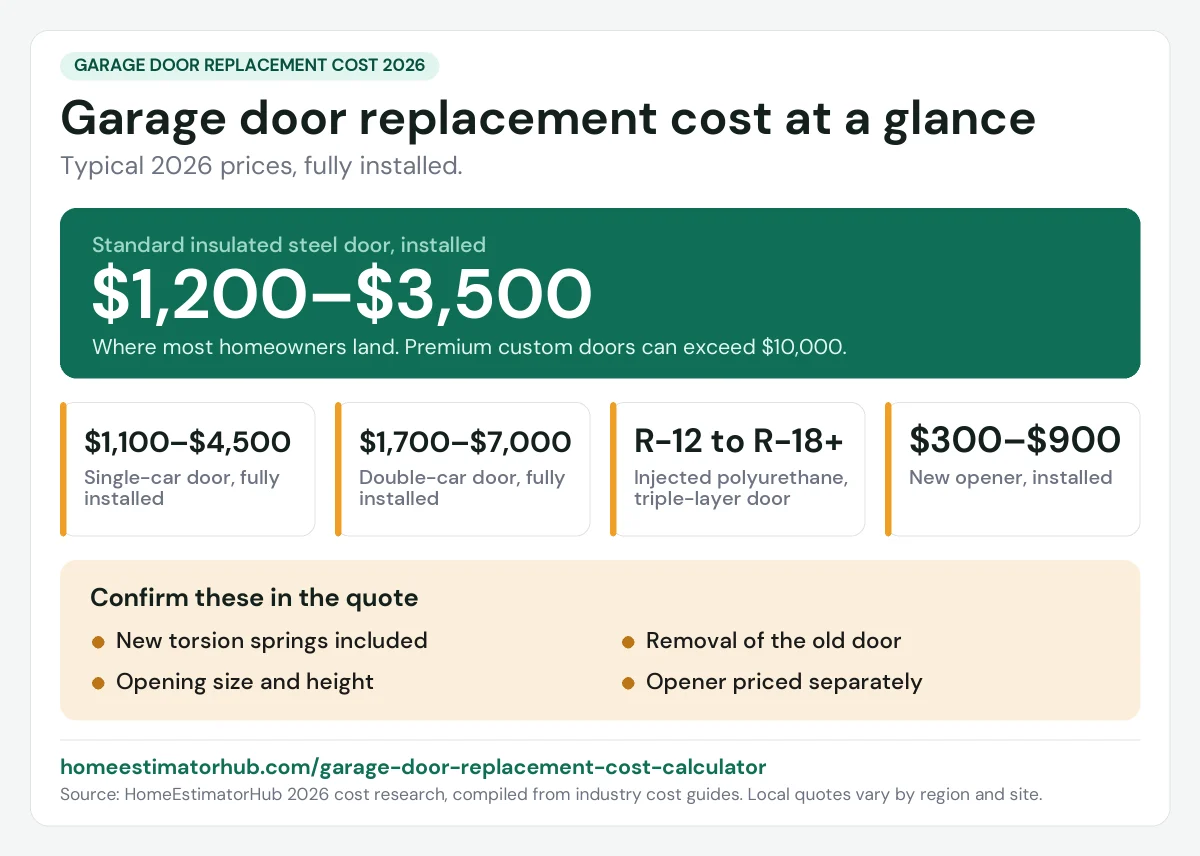
Garage door replacement costs $1,100 to $4,500 for a single door and $1,700 to $7,000 for a double, installed. If it's just a broken spring, that's usually a $150–$500 repair, not a full replacement. Use our free calculator to price either scenario.
What do you need?
Estimated garage door replacement cost
Typical range for your configuration
Cost breakdown
What affects garage door cost?
- Size — A double-car door costs roughly 1.5–1.7x a single door of the same material.
- Material — Steel is the most affordable; wood and premium composites cost significantly more.
- Insulation — Higher R-value insulation adds cost but pays back in energy savings for attached garages.
- Springs — Should always be replaced alongside a new door since they wear at a similar rate.
- Opener — Smart Wi-Fi openers cost more than basic chain or belt drives but add convenience and safety features.
- State — Labor costs in California and the Northeast run higher than Midwest and Southern states.

How much does garage door replacement cost in 2026?
Garage door replacement costs $1,100 to $4,500 for a single-car door and $1,700 to $7,000 for a double-car door, fully installed. Most homeowners land in the $1,200–$3,500 range for a standard insulated steel door. Premium custom doors — carriage-house wood, oversized, or heavily upgraded — can exceed $10,000. Use our free calculator above for an instant estimate based on your size, material and add-ons.
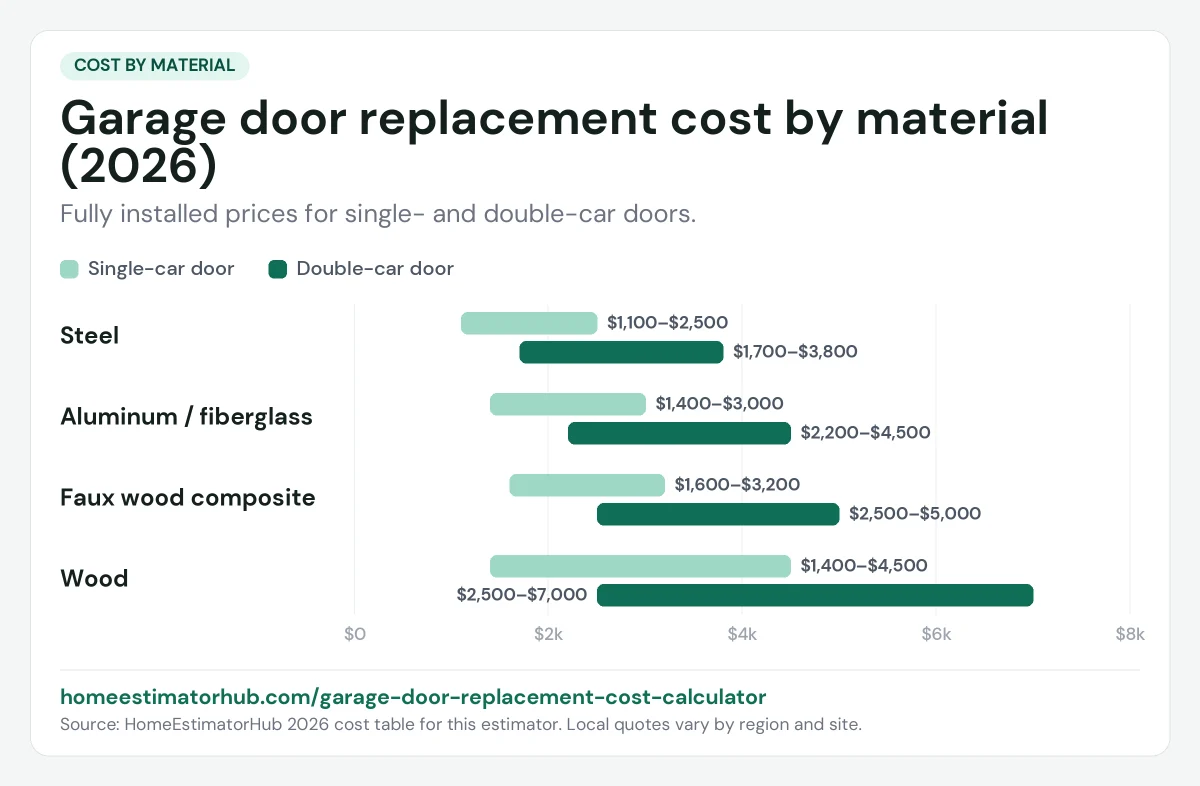
Garage door replacement cost calculator — by material
| Material | Single-car door | Double-car door |
|---|---|---|
| Steel | $1,100–$2,500 | $1,700–$3,800 |
| Aluminum / fiberglass | $1,400–$3,000 | $2,200–$4,500 |
| Faux wood composite | $1,600–$3,200 | $2,500–$5,000 |
| Wood | $1,400–$4,500 | $2,500–$7,000 |
Garage door spring replacement cost
Many homeowners search "garage door replacement" when what they actually need is a much cheaper spring repair. A broken spring, single dented panel, or noisy operation is usually a $150 to $700 repair — not a new door. Spring replacement specifically runs $150 to $500 depending on type: extension springs (older systems) cost $150–$300, a single torsion spring runs $200–$350, and a double torsion spring system (most double doors) costs $350–$500. Springs typically last 10,000–20,000 open/close cycles, or roughly 7–15 years of normal use. This is not a DIY repair — torsion springs store enough tension to cause serious injury, and professional installation is strongly recommended in every case.
Should I repair or replace my garage door?
Use the 50% rule: if repair costs exceed 50% of what a comparable new door would cost, replacement is usually the smarter long-term investment. For example, if a spring, two damaged panels, and hardware repairs would run $800–$1,200, spending just a few hundred dollars more on a brand-new insulated door often makes more sense — you get a warranty, better energy efficiency, and modern safety features rather than patching an aging door.
Is a new garage door a good investment?
Yes — garage door replacement consistently ranks among the highest-ROI home improvement projects, returning well over 100% of its cost at resale according to industry Cost vs. Value reports, thanks to its outsized impact on curb appeal. Beyond resale value, a new door improves energy efficiency, security, and daily convenience, especially when paired with a modern insulated design and smart opener.
What a garage door R-value actually buys you
On an attached garage, the R-value printed on the brochure matters less than the condition of the seal around the opening. Most residential doors sold in 2026 sit between R-6 and R-18, and moving from the bottom of that range to the top usually adds a few hundred dollars to a single door.
That number comes from whatever is sandwiched inside the panel, and in practice there are only two fills on the market:
| Insulation fill | Typical R-value | Construction | Best suited to |
|---|---|---|---|
| Polystyrene board | R-6 to R-9 | Double-layer — steel skin with a vinyl-backed board behind it | Detached garages, budget replacements |
| Injected polyurethane | R-12 to R-18+ | Triple-layer — foam bonded to both steel skins | Attached garages, rooms above or beside the garage |
Polyurethane doors are also stiffer and noticeably quieter, because the foam bonds the two skins into one panel instead of sitting loose between them. That rigidity is why installers often steer wide double doors toward polyurethane even when nobody is heating the space.
Where the R-value stops earning its keep: an unheated detached garage, or any opening where the perimeter weatherstrip and bottom astragal are worn through. Air moving around the door cancels out the number printed on it.
What the installed price actually covers
A replacement quote is rarely a single line. Installed pricing in 2026 generally runs $1,100 to $4,500 for a single door and $1,700 to $7,000 for a double, with most standard insulated steel doors landing between $1,200 and $3,500. The total is assembled from these parts:
| Line item | Typical cost | Usually included? |
|---|---|---|
| Door sections | Largest single item | Yes |
| Installation labor | $150–$500 single; $300–$700 double | Yes |
| Track, rollers, hinges, springs | Bundled with the door | Usually — confirm springs |
| Removal and disposal of the old door | Varies by installer | Sometimes extra |
| New opener | $300–$900 installed | No — priced separately |
Two of those deserve a direct question before you sign. The first is whether new torsion springs are in the price: an insulated door is heavier than the uninsulated one it replaces, and springs balanced for the old weight will not balance the new one. The second is haul-away, which is the most common reason a quote grows on installation day.
The opening size drives more of the price than the finish
- Standard single, 8 to 9 feet wide. The cheapest opening to work with, and the one most stock doors are built for.
- Standard double, 16 feet. Not simply twice a single — a wider door needs heavier track, a stronger spring assembly and often a strut across the top section.
- Eight-foot-tall doors. Common where a truck or van has to fit. Taller means an extra section and more track, so expect a step up from the standard 7-foot price.
- Non-standard openings. Anything custom-sized moves you out of stock inventory and into a made-to-order lead time, which shows up as both a higher price and a longer wait.
If the opener is on its last legs, replacing it while the crew is already on site avoids paying a second call-out fee. If the driveway in front of it is due for attention too, our asphalt driveway cost estimator prices that work, and the vinyl siding cost estimator is worth a look if a new door is about to make the rest of the facade look tired.
Frequently asked questions
How do I estimate garage door replacement cost?
Determine your door size (single or double), choose a material, decide on insulation level, and factor in add-ons like a new opener or springs. Our calculator combines all of these automatically — as a rule of thumb, budget $1,200–$4,500 for a single door or $1,700–$7,000 for a double.
How much does it cost to replace a garage door spring?
Garage door spring replacement costs $150 to $500 depending on spring type — extension springs run $150–$300, a single torsion spring $200–$350, and a double torsion spring system $350–$500. This should always be done by a licensed professional due to the serious injury risk from stored spring tension.
Should I replace springs when replacing my garage door?
Yes. Springs wear at a similar rate to the door itself, so installing a new door on old springs creates a mismatch that often leads to a separate service call soon after. Replacing both together typically costs less than a future standalone spring repair.
How accurate is this garage door cost calculator?
There is no validated accuracy figure for this estimator, and we will not invent one. Its rates come from published 2026 cost data and are maintained by hand, but they have not been measured against a body of real quotes. Door brand, hardware grade, site conditions and whether old-door removal is included all change the price. Treat the result as a planning figure and the range as the realistic spread, then get 3 or more quotes and confirm exactly what each includes before signing.
Do I need a permit to replace my garage door?
Usually not, if it's a like-for-like replacement in the same opening size. A permit may be required if you're changing the size of the opening, adding electrical work, or making structural modifications — check with your local building department first.
Sources & standards
Primary references behind the standards, code requirements and safety guidance cited on this page. Cost ranges shown here are HomeEstimatorHub estimates, not contractor quotes — see how these are calculated, and always confirm against written bids and your local building department.
More free estimators
Explore more home cost estimators
Free cost estimators for every home improvement project — updated for 2026, no signup required.
Disclaimer: All garage door cost estimates are for informational purposes only based on average 2026 US contractor rates. Actual costs vary based on door brand, hardware grade, site conditions and contractor availability. Garage door spring work involves serious injury risk from stored tension and should only be performed by licensed professionals. Always obtain multiple quotes before proceeding with any project.