
Foundation & moisture estimator · Updated September 2026
Basement Waterproofing Cost Calculator
Basement waterproofing costs $3 to $10 per square foot — interior solutions average around $3,000, while exterior excavation projects average around $7,000 or more. Use our free calculator to get an instant estimate by method, severity and basement size.
Enter your basement details
Enter your basement's square footage
Enter your basement's floor area to calculate your instant waterproofing cost estimate.
- Interior waterproofing averages around $3,000; exterior averages around $7,000
- Exterior excavation methods cost the most but last the longest
- Older homes without a footer often need pricier "fast-track" drainage
- Most home insurance policies do not cover basement waterproofing
What affects basement waterproofing cost?
- Method — Interior sealants cost far less than exterior excavation, but exterior methods last longer and address the root cause.
- Basement size — Larger basements need more linear feet of drainage and more wall area to treat.
- Severity — Minor dampness costs much less to fix than active flooding or structural water intrusion.
- Foundation age — Homes without a footer (pre-1960s) often need more expensive "fast-track" drainage systems.
- Site access — Exterior excavation may require removing patios, decks or landscaping to reach the foundation.
- State — Labor costs in California and the Northeast run 25–30% higher than Midwest and Southern states.

How much does basement waterproofing cost in 2026?
Basement waterproofing costs $3 to $10 per square foot, depending on the method used and the severity of the moisture problem. Interior solutions like sealants, drain tile and sump pumps average around $3,000, while more comprehensive exterior excavation projects average around $7,000 or more. Use our free calculator above to get an instant estimate based on your method, severity and basement size.
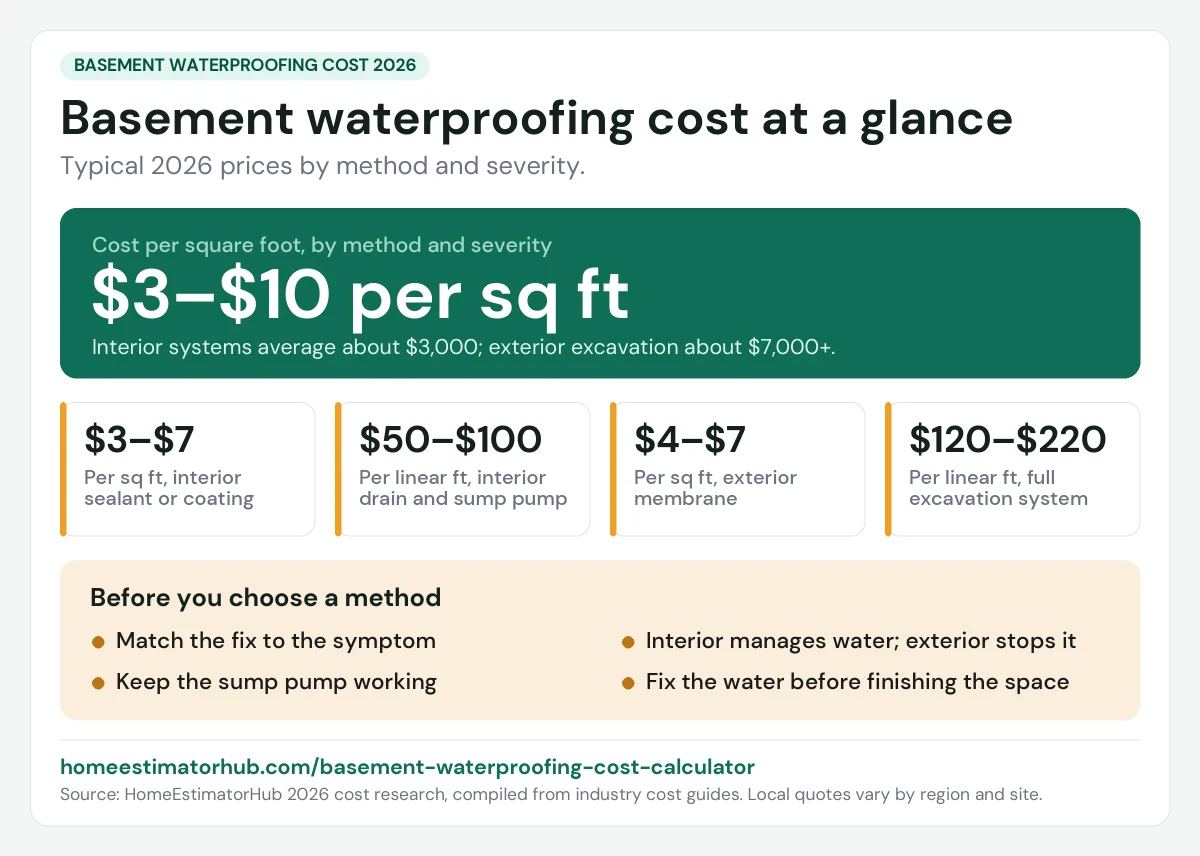
Basement waterproofing cost calculator — by method
Contractors typically price coating-based methods per square foot and drainage-based methods per linear foot of basement perimeter. Our calculator converts your floor area into an estimated perimeter automatically to price drainage systems correctly.
| Method | Typical cost | Best for |
|---|---|---|
| Interior sealant / coating | $3–$7 per sq ft | Minor dampness, budget-friendly |
| Interior French drain + sump pump | $50–$100 per linear ft | Recurring seepage, standing water |
| Exterior membrane | $4–$7 per sq ft | Stopping water before it enters |
| Full excavation system | $120–$220 per linear ft | Severe, long-term, permanent fix |
Interior vs. exterior basement waterproofing
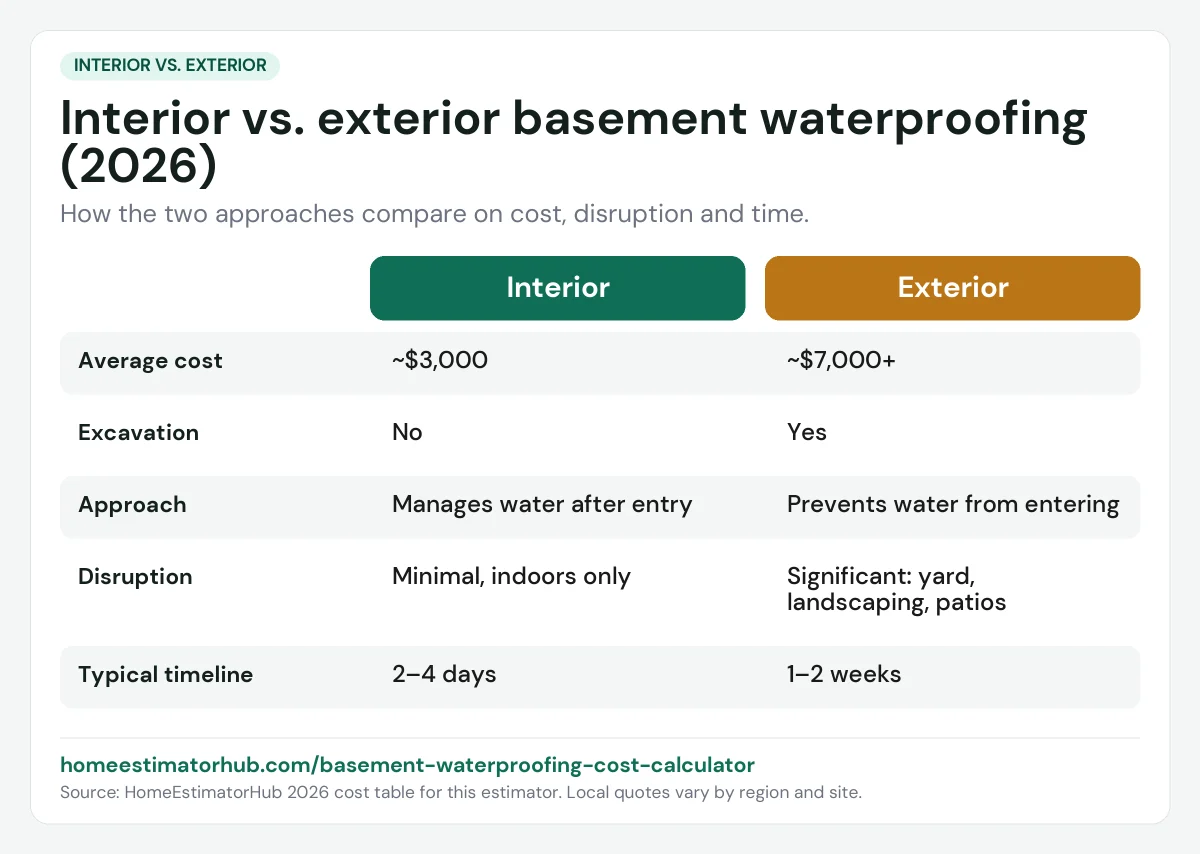
Interior methods manage water after it has already entered, while exterior methods stop water before it reaches the foundation wall. Most basements benefit from a combination of both for full protection.
| Factor | Interior | Exterior |
|---|---|---|
| Average cost | ~$3,000 | ~$7,000+ |
| Involves excavation | No | Yes |
| Approach | Manages water after entry | Prevents water from entering |
| Disruption | Minimal, indoors only | Significant — yard, landscaping, patios |
| Typical timeline | 2–4 days | 1–2 weeks |
Signs your basement needs waterproofing
- Musty odor — Often the first sign of trapped moisture, even before visible water appears.
- White, chalky residue (efflorescence) — Mineral deposits left behind as water evaporates through concrete.
- Visible cracks in walls or floor — Common entry points for water, especially after heavy rain.
- Peeling paint or bubbling on walls — A sign moisture is pushing through from behind the surface.
- Standing water or damp carpet — Indicates an active, ongoing intrusion problem.
- Visible mold or mildew — Often follows untreated moisture within 24–48 hours.
Does insurance cover basement waterproofing?
Generally, no. Basement waterproofing is considered a preventative home maintenance measure, and most standard homeowners insurance policies exclude it. If water damage already occurred from a sudden, covered event — like a burst pipe — the cleanup and repair may be covered, but the waterproofing system itself to prevent future issues is typically an out-of-pocket investment.
Interior or exterior is the whole decision
Basement waterproofing quotes vary enormously, and most of the spread comes down to one choice. These are not competing brands of the same fix — they are different jobs solving different problems.
| Interior drain tile + sump | Exterior excavation | |
|---|---|---|
| What it does | Manages water that has already reached the foundation and routes it out | Stops water reaching the wall in the first place |
| Method | Perimeter of the slab is cut, drainage pipe laid, water taken to a sump | Foundation dug out, wall sealed and membraned, exterior drainage laid |
| Disruption | Inside only. Commonly 1–3 days | Excavation around the house. Landscaping, porches and driveways affected |
| Typical range | Roughly $3,000–$8,000 | Roughly $8,000–$30,000 |
Interior systems resolve most residential water problems, and for ordinary seepage they are the sensible default. The honest summary from the trade is that exterior work is reserved for bowing walls, severe hydrostatic pressure and structural failure — not for a damp corner after heavy rain.
What the symptom tells you about the fix
- Water at the cove joint, where floor meets wall, is the classic case for interior drain tile. It is hydrostatic pressure finding the weakest seam.
- Water through floor cracks points the same way — pressure from beneath rather than from the side.
- A bowing or inward-moving wall is a different category. That is lateral soil pressure, it is structural, and no interior drainage system addresses the cause.
- Damp only after heavy rain, near a downspout may not be a waterproofing job at all. Sometimes it is guttering and grading, at a fraction of the price.
That last one is worth exhausting first. Water repeatedly delivered to the base of a wall by a blocked or undersized gutter is a cheap problem that mimics an expensive one — our gutter installation calculator prices that alternative.
The sump pump is the part that has to keep working
An interior system is only as good as the pump at the end of it, and a pump is a mechanical device in a wet hole. Two questions are worth asking of any quote:
Is there a battery backup? The storms that cause flooding are the storms that cause power cuts. A mains-only pump is offline exactly when it is needed.
Where does the discharge go? If it surfaces near the foundation, the water simply returns. It needs to be taken far enough away, and on a sloped site that is its own small job.
Fix the water before you finish the space
If the plan is to finish the basement, sequence matters more than budget. Framing, insulating and boarding over an active moisture problem does not contain it; it hides it until the drywall reports back. The cost of doing the waterproofing first is always lower than the cost of doing the finishing twice — our basement finishing guide covers the order and the below-grade valuation maths.
Frequently asked questions
How do I estimate basement waterproofing cost?
Measure your basement's floor area, choose a method (interior sealant, interior drain, exterior membrane, or full excavation), and factor in severity and foundation age. Our calculator converts your square footage into an estimated linear-foot perimeter automatically for drainage-based methods, since contractors price those differently than coatings.
How accurate is this basement waterproofing cost calculator?
There is no validated accuracy figure for this estimator, and we will not invent one. Its rates come from published 2026 cost data and are maintained by hand, but they have not been measured against a body of real quotes. A licensed waterproofing contractor has to inspect in person to confirm where water is entering and which method fits. Treat the result as a planning figure and the range as the realistic spread, then get 3 or more quotes before committing.
What is the average cost of basement waterproofing?
Interior waterproofing averages around $3,000, while exterior waterproofing projects average around $7,000 or more, depending on basement size and severity. Most homeowners pay $3 to $10 per square foot overall.
Is interior or exterior basement waterproofing better?
Exterior waterproofing is generally more effective long-term since it stops water before it reaches the foundation, but it costs significantly more due to excavation. Interior methods are more affordable and less disruptive but only manage water after it has already entered.
How long does basement waterproofing last?
Exterior waterproofing systems can last 25 years or more when installed correctly. Interior sealants typically need resealing every 5 to 10 years, costing around $1,000 each time, since they only manage symptoms rather than stopping water at the source.
Sources & standards
Primary references behind the standards, code requirements and safety guidance cited on this page. Cost ranges shown here are HomeEstimatorHub estimates, not contractor quotes — see how these are calculated, and always confirm against written bids and your local building department.
More free estimators
Explore more home cost estimators
Free cost estimators for every home improvement project — updated for 2026, no signup required.
Disclaimer: All basement waterproofing cost estimates are for informational purposes only based on average 2026 US contractor rates. Actual costs vary based on the water entry point, soil conditions, foundation type, site access, permit requirements and contractor availability. Always obtain multiple quotes from licensed basement waterproofing contractors before proceeding with any project.