
Disaster recovery estimator · Updated September 2026
Water Damage Restoration Cost Calculator
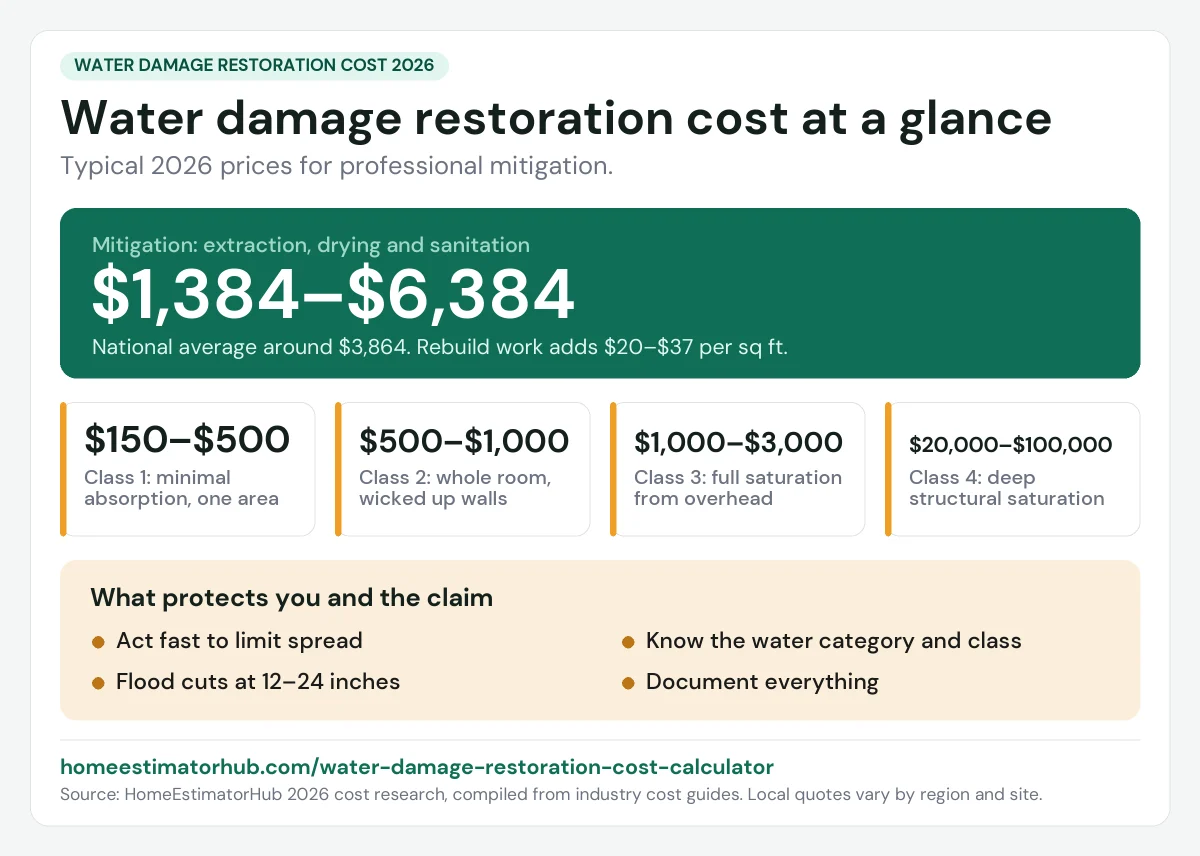
Water damage restoration costs $1,384 to $6,384 on average (national average around $3,864) for mitigation and drying. Repairs to drywall, flooring and structure add $20–$37 per square foot. Use our free calculator to get an instant estimate by water category, severity and affected area.
Enter your water damage details
Enter the affected square footage
Enter the size of the water-damaged area to calculate your instant restoration estimate.
- The national average for water damage restoration is around $3,864
- Mold can begin growing within 24–48 hours of materials staying wet
- Category 3 (black water) costs roughly double Category 1 (clean water)
- Insurance typically covers sudden events, not gradual leaks or flooding
What affects water damage restoration cost?
- Water category — Black water (Category 3) requires full PPE, biocide treatment and more demolition than clean water.
- Affected area — Mitigation and repairs are both priced per square foot of damaged surface.
- Severity (class) — Deep saturation into structural materials costs far more than a surface-level leak.
- Response time — Category 1 water left untreated 24–48 hours can escalate to Category 2 or 3 as bacteria multiply.
- Repairs needed — Mitigation and drying alone cost less than projects requiring drywall, flooring or structural rebuild.
- State — Labor costs in California and the Northeast run 25–30% higher than Midwest and Southern states.

How much does water damage restoration cost in 2026?
Water damage restoration costs $1,384 to $6,384 on average, with a national average around $3,864, for professional mitigation — extraction, drying and sanitation. This figure covers mitigation only; if drywall, flooring or structural rebuild is also needed, repairs add roughly $20 to $37 per square foot on top. Use our free calculator above to get an instant, personalized estimate based on water category, severity and affected area.
Water damage restoration cost calculator — by water category
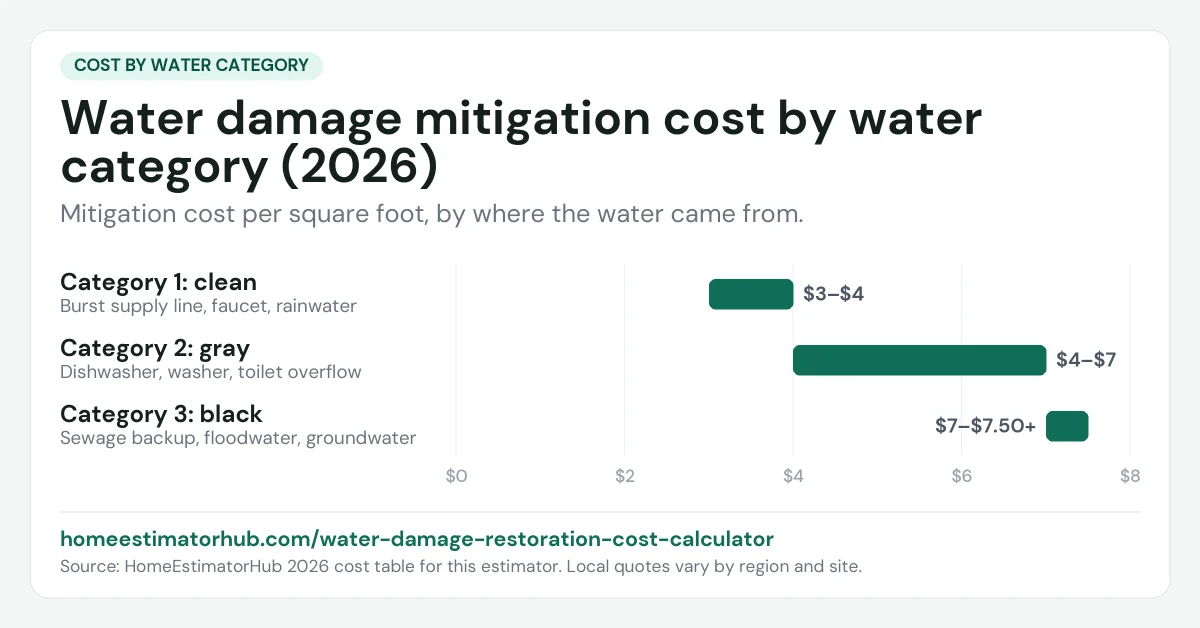
The Institute of Inspection, Cleaning and Restoration Certification (IICRC) S500 Standard classifies water damage into three categories, and this is the single biggest driver of mitigation cost after square footage.
| Category | Source | Mitigation cost per sq ft |
|---|---|---|
| Category 1 — Clean | Burst supply line, faucet, rainwater | $3–$4 |
| Category 2 — Gray | Dishwasher, washing machine, toilet overflow | $4–$7 |
| Category 3 — Black | Sewage backup, floodwater, groundwater | $7–$7.50+ |
Water damage cost by class (severity)
While category describes the water source, "class" describes how much of the structure is affected — and class is what drives total project size.
| Class | Description | Typical cost |
|---|---|---|
| Class 1 | Minimal absorption, single area or material | $150–$500 |
| Class 2 | Whole room, water wicked up walls to 1 ft | $500–$1,000 |
| Class 3 | Full saturation, water from overhead (ceiling) | $1,000–$3,000 |
| Class 4 | Deep saturation into structural materials | $20,000–$100,000 |
Does homeowners insurance cover water damage?
Usually yes, if the damage is sudden and accidental — like a burst pipe, appliance failure, or storm-driven rainwater intrusion caught quickly. Insurance typically does not cover gradual leaks, long-term maintenance neglect, or flooding from rising water, which requires a separate flood insurance policy. Contact your insurer as soon as damage is discovered, since many companies won't accept a DIY damage assessment — only a licensed restoration professional's documentation will satisfy a claim.
Why acting fast matters
Category 1 (clean) water left untreated for 24 to 48 hours can degrade into Category 2 or even Category 3 as bacteria multiply — turning an inexpensive mitigation job into a far more expensive one. Mold can also begin growing on wet materials within 24 to 48 hours. Acting quickly isn't just about cost: it directly limits health risk and the scope of materials that need to be replaced rather than simply dried.
Two classifications drive the price, and people mix them up
Restoration quotes reference Category and Class as if everyone knows the difference. They measure different things, and both appear on your invoice.
Category describes what is in the water — how contaminated it is. Class describes how much material is wet and how hard it will be to dry, which the standard calls evaporative load.
| Class | What it means |
|---|---|
| Class 1 | Least absorption. A small area, low-porosity materials, minimal evaporative demand |
| Class 2 | Significant absorption — an entire room, with water into lower wall cavities |
| Class 3 | Greatest evaporative demand, including saturation from overhead |
| Class 4 | Deep penetration into low-porosity materials. Needs specialty drying methods |
A small Category 3 loss and a large Category 1 loss are completely different jobs, and knowing which pair you have tells you why the number looks the way it does.
What the equipment on your floor is actually doing
The machines left running for several days are not generic fans. Under IICRC S500 the classification determines equipment type, quantity and placement, and the quantities come from formulas rather than intuition.
Air movers create high-velocity airflow across wet surfaces to accelerate evaporation — driving moisture out of materials and into the air. Dehumidifiers then remove it from the air. One without the other does not dry a building: air movement alone just relocates the moisture.
This is why day rates on equipment are a real line item rather than padding, and why removing the machines early to save money extends the job rather than shortening it.
The flood cut, and why 12 to 24 inches
When drywall cannot be dried in place, restorers remove a horizontal strip above the waterline rather than the whole wall. That is a flood cut, and it is usually somewhere in the region of 12 to 24 inches up from the floor.
The logic is that water wicks upward through gypsum well above the visible line, so cutting at the waterline leaves wet material behind. Cutting higher than necessary wastes material and labor. The cut also opens the cavity so insulation can be checked and the framing dried — which is the actual point.
Documentation is what gets the claim paid
Restoration is one of the few trades where the paperwork has direct financial value to you.
A firm working to standard records moisture readings, temperature and relative humidity — inside and outside the affected area, and at the dehumidifier outlet — through the whole drying period. That log is the evidence that the structure actually reached dry standard, and it is what an adjuster looks for.
Ask for the drying log at the end. A company that cannot produce one has not really demonstrated the building is dry, whatever the invoice says.
Our guide on the three water categories covers the escalation clock in detail — the reason speed matters this much is that Category 1 does not stay Category 1.
Frequently asked questions
How do I get a water damage restoration cost estimate?
Identify the water source (clean, gray, or black), measure the affected square footage, and assess how long the area has been wet. Our calculator combines these into an instant estimate. For a binding price, a licensed IICRC-certified restoration company must inspect the property in person, since hidden moisture isn't always visible.
How accurate is this water damage restoration cost calculator?
There is no validated accuracy figure for this estimator, and we will not invent one. Its rates come from published 2026 cost data and are maintained by hand, but they have not been measured against a body of real quotes. Hidden moisture in wall cavities and the true extent of saturation cannot be confirmed without a field inspection and moisture mapping. Treat the result as a planning figure and the range as the realistic spread, then use it to prepare for that conversation rather than as a final price.
What is the average cost of water damage restoration?
The national average cost for water damage restoration mitigation is around $3,864, with most homeowners paying between $1,384 and $6,384. If repairs like drywall and flooring replacement are also needed, total project cost rises further.
How long does water damage restoration take?
Structural drying typically takes 3 to 5 days. Full restoration — including any repairs or rebuild — can take significantly longer depending on the extent of demolition and reconstruction required.
What's the difference between water category and water class?
Category describes how contaminated the water is (clean, gray, or black), which determines safety protocols and mitigation cost per square foot. Class describes how much of the structure is affected and how deeply it's saturated, which determines the overall scope and labor required.
Sources & standards
Primary references behind the standards, code requirements and safety guidance cited on this page. Cost ranges shown here are HomeEstimatorHub estimates, not contractor quotes — see how these are calculated, and always confirm against written bids and your local building department.
More free estimators
Explore more home cost estimators
Free cost estimators for every home improvement project — updated for 2026, no signup required.
Disclaimer: All water damage restoration cost estimates are for informational purposes only based on average 2026 US contractor rates and IICRC S500 standard cost guidance. Actual costs vary based on hidden moisture, water category, extent of saturation, local material pricing and contractor availability. Always obtain multiple quotes from licensed, IICRC-certified restoration contractors before proceeding with any project, and contact your insurance company promptly if the damage may be covered.