
Site & utilities estimator · Updated September 2026
Water Well Drilling Cost Calculator
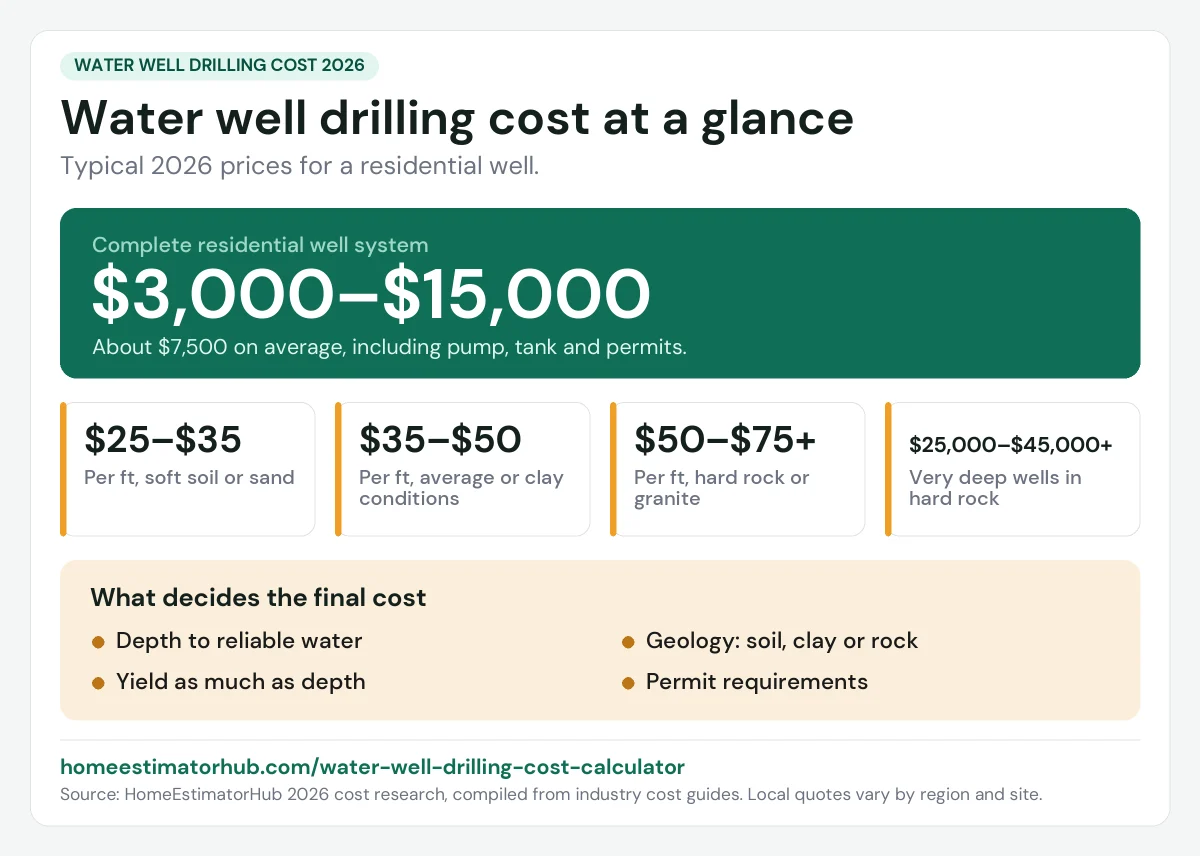
Water well drilling costs $25 to $65 per foot, with a complete residential well system typically running $3,000 to $15,000 (national average around $7,500). Use our free calculator to get an instant estimate by depth, geology, casing and pump system.
Enter your well details
Enter your well's estimated depth
Enter the expected drilling depth to calculate your instant cost estimate. Check your county's well log database or ask neighbors for a realistic depth estimate.
- The national average well drilling cost is around $7,500 complete
- Most residential wells are 100–300 feet deep
- Hard rock/granite drilling costs roughly double soft soil
- Depth cannot be confirmed until drilling actually begins
What affects water well drilling cost?
- Depth — The single biggest cost driver, priced per foot and unknown until drilling begins.
- Geology — Hard rock and granite drill far slower than sand or clay, nearly doubling the per-foot rate.
- Casing material & diameter — Steel costs significantly more than PVC; 6-inch casing costs more than standard 4-inch.
- Pump & system — Deeper wells need more powerful (and pricier) submersible pumps.
- Site access — Steep slopes, dense trees, or narrow access add mobilization cost for the drill rig.
- State & permits — Permit fees and labor rates vary widely by county and state.

How much does it cost to drill a water well in 2026?
Water well drilling costs $25 to $65 per foot, with a complete residential well system — including drilling, casing, pump, pressure tank, electrical, and permits — typically running $3,000 to $15,000, or about $7,500 on average. Very deep wells (300–500+ feet) in hard rock can reach $25,000 to $45,000 or more. Use our free calculator above to get an instant estimate based on your expected depth, geology, casing and pump system.
Water well drilling cost calculator — by depth
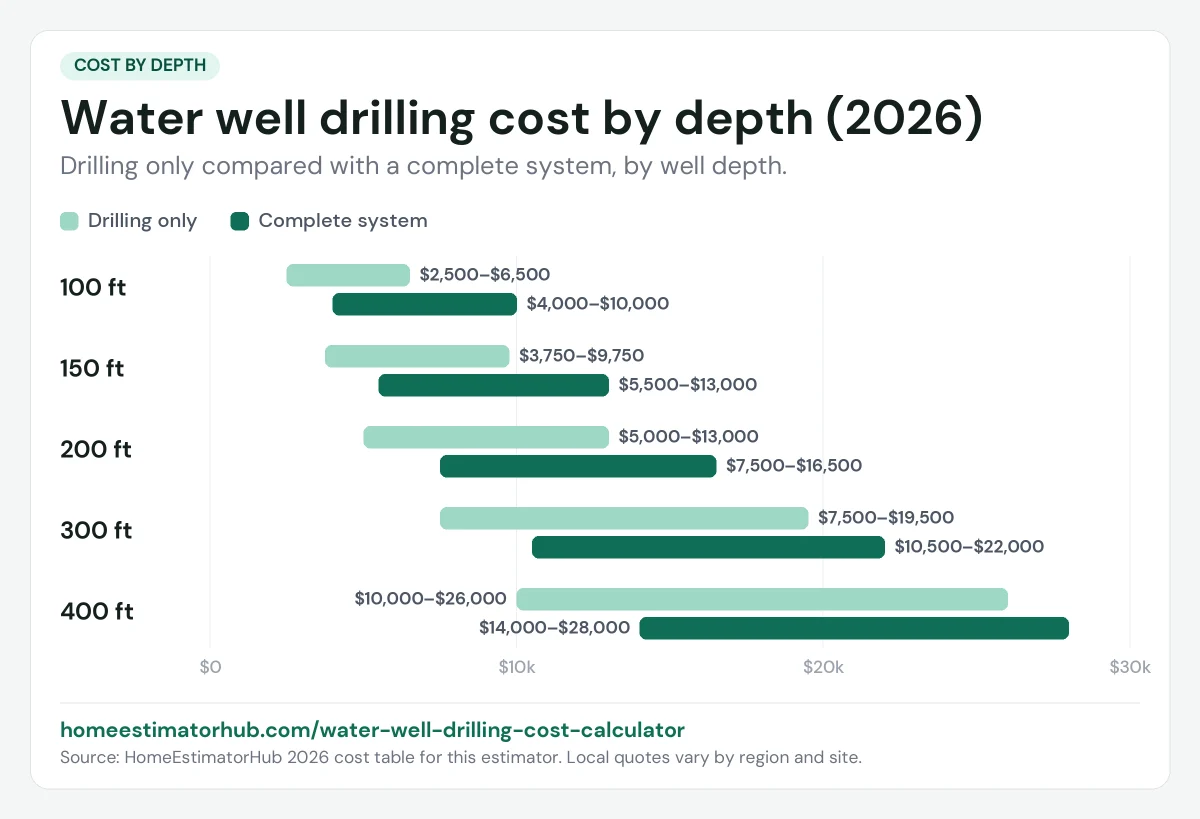
Depth is the single biggest cost variable in well drilling, and it can't be confirmed with certainty until drilling actually begins. The table below shows typical complete-system costs at common residential depths in average soil conditions.
| Depth | Drilling only | Complete system |
|---|---|---|
| 100 ft | $2,500–$6,500 | $4,000–$10,000 |
| 150 ft | $3,750–$9,750 | $5,500–$13,000 |
| 200 ft | $5,000–$13,000 | $7,500–$16,500 |
| 300 ft | $7,500–$19,500 | $10,500–$22,000 |
| 400 ft | $10,000–$26,000 | $14,000–$28,000 |
Water well drilling cost by geology
Your local soil and rock conditions affect the per-foot rate more than almost any other factor. Drillers charge more through hard rock because it wears equipment faster and slows progress significantly.
| Geology | Cost per foot | Notes |
|---|---|---|
| Soft soil / sand | $25–$35 | Fastest drilling, often 1 day for 150–200 ft |
| Average / clay | $35–$50 | Most common residential conditions |
| Hard rock / granite | $50–$75+ | 2–4 days for the same depth, may need a full water quality panel |
Drilled vs. dug vs. driven wells
Drilling is the standard method for new residential wells, but dug and driven wells remain viable in some shallow water table conditions.
| Well type | Typical depth | Typical cost | Best for |
|---|---|---|---|
| Drilled | 100–300 ft | $5,500–$15,000 | Standard for new residential wells |
| Dug | 25–50 ft | $1,800–$3,000 | High water table, but higher contamination risk |
| Driven | Under 50 ft | $4,000+ | Sandy soil with shallow water table |
| Artesian | Varies | $5,000–$15,000 | Naturally pressurized aquifer, saves on pump cost |
What's included in a complete well system?
A full well installation involves more than just the borehole. Beyond per-foot drilling, expect to budget for: casing ($6–$11/ft for PVC, $30–$130+/ft for steel), a submersible pump ($300–$2,000 depending on depth), a pressure tank ($500–$2,000), electrical hookup ($1,000–$3,000), a permit ($50–$1,500 depending on county), and a water quality test ($100–$350) before you drink the water.
Why a well is priced per foot, and what that rate includes
A well is one of the few home projects where nobody — including the driller — knows the final price before work starts. You are buying depth, and depth is decided by geology rather than by choice.
That is why quotes come as a per-foot rate. Drilling alone commonly runs somewhere around $15 to $25 per foot, while a complete installed system is more often quoted at roughly $25 to $65 per foot, because that figure absorbs several things beyond the hole itself.
- Casing. Pipe that keeps the bore from collapsing and stops surface contamination reaching the water. PVC sits at the low end of the range, steel at the high end.
- Grouting. Sealing the annular space around the casing. This is usually a permit requirement rather than an upgrade, and it is what stops surface water travelling down the outside of the casing.
- The pump and pressure tank. Submersible pumps suit deeper wells; jet pumps are for shallow ones. This is a real line item, not an accessory.
- Formation difficulty. Sand, clay and loose gravel drill fastest and cheapest. Hard bedrock is slower and dearer per foot.
Ask specifically which of those the per-foot number covers. Two quotes at different rates frequently include different things.
Yield matters as much as depth
Depth tells you what the well costs. Yield tells you whether it is any use. Yield is measured in gallons per minute, and a typical household wants somewhere around 5 to 10 GPM for comfortable everyday use.
Geology decides this too. Sandy aquifers can deliver well into double figures, while some bedrock wells produce only a few gallons a minute. A low-yield well is not necessarily a failed well — but it usually needs a larger pressure tank or a storage cistern so that peak demand is met from stored water rather than from the aquifer directly, and that is an extra cost worth knowing about before drilling rather than after.
The permit sets more than the fee
Well permits are usually inexpensive, commonly somewhere in the region of $50 to $300 depending on county. The fee is the least important part of the document.
The permit typically specifies minimum casing depth, grouting requirements, and setback distances — how far the well must sit from a septic system, from property lines, and from surface water. Those setbacks can genuinely constrain where a well can go on a smaller lot, which is worth establishing before you decide on a location.
If a septic system is going in at the same time, the two have to be planned together for exactly this reason. Our septic tank installation calculator covers that side, and our regional well depth guide gives typical depth ranges by area.
How to narrow the estimate before anyone drills
You cannot remove the uncertainty, but you can reduce it considerably:
- County well completion reports. Filed records from wells already drilled nearby are the single best predictor for your own property — better than any state or national average.
- A driller who works your area regularly. Local experience frequently produces a close depth estimate before the rig arrives.
- A test bore in genuinely uncertain ground, which establishes conditions before you commit to a full well.
Frequently asked questions
How do I estimate water well drilling cost?
Start with an expected depth — check your county's well log database or ask neighbors what depth their wells reached. Multiply that by the per-foot rate for your local geology ($25–$75/ft), then add casing, pump, pressure tank, electrical and permit costs. Our calculator combines all of these automatically.
How accurate is this water well drilling cost calculator?
There is no validated accuracy figure for this estimator, and we will not invent one. Its rates come from published 2026 cost data and are maintained by hand, but they have not been measured against a body of real quotes. Depth and geology cannot be confirmed until drilling begins. Treat the result as a planning figure and the range as the realistic spread, then get 3 quotes from licensed local well drillers and ask each about their dry-hole policy before signing.
What is the average cost to drill a well?
The national average cost to drill and equip a residential water well is about $7,500, with most homeowners paying between $3,000 and $15,000 for a complete system including drilling, casing, pump, pressure tank, and electrical hookup.
How deep does a residential well need to be?
The average US residential well is about 150 feet deep, though depth varies widely by region — from 50 feet in some Midwest and Southeast locations to 300+ feet in hard-rock regions like New England or the Mountain West.
Do I need a permit to drill a water well?
Yes, a permit is required in virtually all US counties before drilling can begin, typically costing $50 to $1,500 depending on your location. Your drilling contractor usually handles the permit application as part of the project.
Sources & standards
Primary references behind the standards, code requirements and safety guidance cited on this page. Cost ranges shown here are HomeEstimatorHub estimates, not contractor quotes — see how these are calculated, and always confirm against written bids and your local building department.
More free estimators
Explore more home cost estimators
Free cost estimators for every home improvement project — updated for 2026, no signup required.
Disclaimer: All water well drilling cost estimates are for informational purposes only based on average 2026 US contractor rates and NGWA cost survey data. Actual costs vary significantly based on local geology, depth required to reach water, site access, permit requirements and contractor availability — depth in particular cannot be confirmed until drilling begins. Always obtain multiple quotes from licensed well drilling contractors before proceeding with any project.