
Site & utilities estimator · Updated September 2026
Septic Tank Installation Cost Calculator
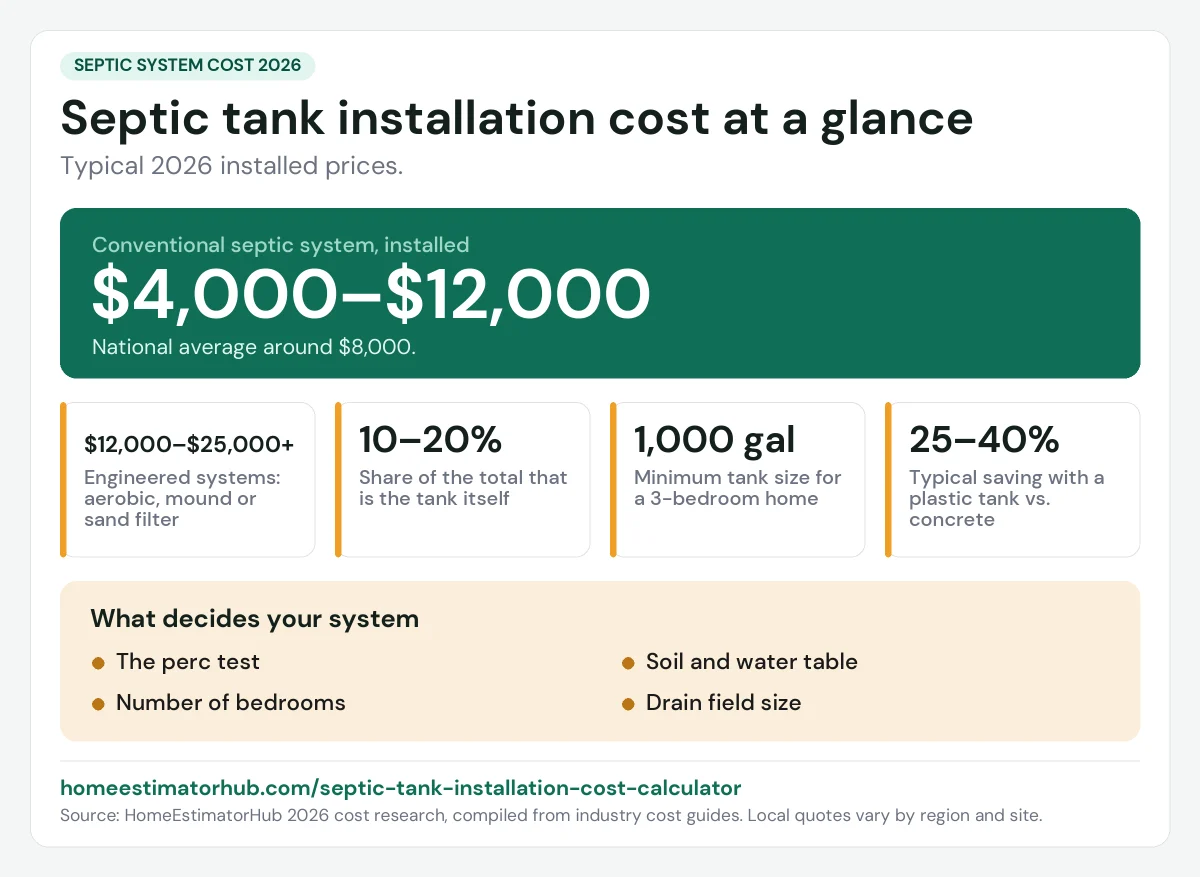
Septic tank installation costs $4,000 to $12,000 for a conventional system, or $12,000 to $25,000+ for an engineered system, depending on bedrooms, soil conditions and tank material. Use our free calculator to get an instant estimate before calling a licensed installer.
Enter your septic system details
Estimated septic system cost
Typical range for your configuration
Cost breakdown
What affects septic tank installation cost?
- System type — Engineered systems (aerobic, mound, sand filter) cost roughly double a conventional gravity system.
- Bedrooms — Tank size is set by bedroom count, not bathrooms, since it determines design wastewater flow.
- Soil conditions — A failed perc test forces a more expensive engineered system regardless of budget.
- Tank material — Concrete is the standard for most counties; plastic is cheaper but must be anchored in high water tables.
- Drainfield scope — A full new drainfield costs significantly more than reusing an existing one in a tank-only replacement.
- State & access — Labor and equipment access costs vary by region and site difficulty.

How much does it cost to install a septic tank in 2026?
Septic tank installation costs $4,000 to $12,000 for a conventional system, with a national average around $8,000. Engineered systems — aerobic treatment units, mounds, or sand filters — needed for poor soil or high water tables typically cost $12,000 to $25,000 or more. The tank itself is usually only 10–20% of the total cost; excavation, the drainfield, and permitting make up the rest. Use our free calculator above to get an instant estimate based on your bedrooms, system type, soil and US state.
Septic tank installation cost calculator — by system type
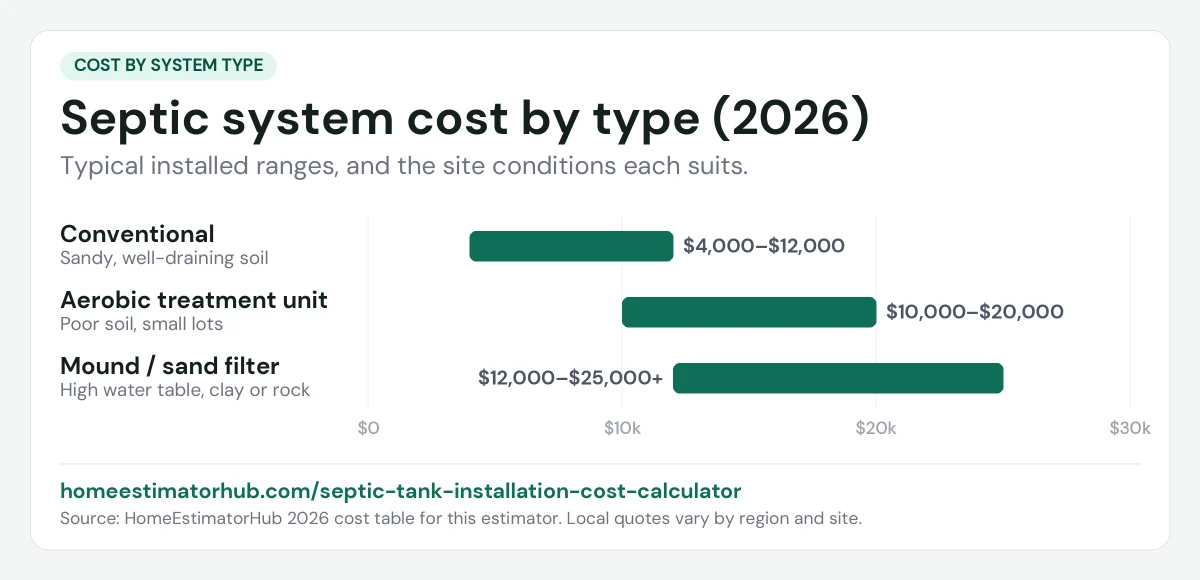
Your soil's perc test result determines which system type your property qualifies for — the homeowner's budget doesn't decide this, the ground does. A conventional gravity system is the cheapest and most common option, used on roughly 70% of residential installations where soil conditions allow.
| System type | Best for | Typical cost |
|---|---|---|
| Conventional | Sandy, well-draining soil | $4,000–$12,000 |
| Aerobic treatment unit | Poor soil, small lots | $10,000–$20,000 |
| Mound / sand filter | High water table, clay/rock | $12,000–$25,000+ |
Septic tank cost by size (bedrooms)
Tank size is set by bedroom count under most county health codes, since it's used to estimate design wastewater flow — not by how many people currently live in the home.
| Bedrooms | Minimum tank size | Tank cost (unit only) |
|---|---|---|
| 1–2 bedrooms | 750 gallons | $650–$1,100 |
| 3 bedrooms | 1,000 gallons | $900–$1,600 |
| 4 bedrooms | 1,250 gallons | $1,150–$2,100 |
| 5+ bedrooms | 1,500+ gallons | $1,400–$2,600 |
Septic tank material comparison
| Material | Pros | Relative cost |
|---|---|---|
| Concrete | Most durable, won't float, county default | Standard |
| Plastic / poly | Lightweight, easy install, 25–40% cheaper | Lowest |
| Fiberglass | Strongest, corrosion-resistant | Highest |
What determines my septic system type?
Before any septic system is permitted, a licensed evaluator runs a percolation ("perc") test to measure how quickly water drains through your soil. Good results allow a conventional gravity-fed system. A failed perc test — common in clay, rocky, or high-water-table soil — means an engineered alternative like an aerobic treatment unit, mound, or sand filter system is required, roughly doubling the cost. A perc test typically costs $250 to $2,000 and should always be done before you budget for installation, since it's the single biggest factor in your final cost.
The perc test decides the system, and sometimes the lot
Before anyone quotes a septic system, the soil has to be tested. A percolation test digs holes to the depth local code specifies, saturates them, then times how many minutes the water takes to drop one inch. That figure — minutes per inch, or MPI — drives everything that follows.
The broadly accepted window for a conventional drain field runs somewhere around 1 to 60 MPI. Outside it in either direction is a problem, and for opposite reasons: soil that drains too fast pushes effluent through before it has been treated, while soil that drains too slowly pushes it back up to the surface.
On raw land this is not merely a design input. A failed perc result can determine whether a lot is buildable at all, which is why it is worth doing before purchase rather than after.
Slower soil means a bigger drain field
The relationship is direct. Slower percolation means the ground absorbs less per square foot, so the field needs more surface area to handle the same household. That is why two identical houses on neighboring lots can carry very different septic costs — the difference is underground and was decided long before either was built.
Bedroom count is the other half of the sizing. Codes generally size for bedrooms rather than occupants, on the reasoning that bedrooms predict long-term capacity better than who happens to live there now.
Three system types, chosen by the ground rather than preference
| System | When it is used | Relative cost |
|---|---|---|
| Conventional gravity | Soil percs within the acceptable range and there is room for a standard field | Lowest |
| Mound | Slowly permeable soil or a high water table — the field is built above grade on imported fill so the designer controls the soil the effluent meets | Substantially higher |
| Aerobic treatment unit | Difficult sites and small lots — oxygen-driven treatment produces cleaner effluent, so the field can be smaller | Highest, plus ongoing servicing |
Aerobic systems carry a commitment beyond installation: they have mechanical components and generally require a service contract. That is a recurring cost a conventional gravity system does not have.
What else sits between the quote and the finished system
- Site evaluation and design, often by a licensed designer or engineer, before any permit is issued.
- Setbacks. Distance from wells, property lines, surface water and structures. On a smaller lot these can dictate the only workable location — and occasionally rule out the easy one.
- Excavation and access. Rock, steep ground or a long haul from the road all add.
- Restoration. A drain field is a large disturbed area. Regrading and reseeding is real work.
If a well is going in on the same property, the two must be planned together because the setback between them constrains both — our water well drilling calculator covers that side. Our guide on how long a septic system lasts explains why the drain field, not the tank, is usually what fails first.
Frequently asked questions
How do I estimate septic tank installation cost?
Start with your bedroom count to determine minimum tank size, then factor in system type (conventional vs. engineered), tank material, soil difficulty, and whether you need a new drainfield. Our calculator combines all of these automatically — as a rule of thumb, budget $4,000–$12,000 for a conventional system or $12,000–$25,000+ for an engineered one.
How accurate is this septic tank installation cost calculator?
There is no validated accuracy figure for this estimator, and we will not invent one. Its rates come from published 2026 cost data and are maintained by hand, but they have not been measured against a body of real quotes. Your actual system type and cost depend on a professional perc test, which no calculator can replace. Treat the result as a planning figure and the range as the realistic spread, then get 3 to 5 written quotes before committing.
What is the average cost of a septic system?
The national average cost of a septic system installation is around $8,000, with most homeowners paying between $3,591 and $12,463 for a conventional system. Engineered systems for difficult soil conditions average significantly higher, often $12,000 to $25,000 or more.
How big of a septic tank do I need?
Tank size is based on bedroom count, not bathrooms: 750 gallons for 1–2 bedrooms, 1,000 gallons for 3 bedrooms, 1,250 gallons for 4 bedrooms, and 1,500+ gallons for 5 or more bedrooms. Some counties require upsizing if you have a garbage disposal.
Do I need a permit to install a septic tank?
Yes, in virtually all US jurisdictions. You'll need a soil/perc test, a building permit for the tank, and often a separate drainfield permit, typically totaling $450 to $2,300 combined. Always check with your local health department before starting any work.
Sources & standards
Primary references behind the standards, code requirements and safety guidance cited on this page. Cost ranges shown here are HomeEstimatorHub estimates, not contractor quotes — see how these are calculated, and always confirm against written bids and your local building department.
More free estimators
Explore more home cost estimators
Free cost estimators for every home improvement project — updated for 2026, no signup required.
Disclaimer: All septic tank installation cost estimates are for informational purposes only based on average 2026 US contractor rates. Your property's actual system requirements depend on a licensed soil/perc test and local health department codes. Actual costs vary based on soil conditions, site access, permit requirements and contractor availability. Always obtain multiple quotes from licensed septic installers before proceeding with any project.