
Insulation & energy estimator · Updated September 2026
Water Heater Installation Cost Calculator
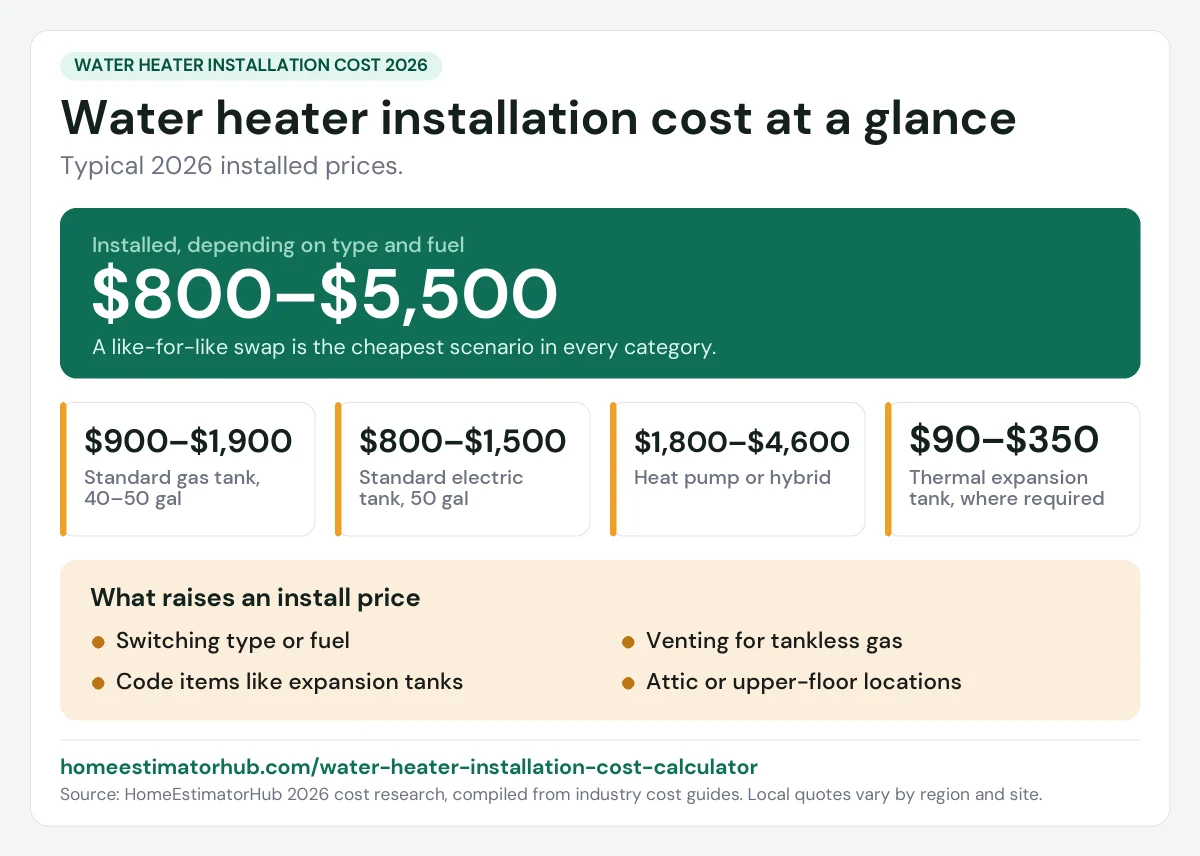
Water heater installation costs $800 to $5,500 depending on type, fuel, and whether you're doing a straightforward swap or converting to a different system. A like-for-like gas tank replacement runs closer to $900-1,600; switching to tankless or heat pump costs significantly more due to infrastructure upgrades. Use our free calculator to get an instant estimate based on your specific situation.
Enter your water heater details
Estimated water heater cost
Typical range for your configuration
Cost breakdown
What affects water heater cost?
- Type — Tankless and heat pump units cost more upfront than a standard tank but last longer.
- Conversion vs. like-for-like — Switching type or fuel requires new infrastructure that a straight swap doesn't.
- Household size — Larger households need bigger tanks or higher-GPM tankless units.
- Electrical capacity — Electric tankless and heat pump units may require a panel upgrade.
- Gas line & venting — Gas tankless units need a larger gas line and dedicated two-pipe venting.
- State — Labor costs in California and the Northeast run 20-30% above the national average.

How much does water heater installation cost in 2026?
Water heater installation costs $800 to $5,500 depending on type, fuel, and whether infrastructure needs to change. A straightforward, like-for-like swap is the cheapest scenario in every category; converting to a different type or fuel adds real cost on top of the unit itself.
| Type | Typical installed cost |
|---|---|
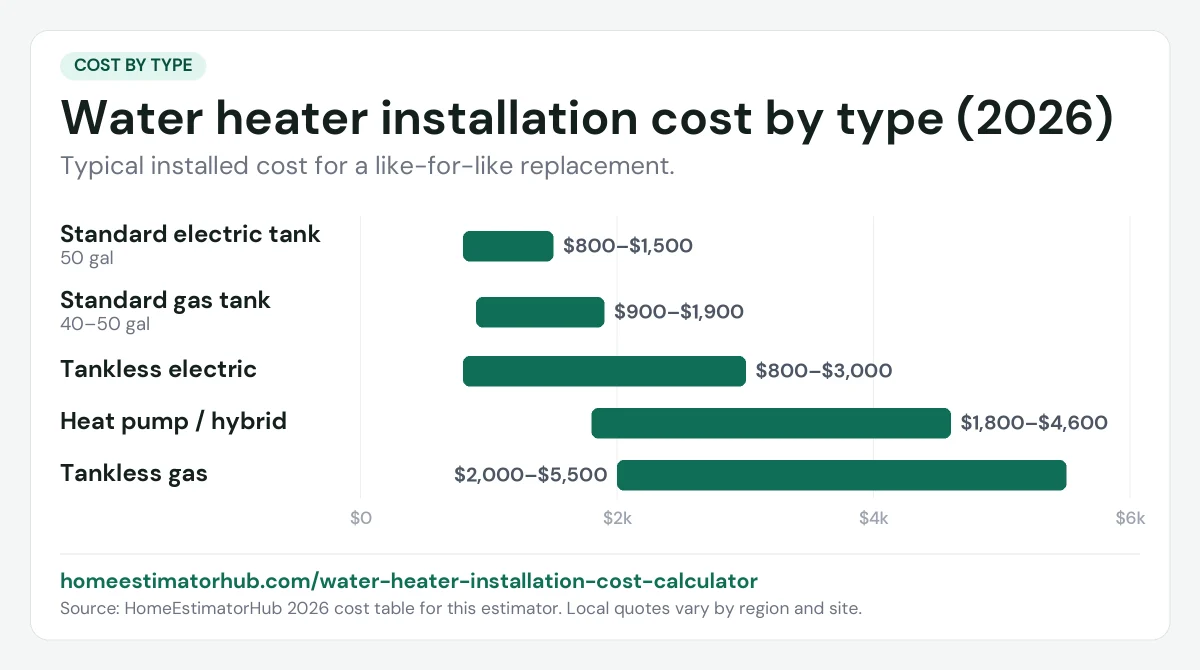
| Standard gas tank (40-50 gal) | $900–$1,900 |
| Standard electric tank (50 gal) | $800–$1,500 |
| Tankless gas | $2,000–$5,500 |
| Tankless electric | $800–$3,000 |
| Heat pump / hybrid | $1,800–$4,600 |
Tank vs. tankless vs. heat pump: how to choose
Standard tanks are the cheapest to install and the most familiar to any plumber, but they last the shortest — typically 8 to 12 years, stretchable to 15 with regular sediment flushing and anode rod replacement. Tankless units cost more upfront but last 15 to 20+ years, and the Department of Energy credits them with 24% to 34% energy savings for households using up to 41 gallons of hot water daily (savings shrink somewhat for higher-usage households). Heat pump water heaters pull warmth from surrounding air rather than generating it directly, making them 2 to 3 times more efficient than a standard electric tank per DOE ratings — the tradeoff is a higher upfront cost and a location requirement: they need roughly 1,000 cubic feet of air around them to work efficiently, which is why they're commonly installed in a garage or utility room, where they also gently cool the surrounding space as a side effect.
Why converting costs so much more than a like-for-like swap
This is the single biggest driver of price variation in this category. Replacing a gas tank with another gas tank in the same spot is plumbing work a professional can typically finish in a few hours. Converting to gas tankless is a different project entirely — it requires a two-pipe venting system, a larger gas supply line (¾ inch minimum), and sometimes a gas meter upgrade. Converting to electric tankless often requires a 200-amp electrical panel and multiple dedicated 240-volt circuits. These infrastructure changes commonly add $500 to $2,000+ on top of the base installation cost, which is why "switching to tankless" quotes vary so much more than "replacing my tank" quotes.
Sizing your water heater
For a tank system, household size is the simplest starting guide: 30 to 40 gallons for 1 to 2 people, 50 gallons for 3 to 4 people, and 65 to 80 gallons for households of 5 or more. Tankless systems are sized differently, by flow rate capacity (gallons per minute, or GPM) rather than storage volume: 3.5 GPM covers 1 to 2 fixtures running at once (a shower plus a sink), 5 GPM covers 2 to 3 fixtures (adding a dishwasher), and 7+ GPM is needed for 3 to 4 fixtures running simultaneously, such as multiple showers alongside laundry and kitchen use. Undersizing a tankless unit causes real performance problems — inconsistent temperature or reduced flow when multiple fixtures run at once — while oversizing simply adds unnecessary cost.
Is the federal tax credit still available?
No, not for 2026 installations. The federal 25C tax credit — which covered 30% up to $2,000 for heat pump water heaters and up to $600 for qualifying high-efficiency gas units — expired for any property placed in service after December 31, 2025. If your installation happened in 2025, you may still be able to claim it on your 2025 tax return; our federal tax credits guide covers this transition in more detail. What's still available in 2026: many electric utilities and some states offer their own rebates specifically for heat pump water heaters, commonly a few hundred dollars up to $1,000 or more — worth checking with your utility provider directly.
How long does a water heater actually last?
Maintenance is the single biggest factor in how long a water heater actually lasts, more than brand or price point. A neglected tank can fail in under a decade; a well-maintained one routinely outlives its warranty. If your water heater is approaching the end of its typical lifespan and facing a costly repair, our repair or replace guide covers the decision framework — including a water-heater-specific rule of thumb once a tank passes roughly 75% of its expected lifespan.
The code items that show up on a compliant install
A water heater swap looks simple and is heavily regulated, because it combines water under pressure with either combustion or a large electrical load. Several items on a legitimate quote are there because an inspector will look for them:
| Item | When it applies | Typical cost |
|---|---|---|
| Thermal expansion tank | Required on a closed system — one with a check valve, backflow preventer or pressure-reducing valve on the incoming supply | About $90–$350, averaging near $220 |
| Temperature and pressure relief discharge piping | Always — the relief valve must discharge safely to an approved location | Minor, but never optional |
| Drip pan and drain | Where a leak could damage the structure, such as an attic or upper floor | Modest |
| Seismic strapping | Required in designated seismic regions | Modest |
| Combustion air and venting review | Any fuel-burning unit | Depends on what exists |
The expansion tank is the one most often questioned. On a closed system, water that expands as it heats has nowhere to go, so pressure rises — stressing the tank, the fittings and the relief valve. Most municipal supplies now include a device that closes the system, which is why this item appears on far more jobs than it used to.
Venting is what makes a tankless conversion expensive
Like-for-like replacement reuses the existing infrastructure. Changing type usually does not, and the reason is rarely the appliance itself. Overall installed pricing in 2026 illustrates the spread: a 40-gallon gas tank commonly runs $900 to $1,600 and a 50-gallon electric $800 to $1,500, against $2,000 to $4,500 for gas tankless, $1,500 to $3,000 for electric tankless and $1,800 to $3,500 for a heat pump unit.
- Gas tankless typically needs a two-pipe venting system, a larger gas supply line — commonly three-quarter inch as a minimum — and occasionally a gas meter upgrade, because it fires at a much higher input rate than a tank.
- Standard atmospheric tanks vent through a metal flue, usually upward through the roof. Power-vent and condensing units can vent horizontally through a sidewall in PVC, which is why they suit homes with no usable flue.
- Electric tankless shifts the problem to the panel. The demand is substantial and frequently requires new circuits or added service capacity — our electrical panel upgrade calculator covers that.
- Heat pump units need air volume around them and produce condensate and cool exhaust air, so a small sealed closet is usually unsuitable without modification.
What maintenance actually extends the life
Three tasks account for most of the difference between a heater that reaches the end of its expected service life and one that fails early:
- The anode rod. A sacrificial rod inside a tank corrodes so the tank does not. Once it is consumed, the tank itself starts to go. Checking it periodically and replacing it when spent is the single highest-value maintenance item on a tank heater.
- Flushing sediment. Minerals settle to the bottom, insulating the burner from the water above and reducing efficiency. Homes with hard water accumulate it faster, which is a good reason to look at our water softener installation calculator if scale is a known problem.
- Testing the relief valve. A safety device that has never been tested is a safety device nobody knows the condition of.
Tankless units have their own version — periodic descaling, which is not optional in hard water areas and is a recurring service cost worth including in any comparison against a tank.
Warning signs that replacement is approaching: rusty hot water, a rumbling or popping tank, moisture around the base, and hot water running out noticeably sooner than it used to. If the unit is in or near a finished space, plan the replacement rather than waiting — a tank that fails does so by leaking, and our water damage restoration cost calculator covers what that costs to put right.
Frequently asked questions
How much does it cost to replace a water heater?
A like-for-like tank replacement costs $800 to $1,900 depending on fuel and size. Switching to tankless or heat pump costs more, $1,800 to $5,500, largely due to infrastructure upgrades rather than the unit itself.
Is a tankless water heater worth the extra cost?
Often yes for long-term ownership. Tankless units cost more upfront but last 15 to 20+ years versus a tank's 8 to 12, and the DOE credits them with 24% to 34% energy savings for typical households.
Is there still a tax credit for water heaters in 2026?
No. The federal 25C tax credit for water heaters expired for installations after December 31, 2025. State and utility rebates for heat pump water heaters specifically may still be available.
What size water heater do I need?
For a tank, 30-40 gallons for 1-2 people, 50 gallons for 3-4 people, and 65-80 gallons for 5+ people. For tankless, 3.5 GPM for 1-2 fixtures, 5 GPM for 2-3 fixtures, and 7+ GPM for 3-4 fixtures running simultaneously.
Sources & standards
Primary references behind the standards, code requirements and safety guidance cited on this page. Cost ranges shown here are HomeEstimatorHub estimates, not contractor quotes — see how these are calculated, and always confirm against written bids and your local building department.
More free estimators
Explore more home cost estimators
Free cost estimators for every home improvement project — updated for 2026, no signup required.
Disclaimer: All water heater cost estimates are for informational purposes only based on average 2026 US contractor rates. This is not tax advice — consult a tax professional and check current IRS and local utility rebate guidance before making a purchase decision. Always obtain multiple quotes from licensed plumbers before proceeding with any project.