
Site & utilities estimator · Updated September 2026
Whole House Generator Cost & Sizing Calculator
A whole house generator costs $6,000 to $25,000 installed, with most homeowners paying $10,000 to $15,000. But before cost, get the number that matters most: the right size in kW for your home. Answer a few questions below for a personalized size recommendation, then an instant installed cost estimate.
Part 1: Size your generator
Part 2: Estimate installation cost
Enter your home's square footage
We'll recommend a generator size in kW, then estimate your installed cost.
- Most 2,000-2,500 sqft homes need a 16-24 kW generator for whole-house coverage
- Essential-circuits-only coverage needs roughly 30-40% less capacity
- The national average installed cost is $10,000-$15,000
- EV chargers and electric heat significantly increase sizing needs
What affects generator cost?
- Size (kW) — The biggest cost driver, though larger systems cost slightly less per kW.
- Brand tier — Premium brands add 25-35% but offer longer lifespans and better load management.
- Fuel type — Propane can add thousands if a new tank is needed; natural gas uses your existing line.
- Distance from panel/meter — Longer trenching runs for gas and electrical lines add real cost.
- Site conditions — Rocky soil or difficult access can increase installation labor.
- State — Labor costs in California and the Northeast run 20-30% higher than Midwest states.

What size whole house generator do I need?
Sizing depends primarily on your home's square footage and whether you want essential-circuit backup or full whole-house coverage, including central AC. As a starting reference:
| Home size | Essential circuits | Whole-house coverage |
|---|---|---|
| Under 1,500 sq ft | 10–12 kW | 16–18 kW |
| 1,500–2,000 sq ft | 12–14 kW | 18–20 kW |
| 2,000–2,500 sq ft | 14–16 kW | 20–24 kW |
| 2,500–3,000 sq ft | 16–18 kW | 22–26 kW |
| 3,000–4,000 sq ft | 18–20 kW | 24–30 kW |
| 5,000+ sq ft | 22–26 kW | 36–48 kW |
Square footage is only a starting point, not the final answer — electric heat, EV charging, and multi-zone AC systems all add meaningful load. A Level 2 EV charger alone adds 7,200–9,600 watts of continuous demand, which is why our calculator above adds capacity for each of these factors rather than relying on square footage alone.
How much does a whole house generator cost in 2026?
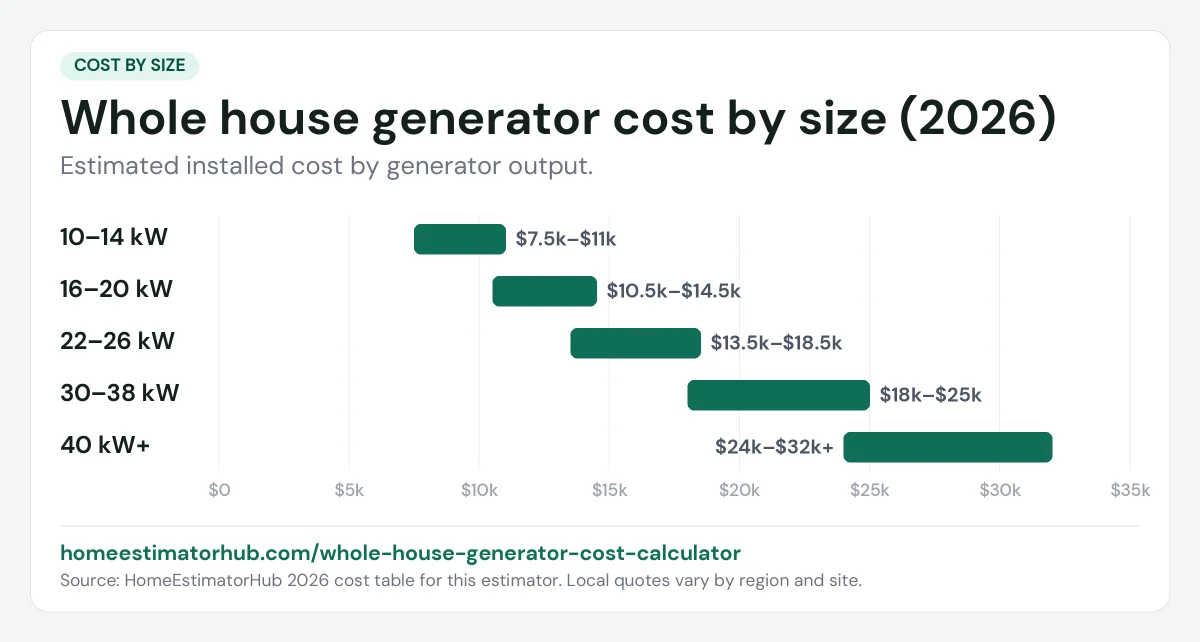
A whole house generator costs $6,000 to $25,000 installed, with most homeowners paying $10,000 to $15,000 for a properly sized system. Budget projects using smaller standard-brand units can start around $6,000-$8,000, while large premium systems for bigger homes can reach $30,000+. Use our calculator above for an instant estimate based on your specific recommended size.
Whole house generator cost calculator — by size
| Generator size | Estimated installed cost |
|---|---|
| 10–14 kW | $7,500–$11,000 |
| 16–20 kW | $10,500–$14,500 |
| 22–26 kW | $13,500–$18,500 |
| 30–38 kW | $18,000–$25,000 |
| 40kW+ | $24,000–$32,000+ |
Natural gas vs. propane: which fuel is better?
Natural gas is typically 30-40% cheaper to run than propane, and if you already have a gas line, installation is simpler since there's no fuel storage to install — the supply is automatic and effectively unlimited. Propane is the better choice if natural gas isn't available in your area; it works anywhere but requires installing and maintaining a tank, which can add $1,800 to $3,500 to your project if you don't already have propane service. Both fuel types work well with standby generators — the right choice usually comes down to what's already available at your property.
Standby vs. portable generators
This calculator covers standby (whole-house) generators specifically — permanently installed units that start automatically within seconds of an outage and run on natural gas or propane with no manual refueling. Portable generators are a different category: manual setup, gasoline-powered, limited to select circuits via extension cords or a transfer switch, and typically cost $500 to $3,000. If you only need short-term backup for a few essential items rather than automatic whole-home coverage, a portable unit may be a more affordable starting point.
Is a whole house generator worth it?
For many homeowners, yes. Consumer Reports and Remodeling magazine have both cited whole house generators as offering a strong return, with some estimates suggesting up to a 150% return on investment and roughly a 5% increase in home value. Beyond resale value, the practical case is straightforward: standby generators last 15-30 years or 10,000-30,000 running hours, and most residential units only run 50-200 hours per year even in areas with frequent outages — meaning a well-installed system can provide decades of reliable backup power.
Where the installed price actually goes
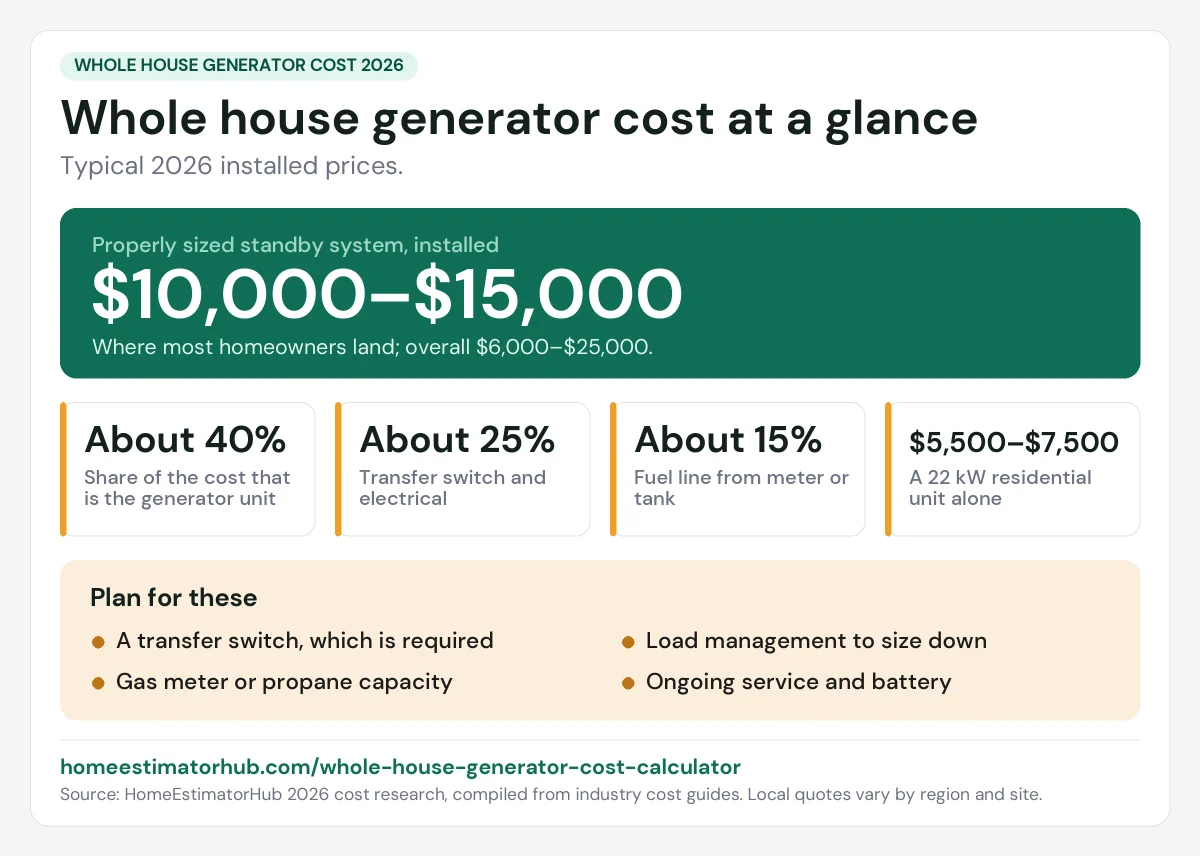
The generator is under half the bill. Installed standby systems commonly land between $7,000 and $20,000, with most 22 kW installations falling in the $10,000 to $14,000 band, and industry breakdowns split that total roughly as follows:
| Component | Approximate share | What it covers |
|---|---|---|
| The generator unit | About 40% | A 22 kW residential unit alone typically runs $5,500–$7,500 |
| Transfer switch and electrical | About 25% | Switch, conductors, panel work, any load management |
| Fuel line | About 15% | Trenching and piping from the meter or tank to the pad |
| Pad and permits | About 10% | Concrete or composite pad, permit fees, inspection |
| Remaining labor | About 10% | Setting, commissioning, testing under load |
Labor on its own commonly runs $4,000 to $7,000 once permits, the pad, the transfer switch, conductors, the fuel line and inspections are counted. That gap between a unit price seen online and an installed quote is the single biggest source of sticker shock on this project.
Why the transfer switch is not optional
NEC Article 702, which governs optional standby systems, is the reason a transfer switch appears on every legitimate quote. Without one there is no compliant way to connect a backup generator to house wiring — and the safety reason is not paperwork. An improperly connected generator can backfeed power onto the utility line, which puts the crews working to restore your power at risk.
Article 702 also requires that a standby system either have the capacity for all the loads it serves, or use automatic load management to prevent an overload. That second clause is the one with money attached: load management lets a smaller generator serve a larger house by shedding non-essential loads when demand spikes, typically dropping a second air conditioning compressor or an electric water heater for a few minutes. Adding load management is frequently cheaper than buying the next size up in generator, which is worth raising directly with your electrician before the unit is ordered.
Fuel supply is a project of its own
- Natural gas. The question is not whether gas reaches the house but whether the existing meter can deliver enough volume for the generator on top of the furnace, water heater and range. If it cannot, the utility has to upgrade the meter, and that is a separate timeline you do not control.
- Propane. Supply is limited by tank size, which makes runtime a planning decision. A tank sized for a cooktop will not carry a whole-house generator through a multi-day outage, and refills during a regional event are not guaranteed.
- Distance. The run from meter or tank to the pad has to be trenched and piped. A generator sited on the far side of the house costs meaningfully more than one placed near the existing supply.
What it costs to own after the install
A standby generator is a small engine that sits outdoors and is expected to start on the worst day of the year. That reliability is bought with maintenance, so budget for it the way you budget for HVAC servicing:
- Scheduled service — oil, filters, plugs, valve checks — on the manufacturer's interval or hours-run schedule.
- The weekly or monthly exercise cycle, which burns a small amount of fuel year-round by design.
- A starting battery, which is a consumable and the most common reason a generator fails to start.
- Fuel consumed during an actual outage, which on natural gas appears on your next utility bill.
Weigh that against what an outage costs you. If a well pump, a sump pump or a freezer full of food is on the line, the calculation looks different than it does for a house that simply goes dark. Our water well drilling calculator covers the system most often cited as the reason a standby generator stops being a luxury, and because many installs also need service capacity added, the electrical panel upgrade calculator prices that side of the job.
Frequently asked questions
What size generator do I need for a 2,000 sq ft house?
Most 2,000 sq ft homes need a 16-20 kW generator for whole-house coverage including central AC, or 12-14 kW if you only want to power essential circuits. Electric heat, EV charging, or multiple AC zones increase this significantly.
How do I calculate whole house generator size?
Start with your home's square footage to get a baseline range, then add capacity for high-demand items: roughly 5 kW for electric heat, 8 kW for a Level 2 EV charger, and 4 kW for multiple AC zones. Our calculator above does this automatically.
What is the average cost of a whole house generator?
The national average installed cost is $10,000 to $15,000, with total costs ranging from $6,000 for smaller basic systems to $25,000 or more for large premium installations.
Is natural gas or propane cheaper for a whole house generator?
Natural gas is typically 30-40% cheaper to run than propane. However, if you don't have an existing natural gas line, installing one can cost $500 to $2,000 or more, which may offset the savings compared to propane in some situations.
Sources & standards
Primary references behind the standards, code requirements and safety guidance cited on this page. Cost ranges shown here are HomeEstimatorHub estimates, not contractor quotes — see how these are calculated, and always confirm against written bids and your local building department.
More free estimators
Explore more home cost estimators
Free cost estimators for every home improvement project — updated for 2026, no signup required.
Disclaimer: All generator size and cost estimates are for informational purposes only based on average 2026 US installer rates and general sizing guidance. Accurate sizing requires a professional load calculation of your home's specific electrical circuits — this calculator provides a planning-stage estimate, not a substitute for a site assessment. Always obtain multiple quotes from licensed, insured generator installers before proceeding with any project.