
Home systems estimator · Updated September 2026
Electrical Panel Upgrade Cost Calculator
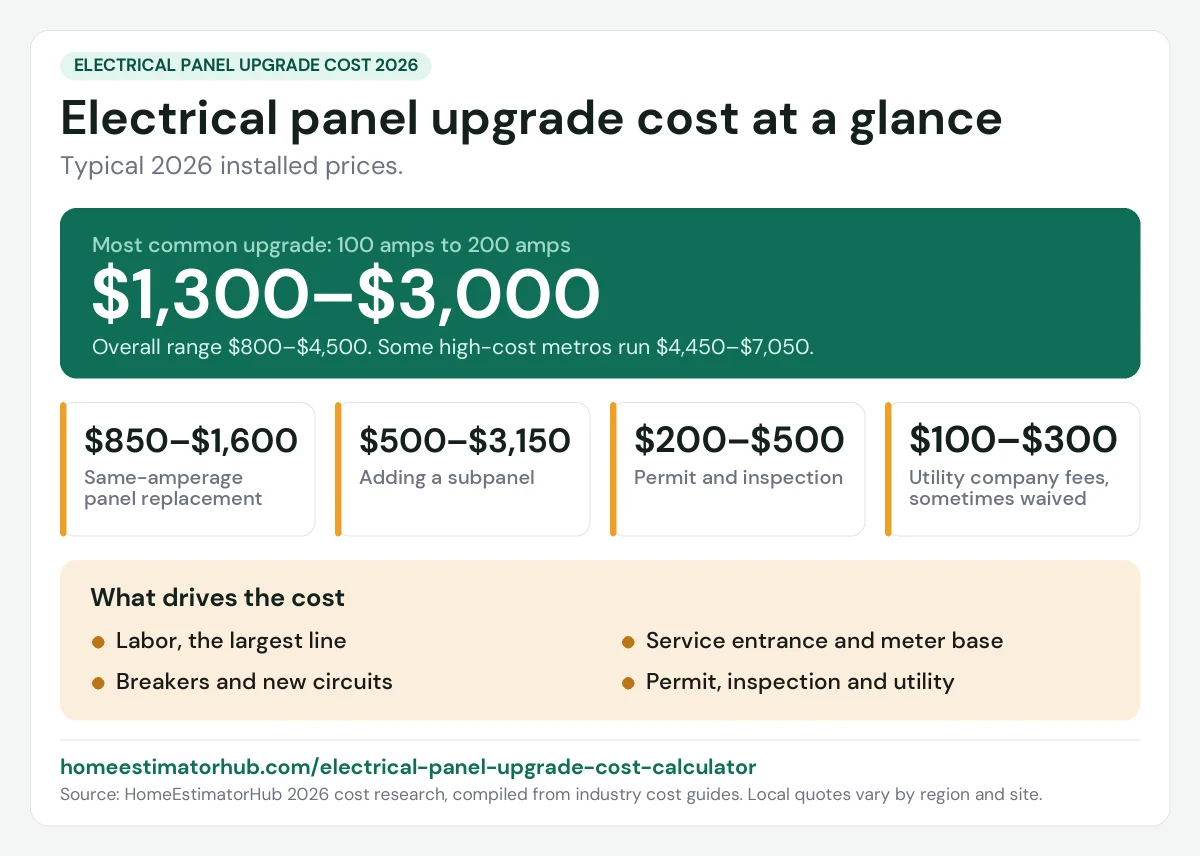
Electrical panel upgrades cost $800 to $4,500, with most homeowners paying $1,300 to $3,000 for a standard 100-to-200-amp upgrade. Use our free calculator to get an instant estimate by project type, target amperage, and installation complexity.
Enter your panel upgrade details
Estimated panel upgrade cost
Typical range for your configuration
Cost breakdown
What affects panel upgrade cost?
- Project type — A subpanel is cheaper but doesn't fix an already-maxed-out main panel.
- Target amperage — 400A upgrades cost significantly more than the standard 200A path.
- Wiring age & condition — Older homes with outdated wiring cost more to bring up to code.
- New circuits — Adding 240V circuits for an EV charger or hot tub adds real cost.
- Utility coordination — Some upgrades require the utility company to also upgrade their equipment.
- State — Labor costs vary significantly by region — some metro markets run well above the national average.

How much does an electrical panel upgrade cost in 2026?
Electrical panel upgrades cost $800 to $4,500, with most homeowners paying $1,300 to $3,000 for the most common upgrade path: 100 amps to 200 amps.
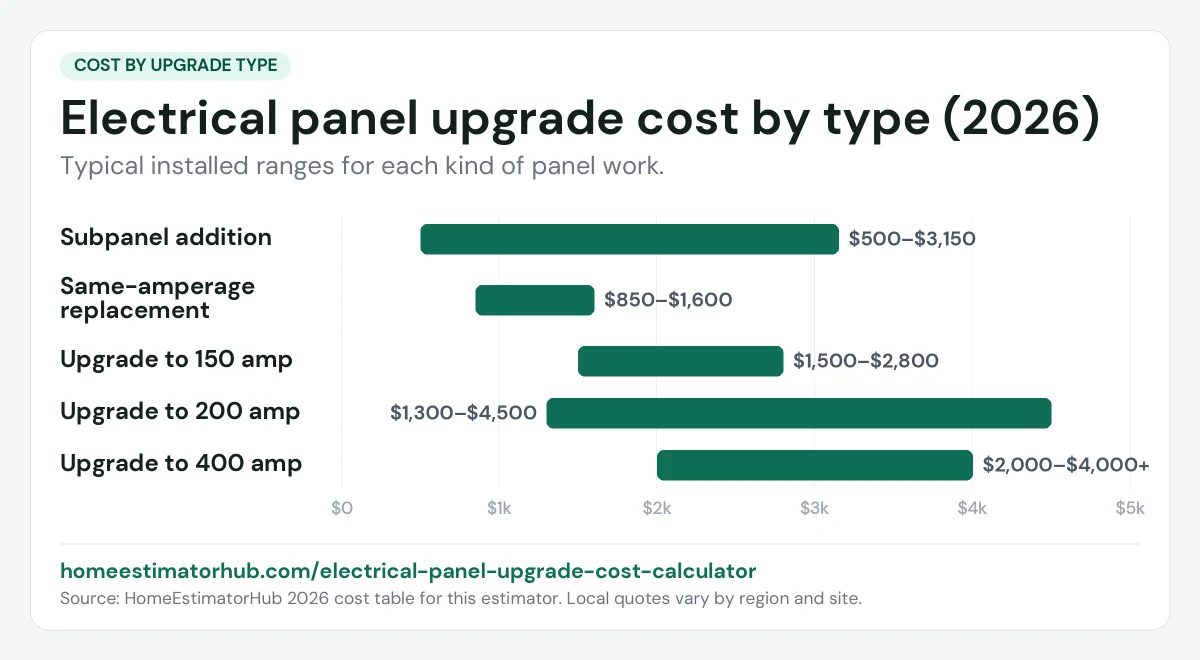
| Upgrade | Typical cost |
|---|---|
| Same-amperage panel replacement | $850–$1,600 |
| Upgrade to 150 amp | $1,500–$2,800 |
| Upgrade to 200 amp | $1,300–$4,500 |
| Upgrade to 400 amp | $2,000–$4,000+ |
| Subpanel addition | $500–$3,150 |
Regional variance is genuinely significant for this trade — the same 100-to-200-amp upgrade that averages $2,000-$3,000 nationally can run $4,450 to $7,050 in some higher-cost metro markets. Use our calculator above for an estimate specific to your state and project.
Full panel upgrade vs. subpanel: which do you actually need?
This is the decision worth getting right before you request quotes. A subpanel adds circuit capacity in a specific area — useful when you're finishing a basement or adding a garage workshop and your main panel already has sufficient overall amperage but is simply out of physical breaker slots. It's a genuinely cheaper option, but it only works if the main panel itself has room to spare. If your main panel is already fully loaded at its rated capacity, a subpanel will not solve the underlying problem — you need a full panel upgrade to increase the total amount of power available to the house, not just add more places to plug new circuits in.
Signs your panel needs an upgrade
- Lights dim when a major appliance like a dryer or AC unit kicks on.
- Breakers trip frequently, especially after adding a new major load like an EV charger or second HVAC system.
- Visible burn marks or a panel that feels warm to the touch.
- Double-tapping — two wires connected to a single breaker. This is worth knowing specifically: it's a genuine code violation and fire risk, not just a minor irregularity, and it means the panel doesn't have enough circuit capacity for your home's actual electrical demand.
- Planning a major addition — a hot tub, a second HVAC system, an EV charger, or finishing a basement are all common triggers that push an aging panel past its limit.
What actually drives the cost
| Component | Typical cost |
|---|---|
| Panel unit (hardware) | $400–$800 |
| Labor (about 4–8 hours) | $800–$2,000 |
| Permit & inspection | $200–$500 |
| New breakers / circuits | $300–$1,000 |
| Utility company fees | $100–$300 (sometimes waived) |
Labor is consistently the largest line item — the panel hardware itself is a relatively small share of the total cost, since safely disconnecting, replacing, and reconnecting an entire home's electrical system to current code takes real time and expertise.
Choosing the right amperage
150 amps is a reasonable fit for homes in the 1,500 to 2,000 sq ft range, especially if you're converting a garage to living space or adding a subpanel down the line. 200 amps has become the modern standard for most homes, comfortably supporting central AC, an electric range, and everyday appliance use without strain. 400 amps is genuinely uncommon in residential settings — it's mainly relevant for larger homes running significant combined loads like an EV charger, solar system, and pool equipment simultaneously. Be upfront with your electrician about future plans (a hot tub next summer, a basement finish, a second HVAC unit) so the panel is sized correctly the first time rather than needing another upgrade in a few years.
Why this always needs a permit and a licensed electrician
There's no legitimate DIY path here — every credible source on this topic is unanimous that panel work requires a permit, an inspection, and a licensed electrician, without exception. The complexity of safely de-energizing and reconnecting a home's entire electrical system, combined with the real fire risk of even a small wiring error, makes this squarely professional-only work. Skipping the permit also creates real problems at resale, since an inspector or buyer's agent can flag unpermitted panel work as a red flag during a home sale.
What to expect on installation day
Plan for 5 to 8 hours without power on the day of the upgrade — an electrician typically has to fully de-energize the home to safely swap the panel. If you have critical electrical needs, such as medical equipment or work-from-home requirements, discuss this with your electrician in advance so you can plan around it. If this project is happening alongside other electrical-heavy upgrades — a tankless or heat pump water heater, a whole house generator, or a heat pump HVAC system — it's worth scheduling the panel work first, since those projects often depend on the panel having enough capacity to support them.
Where a panel upgrade budget goes
The common 100-to-200 amp change usually runs $1,300 to $3,000 covering the panel, breakers, labor and permit, with a typical job near $2,500. A representative breakdown of a roughly $2,200 job looks like this:
| Item | Typical share |
|---|---|
| Labor, around six hours | About $800 |
| Panel and breakers | About $500 |
| Meter base | About $400 |
| Service entrance cable | About $300 |
| Permit and inspection | About $200 |
When a quote lands well above that, the reason is usually that the work extends past the panel. A new meter base or service entrance cable can push a job to $3,500 to $5,000, and permits, usually $200 to $500, run higher in some jurisdictions.
The panel is only part of the service
An upgrade touches the whole path power takes into the house, and several of those components are not optional if the amperage changes:
- Service entrance conductors. Cable sized for 100 amps cannot carry 200. If the existing run is undersized, it is replaced — and if it runs underground or a long distance, that is its own project.
- Meter base and mast. Frequently replaced at the same time, and it is utility-owned equipment on one side of the connection, which introduces scheduling you do not control.
- Grounding and bonding. Modern code requirements for the grounding electrode system are often stricter than what an older house has, so ground rods or water pipe bonding may be added.
- A power-off window. The utility disconnects, the work happens, the inspector signs off, and only then is power restored. Plan for a day without electricity, and note that the inspection has to fit the utility's reconnection schedule — which is the usual reason these jobs span more than one day.
Breakers are no longer the cheap part
Circuits landed in a new panel generally need to meet current requirements, and that changes the arithmetic. A standard breaker is roughly $5 to $15; an AFCI or GFCI breaker is roughly $30 to $50. Across a full panel of circuits that difference is material, and it is a legitimate line rather than padding — these devices detect arc faults and ground faults that a standard breaker will not.
Ask your electrician which circuits require them in your jurisdiction, and get that reflected in the written quote rather than discovered at the end.
Some existing panels are a problem in themselves
Beyond capacity, certain older panel types have a documented history of performance concerns, and some insurers apply conditions or decline coverage where they are present. This is not something to diagnose from a photograph online — have a licensed electrician identify what you have and tell you whether it is a known concern, because if it is, replacement becomes a safety decision rather than a capacity one.
Other findings that commonly turn a routine inspection into an upgrade recommendation include scorch marks or a burning smell, breakers that trip repeatedly, a panel with no remaining spaces, corrosion inside the enclosure, and evidence of amateur work.
Finally, worth checking before sizing: an upgrade is often driven by something else you are planning. Standby generators need a transfer switch and sometimes added capacity — see our whole house generator calculator. Solar requires an interconnection the panel must accommodate, covered in our solar panel installation calculator. And heat pumps and electric water heating add substantial load, priced in our HVAC cost estimator. Doing the panel once, sized for all of it, is considerably cheaper than doing it twice.
Frequently asked questions
How much does it cost to upgrade from 100 amp to 200 amp service?
$1,300 to $4,500, with most homeowners paying $1,300 to $3,000. Cost depends on your home's wiring age, panel accessibility, and whether the utility company needs to upgrade their connection to your home.
Do I need a full panel upgrade or just a subpanel?
A subpanel works if your main panel has sufficient amperage but not enough physical circuit slots. If your main panel is already at full capacity, a subpanel won't solve that — you need a full panel upgrade instead.
What is double-tapping and why does it matter?
Double-tapping is when two wires are connected to a single breaker meant for one. It's a genuine code violation and fire risk, and it's a sign your panel doesn't have enough circuit capacity for your home's electrical needs.
Can I upgrade my electrical panel myself?
No. This work always requires a permit, an inspection, and a licensed electrician. There is no legitimate DIY path for panel replacement due to the safety risk and code requirements involved.
Sources & standards
Primary references behind the standards, code requirements and safety guidance cited on this page. Cost ranges shown here are HomeEstimatorHub estimates, not contractor quotes — see how these are calculated, and always confirm against written bids and your local building department.
More free estimators
Explore more home cost estimators
Free cost estimators for every home improvement project — updated for 2026, no signup required.
Disclaimer: All electrical panel upgrade cost estimates are for informational purposes only based on average 2026 US licensed electrician rates. Actual costs vary based on wiring condition, home age, local utility requirements, and permit fees. This work always requires a licensed electrician and building permit — always obtain multiple quotes before proceeding with any project.