
Insulation & energy estimator · Updated September 2026
Solar Panel Installation Cost Calculator
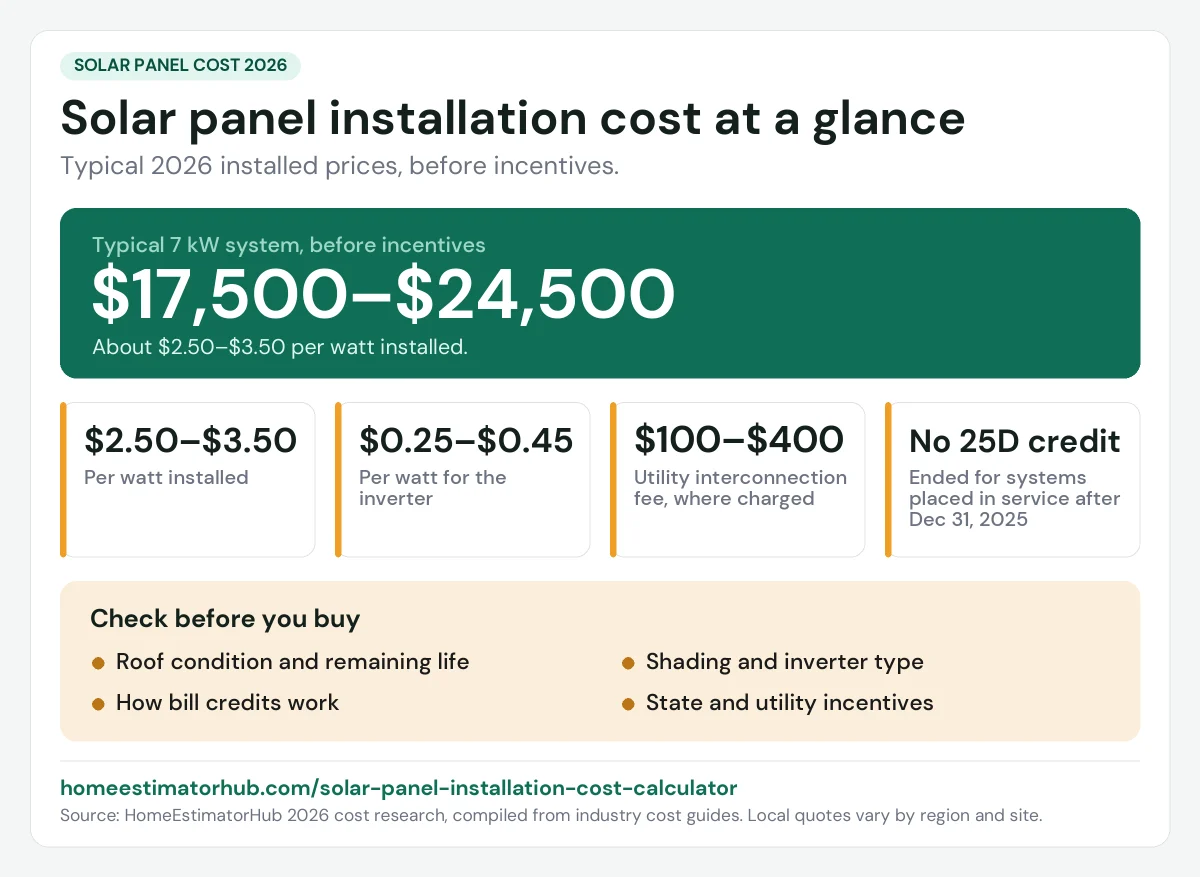
Solar panel installation costs $2.50 to $3.50 per watt in 2026, or roughly $17,500 to $24,500 for a typical 7 kW system before incentives. Enter your average monthly electric bill below and we'll estimate the system size you need and what it costs to install — including the current status of the federal tax credit.
Enter your solar project details
Enter your average monthly electric bill
We'll use it to estimate the system size you need, then calculate your installation cost.
- Most homes need a 6–10 kW system to offset most of their electric bill
- A typical 7 kW system costs $17,500–$24,500 before incentives
- The 30% federal tax credit expired for direct-purchase systems after 2025
- State and utility incentives still vary widely — always check what's available locally
What affects solar installation cost?
- System size — Driven by your electricity usage; bigger systems cost more total but less per watt.
- Panel tier — Premium panels cost 15–25% more but offer higher efficiency and better warranties.
- Roof complexity — Steep pitches, tile roofing, or multiple planes add labor and material cost.
- Battery storage — The single biggest optional add-on, often $8,000–$18,000 depending on capacity.
- Mount type — Ground-mount systems add trenching and footing costs roof-mounts don't need.
- State — Labor, permitting and inspection costs vary $1+ per watt between states.

How much does solar panel installation cost in 2026?
Solar panel installation costs $2.50 to $3.50 per watt installed in 2026, or roughly $17,500 to $24,500 for a typical 7 kW residential system before any incentives. The single most important cost update for 2026: the 30% federal residential solar tax credit (Section 25D) expired for direct-purchase systems placed in service after December 31, 2025. Unlike prior years, homeowners buying solar with cash or a loan in 2026 cannot claim that federal credit — budget based on the pre-incentive price, then layer in whatever state or utility incentives you actually qualify for. Use our free calculator above to estimate your system size from your electric bill and get an instant cost estimate.
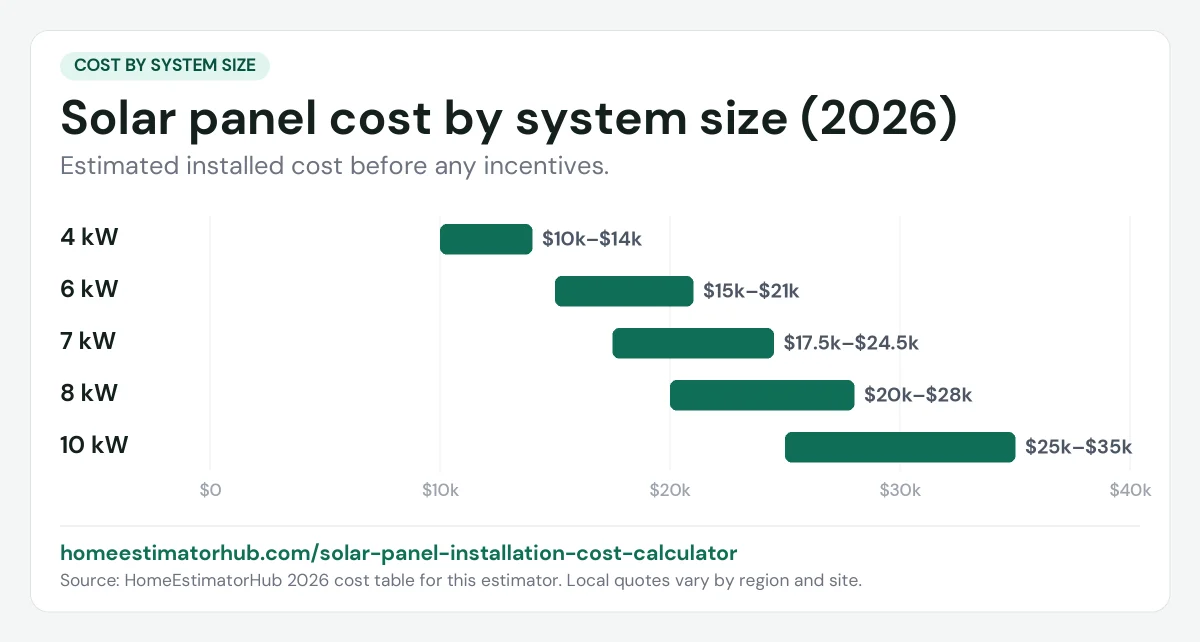
Solar panel installation cost calculator — by system size
| System size | Estimated cost (before incentives) |
|---|---|
| 4 kW | $10,000–$14,000 |
| 6 kW | $15,000–$21,000 |
| 7 kW | $17,500–$24,500 |
| 8 kW | $20,000–$28,000 |
| 10 kW | $25,000–$35,000 |
Larger systems typically cost less per watt, since fixed costs like permitting and the site visit are spread across more panels — a 10 kW system usually runs closer to 1.7x a 5 kW system, not exactly double.
Is the federal solar tax credit still available in 2026?
Not for direct-purchase systems. The 30% federal residential solar tax credit (Section 25D), which had been in place for over a decade, expired on December 31, 2025 under the One Big Beautiful Bill Act. If you buy or finance a solar system with cash or a loan in 2026, you cannot claim that credit. There's one meaningful exception: solar leases and power purchase agreements (PPAs) can still indirectly access a commercial-side credit (Section 48E) through 2027, since the leasing company — not you — owns the system and can claim it, sometimes passing some savings through as a lower monthly payment. Many state, local, and utility incentives remain available independent of the federal credit and vary significantly by location — the DSIRE database (Database of State Incentives for Renewables and Efficiency) is the most reliable place to check what applies where you live.
How many solar panels do I need?
The simplest starting point is your electric bill, not your roof size. Divide your annual electricity usage in kWh by roughly 1,200–1,500 (a national blended production estimate) to get your target system size in kW. Most homes with a $120–$200 monthly bill land in the 6–10 kW range, translating to roughly 17–25 standard 400-watt panels. Our calculator above runs this same math automatically from your monthly bill, targeting about 85% offset of your usage — a realistic goal once shading, seasonal variation, and system losses are accounted for.
Is solar worth it without the federal tax credit?
For many homes, yes — just with a longer payback period than the 6–9 years commonly quoted when the federal credit was still active. Without it, a cash-purchase system typically pays for itself in 9 to 14 years, depending on your local electricity rate and sun exposure, with 20+ years of largely free electricity after that. The math works best for homes with consistently high electric bills (generally above $120/month) in states with strong electricity rates or solid net metering policies. Before committing, get a clear, itemized quote and check what state or utility incentives you actually qualify for — in some states those can still meaningfully close the gap the federal credit used to cover.
Battery storage: is it worth adding?
Battery storage adds real cost — typically $8,000 to $18,000 depending on capacity — and isn't required for a grid-tied solar system to work. It makes the most sense in three specific situations: frequent power outages in your area, a utility with poor net metering (where selling excess power back isn't worth much), or time-of-use electricity rates where storing your own solar power for evening use saves more than exporting it during the day. If none of those apply to you, a battery mainly adds resilience rather than direct financial payback.
What the per-watt price is made of
Solar is quoted per watt of installed capacity — roughly $2.50 to $3.50 per watt in 2026, putting a typical 8 kW system at $20,000 to $28,000. The panels themselves are a smaller share of that than most people assume.
| Component | Notes |
|---|---|
| Panels | The commoditized part, and where price competition is strongest |
| Inverter | Roughly $0.25–$0.45 per watt, depending on architecture |
| Racking and mounting | Varies with roof type — tile and metal cost more to mount than asphalt shingle |
| Labor | Driven by roof pitch, height, number of planes and access |
| Permitting and design | Plan sets, structural review, local fees |
| Interconnection | Often bundled; some utilities charge $100–$400 for the application and meter change |
When two quotes differ substantially, the difference is usually in the inverter architecture, the racking, or what has been assumed about your roof — not in the panels.
Inverter architecture is the decision shading forces
Panels produce direct current; the inverter converts it to the alternating current your house uses. How that conversion is arranged determines how the array behaves when part of it is shaded.
- String inverter. One central unit serving a string of panels. Lowest cost, simplest, and a single point of failure. Its weakness is that output across the string is dragged down by the weakest panel, so partial shade has an outsized effect.
- Microinverters. One small inverter per panel. Each panel performs independently, which suits roofs with chimneys, dormers, vents or tree shade, and gives per-panel monitoring. It costs more and puts electronics on the roof.
- String inverter with power optimizers. A middle path — per-panel optimization feeding a central inverter.
If an installer proposes a plain string inverter for a roof with real shading, ask how they modeled the loss. If they propose microinverters for a clean, unshaded south-facing plane, ask whether the premium is buying you anything beyond monitoring.
Check the roof before you check the payback
Panels are expected to last decades. Asphalt shingles are not. Installing an array over a roof with only a few years left means paying to remove and reinstall the system when the roof is replaced — a substantial cost that appears nowhere in the original quote.
The rule of thumb worth following: if the roof will need replacing within the first several years of the array's life, replace it first. Our roof replacement cost estimator prices that, and doing both together is far cheaper than doing them in sequence.
Two more pre-conditions worth confirming early. The electrical panel may need upgrading to accommodate the interconnection — see our electrical panel upgrade calculator. And reducing the load before sizing the system is almost always cheaper per unit of benefit than generating more; our attic insulation cost calculator covers the usual first move there.
How the credits on your bill actually work
Net metering is the arrangement under which exported power earns credit against what you import, and the details vary enormously by state and by utility. Two things are consistently misunderstood:
- Credits offset energy charges, not fixed charges. The service or connection fee on your bill stays regardless of how much you export, so a system sized to zero out your usage does not produce a zero bill.
- Not all credit is equal. Some programs credit exports at the full retail rate, others at a lower wholesale or avoided-cost rate, and some apply time-of-use pricing so an exported kilowatt-hour at noon is worth less than one imported at 7pm.
Ask your installer which specific tariff their savings projection assumes, then verify it against your utility's current published terms. Since the federal residential credit ended for direct-purchase systems placed in service after 31 December 2025, state, local and utility-level incentives together with the net metering terms are now what determine whether the numbers work — which makes checking them yourself more important than it used to be.
Frequently asked questions
How do I estimate solar panel installation cost?
Start with your average monthly electric bill to estimate the system size you need in kW, then multiply that by the local cost per watt for your area ($2.50–$3.50 nationally). Our calculator does this automatically and adds panel tier, roof complexity, and any add-ons you select.
Is the 30% solar tax credit still available in 2026?
Not for direct-purchase systems. The residential federal tax credit (Section 25D) expired for systems placed in service after December 31, 2025. Solar leases and PPAs can still indirectly access a separate commercial credit through 2027, and many state and utility incentives remain available.
What is the average cost of solar panels per watt?
The national average is $2.50 to $3.50 per watt installed in 2026, with lower-cost states like Texas and Arizona closer to $2.20–$2.70/W and higher-cost states like Massachusetts and New York closer to $2.90–$3.60/W.
How long does it take for solar panels to pay for themselves?
Without the expired federal tax credit, a typical cash-purchase system pays back in 9 to 14 years, depending on your electricity rate and sun exposure. After that, the system continues producing largely free electricity for its remaining 15+ year lifespan.
Sources & standards
Primary references behind the standards, code requirements and safety guidance cited on this page. Cost ranges shown here are HomeEstimatorHub estimates, not contractor quotes — see how these are calculated, and always confirm against written bids and your local building department.
More free estimators
Explore more home cost estimators
Free cost estimators for every home improvement project — updated for 2026, no signup required.
Disclaimer: All solar cost estimates are for informational purposes only based on average 2026 US installer rates. This calculator does not apply the federal residential solar tax credit, which expired for direct-purchase systems placed in service after December 31, 2025 — tax law is subject to further change, and state, local, and utility incentive availability varies widely. This is not tax or financial advice; consult a tax professional and check the DSIRE database for programs specific to your location. Always obtain multiple quotes from licensed solar installers before proceeding with any project.