
Site & utilities estimator · Updated September 2026
Water Softener Installation Cost Calculator
Water softener installation costs $1,000 to $7,000 or more depending on system type, household size, and water hardness. Salt-based ion exchange systems average around $1,500 and are the only type that genuinely removes hardness minerals. Use our free calculator to get an instant estimate based on your specific water and household.
Enter your water softener details
Enter your water hardness in grains per gallon
Check with your municipality or use a home test kit to find your hardness, then calculate your instant estimate.
- Only salt-based systems genuinely remove hardness minerals from water
- A family of four with 10 GPG hardness typically needs a 32,000-48,000 grain system
- Oversizing wastes money; undersizing means more frequent regeneration cycles
- Salt-based systems cost about $40-120/year in salt to maintain
What affects water softener cost?
- System type — Dual-tank systems cost more than single-tank salt-based or salt-free units.
- Grain capacity — Larger households and harder water both require higher-capacity systems.
- Existing plumbing — A pre-plumbed softener loop costs far less to connect to than a retrofit.
- Drain access — No nearby floor drain means running a new drain line.
- Water quality — Iron or sediment in well water may require additional pre-filtration.
- State — Labor costs in California and the Northeast run 20-30% above the national average.

How much does a water softener cost in 2026?
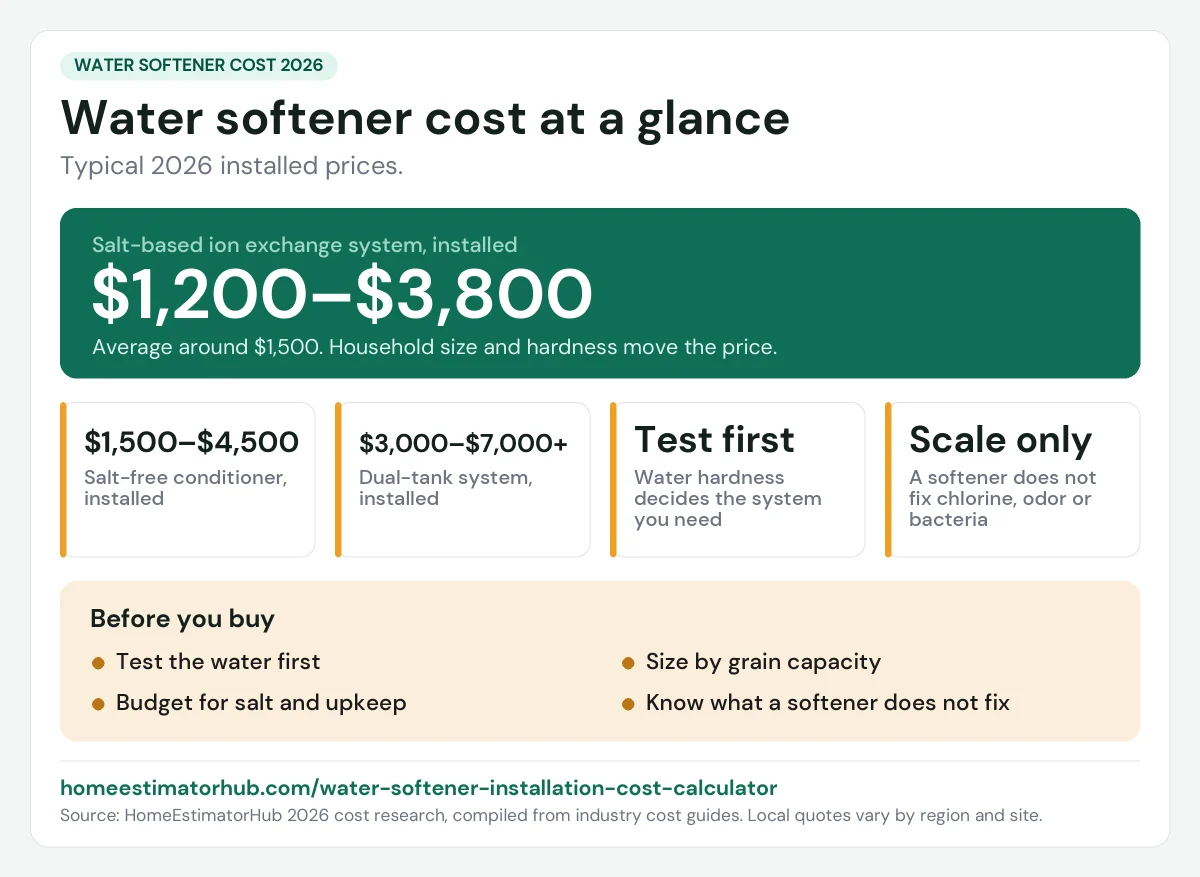
Water softener installation costs $1,000 to $7,000 or more depending on system type, household size, and water hardness.
| System type | Typical installed cost |
|---|---|
| Salt-based ion exchange | $1,200–$3,800 (avg ~$1,500) |
| Salt-free conditioner | $1,500–$4,500 |
| Dual-tank | $3,000–$7,000+ |
Salt-based vs. salt-free: the difference most marketing doesn't explain clearly
This is worth understanding before you buy, since it changes what you're actually getting for your money. Salt-based ion exchange systems are the only type that genuinely removes hardness minerals — calcium and magnesium — by exchanging them for sodium ions as water passes through. Salt-free systems work completely differently: they use a process called Template-Assisted Crystallization (TAC) to change the physical structure of the hardness minerals so they don't stick to pipes and fixtures, but the minerals themselves stay in the water. In practical terms, a salt-free unit prevents the scale buildup that damages plumbing and appliances, but it isn't technically softening your water at all — "conditioner" is the more accurate term, even though these systems are frequently marketed as softeners. Salt-free systems make sense if you're on a sodium-restricted diet, live somewhere that restricts salt discharge, or have moderate rather than severe hardness. For genuinely hard water (above roughly 15 GPG), salt-based remains the more effective, proven option.
Sizing your system: grain capacity
Grain capacity is the total amount of hardness a system can remove before it needs to regenerate, and getting this number right matters more than most people expect. As a starting guide: 24,000 to 32,000 grains suits a smaller household (1-2 people), 32,000 to 48,000 grains fits a typical family of 3-5, and 48,000 to 64,000+ grains is appropriate for larger households or high water usage. Water hardness itself is measured in grains per gallon (GPG) — check with your municipality for a free test, or use an inexpensive home test kit, before assuming a system size. Undersizing means more frequent regeneration cycles, higher salt and water use, and the real risk of running out of soft water between cycles. Oversizing simply wastes money upfront and uses more salt per cycle than necessary — bigger isn't automatically better here.
What actually drives installation cost
Professional installation typically runs 20% to 30% of the total project cost. If you're replacing an existing system in a home that already has a dedicated softener loop, installation is comparatively simple and inexpensive. Installing a softener from scratch — especially in an older home without existing infrastructure — can meaningfully increase the labor cost, sometimes doubling it compared to a straightforward swap. If your installation location doesn't have a nearby floor drain, running a new drain line adds real cost, and some municipalities require a permit for the installation.
The real long-term cost comparison
Sticker price alone doesn't tell the full story here, and it's worth running the actual numbers rather than assuming the cheaper unit is the better deal. A $1,500 salt-based system that lasts 15 years works out to roughly $100 a year in depreciation. A $2,000 salt-free system lasting 8 years works out to about $250 a year in depreciation — but salt-free systems typically save $85 to $190 a year in operating costs compared to salt-based, since there's no ongoing salt expense. Depending on your household's usage and how long you plan to stay in the home, either total-cost picture can come out ahead — it's worth doing this math for your specific situation rather than comparing only the installed price.
Ongoing costs to budget for
- Salt — $40 to $120 a year for salt-based systems, typically one 40-lb bag every 4 to 6 weeks at $5-10 per bag. Potassium chloride, the sodium-free alternative, costs 3 to 4 times more.
- Resin replacement — every 7 to 10 years, $100 to $300, as resin beads gradually lose exchange capacity.
- Electricity — minimal, typically $10 to $20 a year for regeneration cycles.
- Water bill increase — regeneration cycles use 25 to 65 gallons each, running 1 to 3 times weekly, adding roughly $20 to $50 a year.
If hard water has already caused scale buildup affecting your water heater's efficiency or lifespan, our water heater installation cost calculator is worth checking alongside this one.
Test the water before you shop for equipment
A softener is sized and selected from numbers, and guessing at those numbers is how people end up with the wrong unit. Two tests give you everything you need: a hardness figure, and a broader water quality panel if you are on a private well.
Hardness is reported either in grains per gallon or in parts per million, and the two are easy to confuse because the figures look nothing alike. Divide ppm by roughly 17.1 to get grains per gallon — so a reading of about 202 ppm is around 11.8 grains, which falls in the very hard category.
Three other results change the specification if they show up:
- Iron. Softener resin will remove modest amounts, but iron above the unit's rating fouls the resin and shortens its life. Higher iron means pre-treatment ahead of the softener, not a bigger softener.
- pH. Water outside the normal range affects both treatment performance and the plumbing itself.
- Manganese, tannins and sediment — common on wells, and each needs its own stage rather than being handled by the softener.
If you are on a private well, testing is worth doing periodically regardless of whether you are buying equipment; our water well drilling cost calculator covers that side of the system.
What a softener does not do
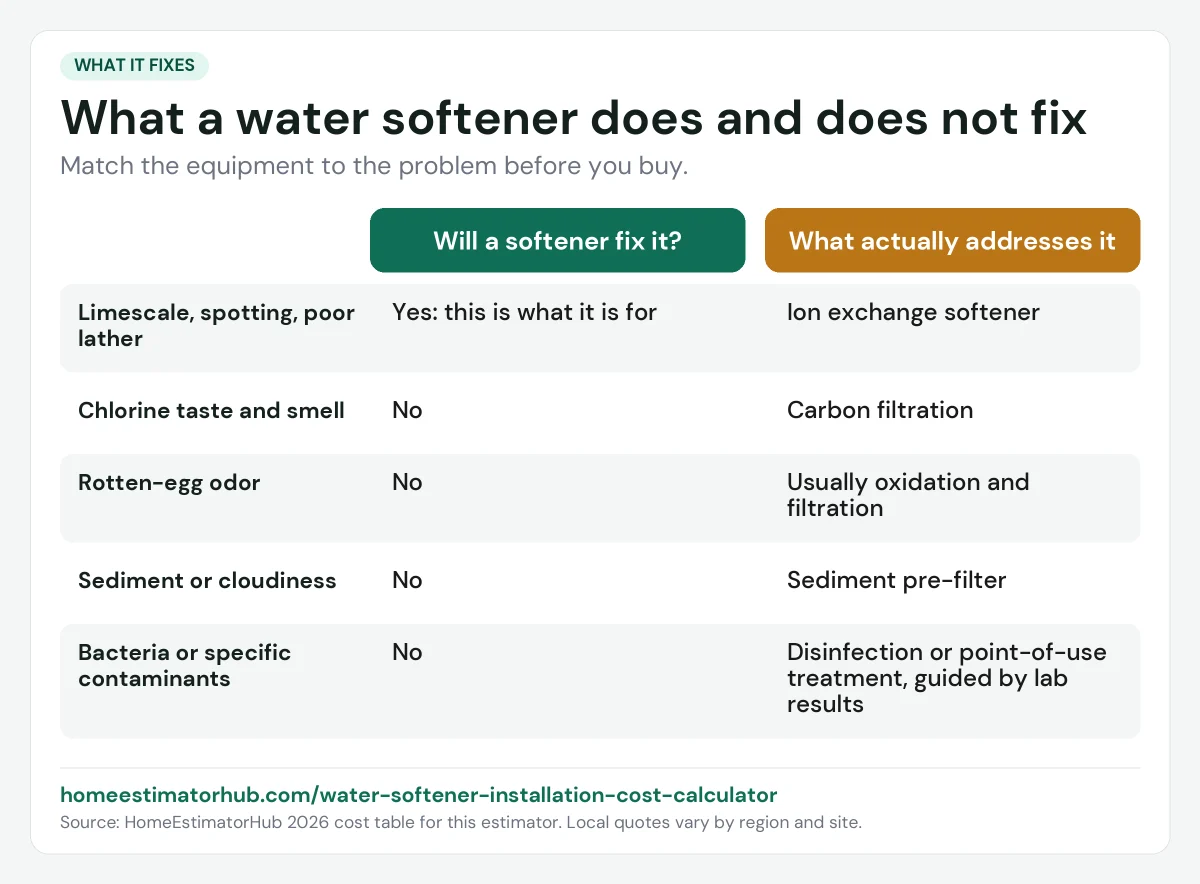
This is the most common misunderstanding in the category, and it leads to expensive disappointment. An ion exchange softener trades hardness minerals for sodium. It is a hardness treatment, not a purifier.
| Complaint | Will a softener fix it? | What actually addresses it |
|---|---|---|
| Limescale, spotting, soap that will not lather | Yes — this is what it is for | Ion exchange softener |
| Chlorine taste and smell | No | Carbon filtration |
| Rotten-egg odor | No | Usually oxidation and filtration |
| Sediment or cloudiness | No | Sediment pre-filter |
| Bacteria or specific contaminants | No | Disinfection or point-of-use treatment, guided by lab results |
Where sodium intake is a concern, potassium chloride can be used in place of salt — it works the same way and costs more per bag. Many households also keep an unsoftened line to a kitchen tap for drinking and cooking, which is a decision to make at installation because it affects the plumbing layout.
The installation details that decide the price
Equipment runs roughly $1,200 to $3,800 installed for a salt-based system and $1,500 to $4,500 for salt-free, with the labor portion commonly $300 to $1,000 on its own. What moves that labor figure is almost entirely about the location:
- A drain within reach. A salt-based unit discharges brine when it regenerates, so it needs a drain connection with a proper air gap. No nearby drain means a condensate pump or new plumbing.
- An outlet. The control valve needs power, and adding a circuit to a crawl space or garage corner is its own small job.
- Where it sits in the line. The softener goes after the main shut-off and before the water heater, and outdoor irrigation is normally taken off ahead of it — there is no reason to soften water for the lawn.
- A bypass valve. Standard on a competent install, and what lets you take the unit out of service without losing water to the house.
One regional check worth making early: some jurisdictions restrict or prohibit brine discharge from self-regenerating softeners because of what it does to wastewater treatment and septic systems. Confirm local rules before buying, since it can push the decision toward a salt-free or off-site-regenerated system.
Finally, if the water heater has been running on hard water for years, it is likely carrying scale. Replacing it at the same time is a sensible pairing while a plumber is already engaged — our water heater installation cost calculator covers it.
Frequently asked questions
How much does a whole house water softener cost?
$1,000 to $7,000 or more installed, depending on system type, household size, and water hardness. Salt-based systems average around $1,500; salt-free and dual-tank systems typically cost more.
Do salt-free water softeners actually work?
They work differently than salt-based systems. Salt-free conditioners use Template-Assisted Crystallization to prevent scale buildup, but they don't remove calcium and magnesium from the water like a true salt-based softener does.
What size water softener do I need?
Grain capacity depends on household size and water hardness. A family of 3-5 with moderate hardness typically needs a 32,000 to 48,000 grain system; larger households or harder water need 48,000 to 64,000+ grains.
How much does it cost to run a water softener?
Salt-based systems typically cost $40 to $120 a year in salt, plus minimal electricity ($10-20/year) and a modest water bill increase ($20-50/year) from regeneration cycles.
Sources & standards
Primary references behind the standards, code requirements and safety guidance cited on this page. Cost ranges shown here are HomeEstimatorHub estimates, not contractor quotes — see how these are calculated, and always confirm against written bids and your local building department.
More free estimators
Explore more home cost estimators
Free cost estimators for every home improvement project — updated for 2026, no signup required.
Disclaimer: All water softener cost estimates are for informational purposes only based on average 2026 US contractor rates. Actual costs vary based on your specific water quality, plumbing configuration, and local labor rates. Always test your water hardness before purchasing a system and obtain multiple quotes from licensed contractors.