
Home systems & exterior estimator · Updated September 2026
Stucco Repair Cost Calculator
Stucco repair costs $8 to $50 per square foot, with a national average around $1,628. The range is unusually wide for a reason — cost depends heavily on what's found once repair begins, not just square footage. Use our free calculator to get an instant estimate by repair type, stucco material and size.
Enter your stucco repair details
Estimated stucco repair cost
Typical range for your configuration
Cost breakdown
What affects stucco repair cost?
- Repair type — The biggest driver. A cosmetic crack fill costs a fraction of a full section replacement.
- Stucco type — Synthetic (EIFS) material and matching costs significantly more than traditional cement stucco.
- Hidden moisture damage — Wet sheathing or framing behind the surface can multiply the cost once discovered.
- Access — Second-story or roofline repairs need scaffolding or a lift.
- Texture matching — Blending a repair invisibly into existing stucco takes real skill and time.
- State — West Coast labor rates run 20-30% above the national average.

How much does stucco repair cost in 2026?
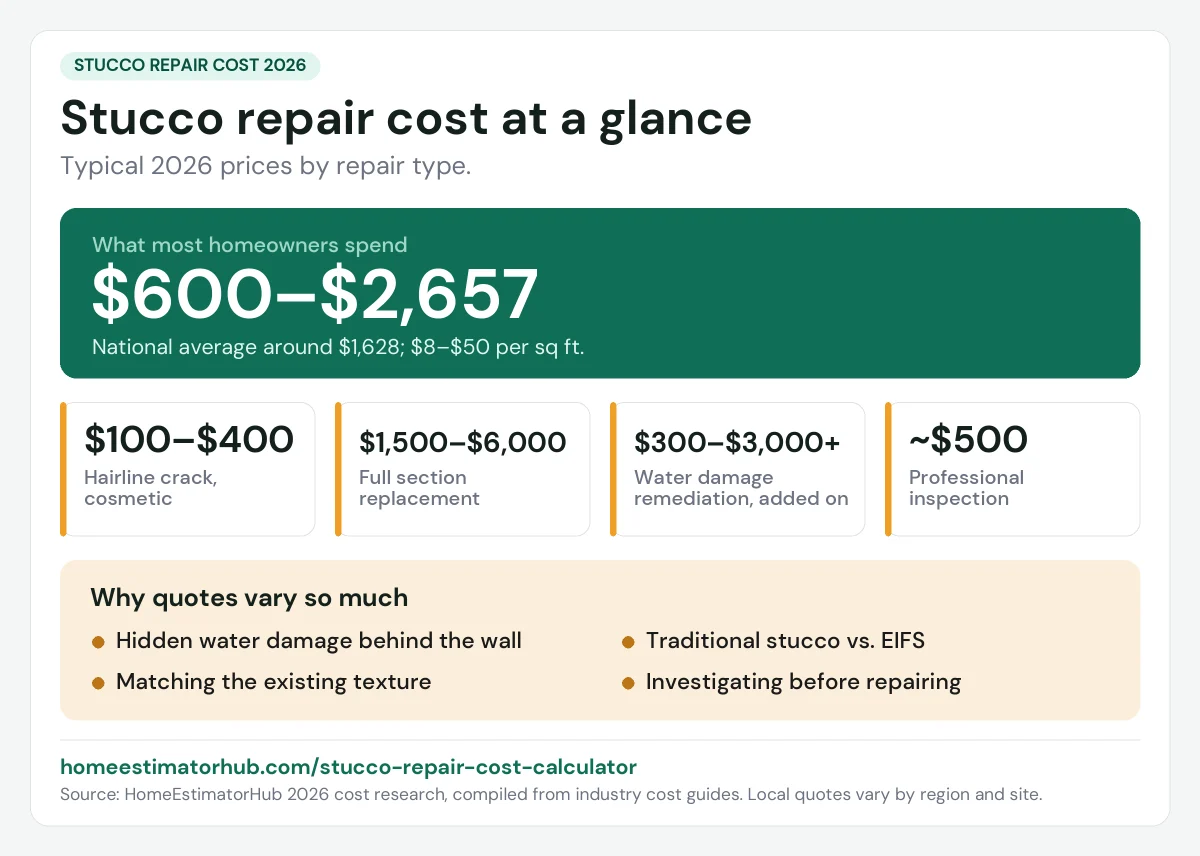
Stucco repair costs $8 to $50 per square foot, with most homeowners spending $600 to $2,657, and a national average around $1,628. That's an unusually wide range compared to most home repairs, and it's not random — stucco pricing depends heavily on what a contractor finds once the damaged surface is opened up, not just how much area is visibly cracked. Minor cosmetic repairs can run as little as $100-$400, while a full section replacement with hidden water damage can reach $6,000 or more. Use our free calculator above for an instant estimate based on your specific repair type.
Stucco repair cost calculator — by repair type
| Repair type | Typical cost |
|---|---|
| Hairline crack (cosmetic) | $100–$400 |
| Structural crack / small patch | $200–$800 |
| Full section replacement | $1,500–$6,000 |
| Water damage remediation (add-on) | $300–$3,000+ |
| Professional inspection | ~$500 |
Traditional vs. synthetic (EIFS) stucco: why repair cost differs so much
Traditional stucco is a three-coat cement, sand, and lime system that's porous — it absorbs and releases moisture rather than trapping it, which is part of why it's been used successfully since the early 1900s. Synthetic stucco (EIFS, or Exterior Insulation and Finish System) bonds rigid foam insulation to the wall under an acrylic finish coat. It offers better insulation, but it doesn't breathe — when EIFS fails or cracks, trapped moisture behind it can cause faster and more extensive damage than traditional stucco ever would.
The material cost gap is dramatic: synthetic stucco material runs roughly 4 to 5 times more per square foot than traditional. Matching an existing EIFS system often means sourcing the original manufacturer's proprietary materials to avoid visible seams, which alone can add $5 to $20 per square foot to a repair. You can generally tell which type you have with a simple test: traditional stucco sounds solid when tapped, like brick, while synthetic stucco sounds noticeably hollow.
Why stucco repair quotes vary so widely
A crack in stucco is often just the visible symptom — the real question is what's happening behind it. As one veteran mason explained to This Old House, the most important diagnostic tool for assessing stucco damage is a contractor's ears: a hollow sound when tapping the surface (sometimes called the "tappy tap" test) indicates the stucco has separated from its backing, which requires far more extensive repair than a surface patch. Before authorizing any stucco repair, it's worth asking your contractor to check for moisture behind the wall at window and door penetrations — a $300 patch over an active leak often means redoing the entire repair within 2-3 years once the underlying moisture problem resurfaces.
Warning signs you shouldn't ignore
- Cracks that keep returning after a previous repair — usually means the underlying cause was never addressed.
- A hollow sound when tapped — indicates the stucco has delaminated from its backing.
- Discoloration or staining — often a visible sign of moisture working its way through from behind.
- Bulging or soft spots — can indicate significant water damage to the wall assembly underneath.
- Stucco falling off in chunks — a sign of serious bonding failure requiring professional assessment right away.
If you're seeing any of these beyond a simple hairline crack, our water damage restoration cost calculator can help you scope the underlying moisture issue separately from the stucco repair itself.
Stucco is a water management system, not a coating
Stucco is porous by design. It absorbs some water in a storm and releases it afterward, and the assembly behind it — the weather-resistive barrier, the flashing, the drainage plane — is what keeps that moisture out of the framing. When stucco fails, the finish is usually the symptom rather than the cause.
That distinction is the whole reason stucco quotes vary so much. Patching a crack treats the surface. If water has been getting behind the wall for years, the sheathing and framing underneath may already be compromised, and no amount of surface work addresses that.
The places water typically gets in are predictable, and they are where an inspection should concentrate:
- Window and door perimeters — the single most common entry point, usually a flashing or sealant failure rather than a stucco failure.
- Roof-to-wall junctions, where a roof plane meets a stucco wall and kick-out flashing is missing or was never installed.
- Penetrations — hose bibs, light fixtures, vents, anywhere something passes through the wall.
- The base of the wall, where a missing weep screed or soil piled against the stucco lets moisture wick upward.
Investigate before you repair
On any wall showing staining, soft spots or repeated cracking in the same place, moisture testing before repair is money well spent. A probe survey takes readings through small holes at suspect locations and maps where moisture is actually sitting, which turns an unknown into a defined scope.
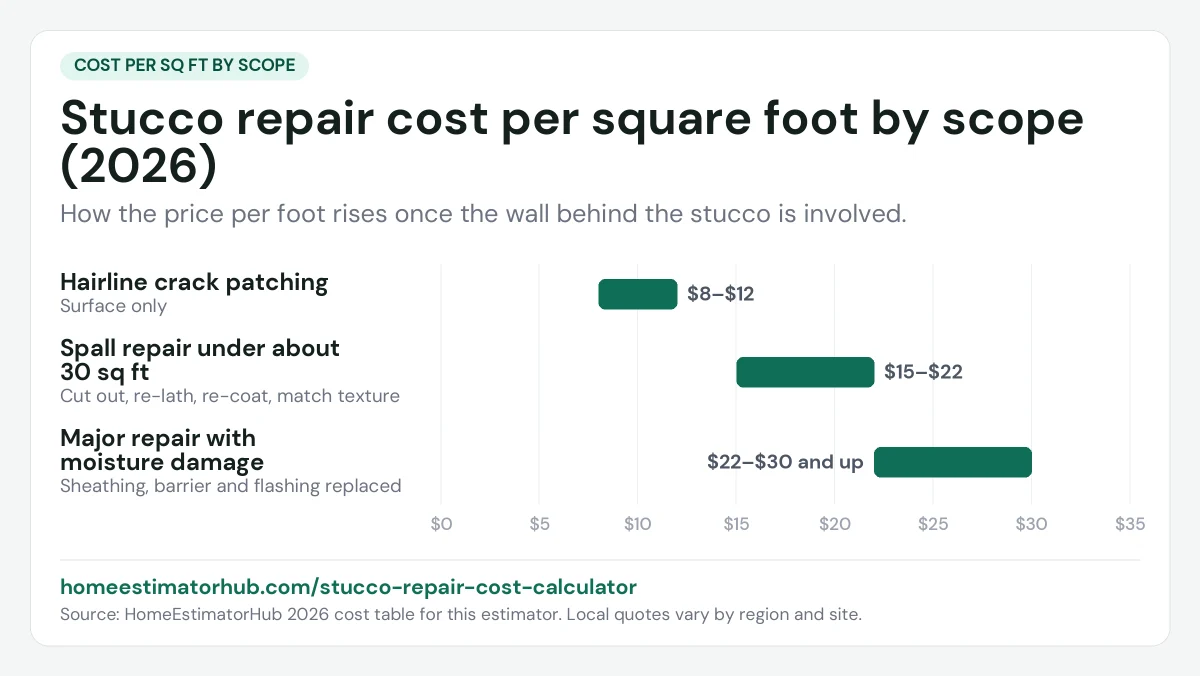
The value is in what it prevents. Repair pricing spans roughly $8 to $30 per square foot, and the spread within that range tracks exactly this question:
| Scope | Typical range | What is involved |
|---|---|---|
| Hairline crack patching | About $8–$12 per sq ft | Surface only; no substrate work |
| Spall repair under about 30 sq ft | About $15–$22 per sq ft | Cut out, re-lath, re-coat, texture match |
| Major repair with moisture damage | About $22–$30 per sq ft and up | Sheathing replacement, new barrier and flashing, second-story access |
Labor typically runs $40 to $75 per hour. If testing reveals damage across a whole elevation, the conversation shifts from repair to remediation — stripping back to the sheathing, correcting the drainage details and re-cladding. That costs more up front and is the only version that stops the cycle. Where growth has taken hold in wet framing, our mold remediation cost calculator covers that component.
Matching the existing wall is the hard part
The technical repair is usually straightforward. Making it disappear is not, and it is where homeowners are most often disappointed by otherwise competent work.
- Texture. Dash, sand, lace, skip trowel and smooth finishes are applied by hand, and matching an existing one is a craft skill. Ask to see a sample panel before the crew works on a visible elevation.
- Color. Existing stucco has weathered. New material mixed to the original color will not match the wall as it looks today, which is why a patch can be technically perfect and still obvious.
- The usual remedy is to repair, then repaint or re-coat the entire elevation to a natural break such as a corner. That is an added cost worth building into the budget from the start rather than discovering afterward.
One thing to avoid entirely: high-pressure washing stucco. It drives water into the wall and can erode the finish. Cleaning is a low-pressure job, as our pressure washing cost calculator explains. If an elevation turns out to need full replacement, our vinyl siding cost estimator is a useful comparison point for what re-cladding in another material would cost.
Frequently asked questions
How do I estimate stucco repair cost?
Identify your repair type — hairline crack, structural patch, or full section replacement — and whether you have traditional or synthetic (EIFS) stucco. Our calculator combines these automatically. As a rule of thumb, budget $100-$400 for minor cosmetic cracks and $1,500+ for section replacement.
Why is stucco repair so expensive per square foot?
Stucco is priced per square foot of damaged area rather than total wall area, and small repair jobs carry the same setup, matching, and minimum-charge costs as larger ones — which is why per-square-foot rates for small patches can look high even though the total dollar amount is modest.
How can I tell if I have traditional or synthetic stucco?
Tap the surface. Traditional cement stucco sounds solid, like brick. Synthetic stucco (EIFS) sounds noticeably hollow because of the foam insulation board underneath it.
Is it cheaper to repair or fully replace stucco?
Repair is almost always cheaper for isolated damage. Full replacement — re-stuccoing an entire home — costs $7 to $17 per square foot and only makes sense when damage is widespread or when a contractor's inspection reveals extensive hidden moisture damage throughout the wall system.
Sources & standards
Primary references behind the standards, code requirements and safety guidance cited on this page. Cost ranges shown here are HomeEstimatorHub estimates, not contractor quotes — see how these are calculated, and always confirm against written bids and your local building department.
More free estimators
Explore more home cost estimators
Free cost estimators for every home improvement project — updated for 2026, no signup required.
Disclaimer: All stucco repair cost estimates are for informational purposes only based on average 2026 US contractor rates. Actual costs vary significantly based on hidden moisture damage, substrate condition, access and contractor availability — often only discovered once repair begins. Always obtain multiple quotes, and ask each contractor to check for moisture behind the wall before finalizing a cosmetic-only repair scope.