
Foundation & moisture estimator · Updated September 2026
French Drain Installation Cost Calculator
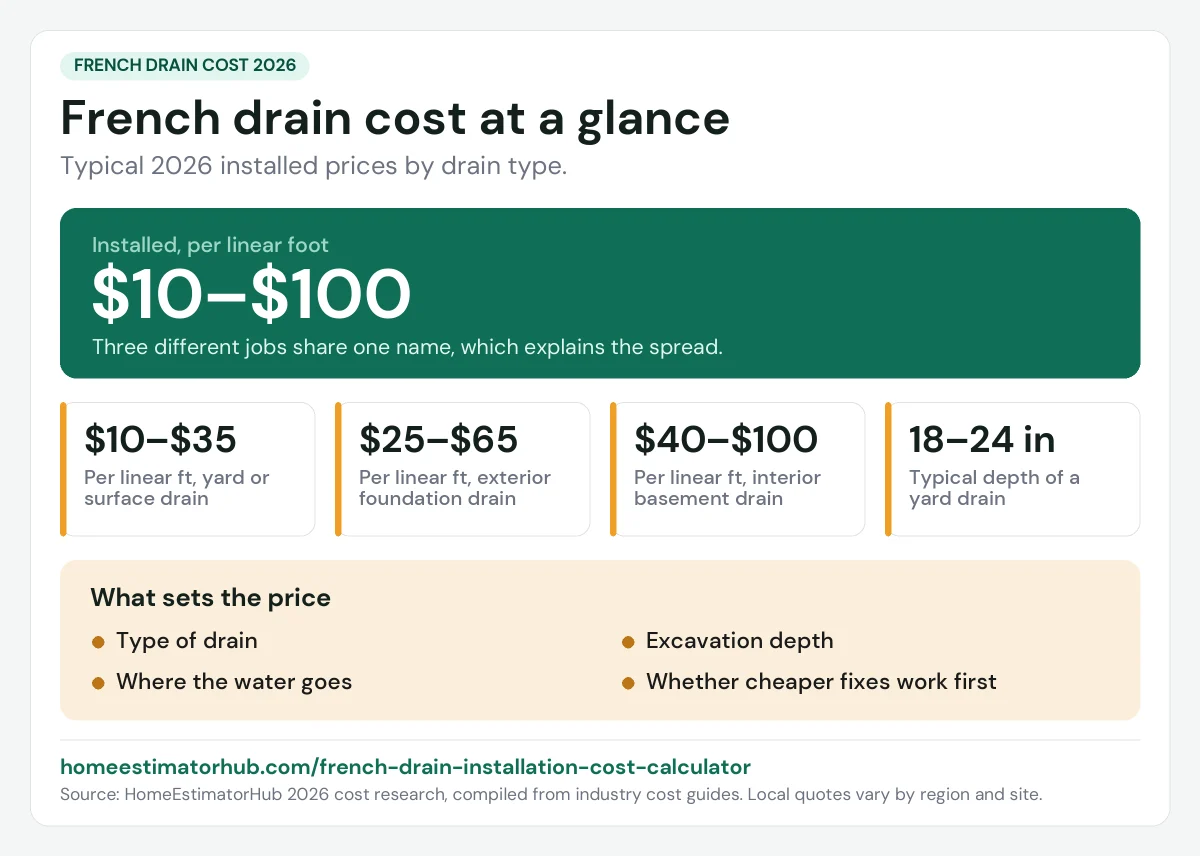
French drain installation costs $10 to $100 per linear foot, with a national average project around $9,250 — but that range is unusually wide because it covers three very different jobs. Use our free calculator to get an instant estimate by drain type, linear footage, and outlet option.
Enter your French drain details
Enter your drain's linear footage
Enter the length needed to calculate your instant cost estimate.
- A typical 50 ft yard drain costs $500–$1,750
- Interior basement drains cost more due to concrete cutting
- Quotes for "the same job" can range from $1,800 to $9,000 — type, depth, and outlet explain why
- A well-built French drain can last 20-30 years or longer
What affects French drain cost?
- Drain type — Interior basement drains cost far more than yard drains due to concrete cutting and sump pump integration.
- Depth — Foundation-level drains require deeper excavation than shallow surface drains.
- Where the water goes — Daylighting to open yard is cheapest; a dry well or sump pump connection adds cost.
- Site access — Rocky soil, tree roots, or tight access between structures increase labor time.
- Length — Longer runs have a lower per-foot rate due to shared setup and mobilization cost.
- State — Labor costs in California and the Northeast run 20-30% above the national average.

How much does a French drain cost in 2026?
French drain installation costs $10 to $100 per linear foot, with a national average project around $9,250. That's an unusually wide range even by home-improvement standards, and it's not random — it's genuinely three different jobs sharing one name. Two quotes for "a French drain" can land at $1,800 and $9,000 for reasons that are perfectly legitimate once you know what to ask: the type of drain, the excavation depth, and what happens to the water once it's collected. Use our calculator above to get an estimate specific to your actual project rather than the headline range.
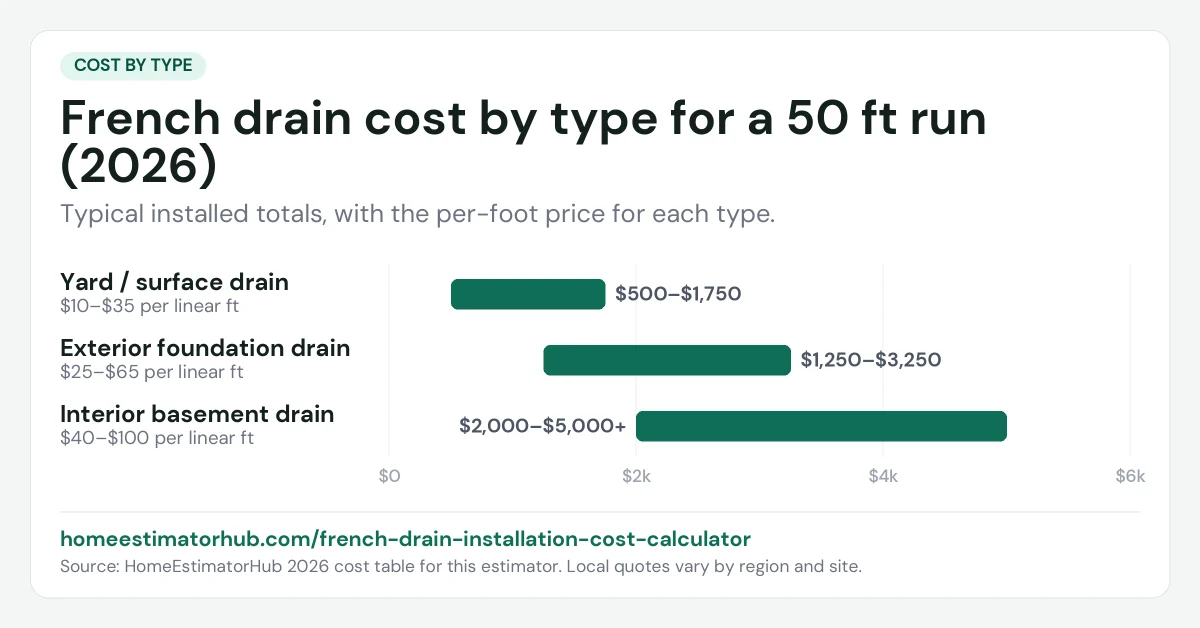
French drain cost by type
| Type | Cost per linear ft | Typical 50 ft total |
|---|---|---|
| Yard / surface drain | $10–$35 | $500–$1,750 |
| Exterior foundation drain | $25–$65 | $1,250–$3,250 |
| Interior basement drain | $40–$100 | $2,000–$5,000, often more with sump pump |
A yard drain is a shallow trench that intercepts surface water before it pools. An exterior foundation (curtain) drain runs deeper, along or near the foundation, to intercept groundwater before it reaches the wall. An interior basement drain is a different project entirely — it's installed under an existing concrete floor around the basement's perimeter, requires cutting and removing concrete, and almost always connects to a sump pump to actually move the water back out. That last category is why the same phrase "French drain" can mean a $1,000 weekend fix or a $10,000+ basement waterproofing project.
Is DIY worth it?
Sometimes, but the numbers are closer than they look. Materials alone run $5 to $12 per linear foot, and renting a trencher can make a short, shallow yard run genuinely affordable to DIY. But one detailed cost breakdown found a real DIY project came out to $21.12 per linear foot once tool rental and materials were totaled — within the range professional installers charge for the same simple job, and without the benefit of a warranty or guaranteed correct slope. A French drain that's installed with the wrong pitch, clogged fabric, or a poorly routed outlet doesn't just fail to help — it can direct water toward your foundation instead of away from it, turning a DIY savings into a foundation repair bill. Short, shallow, open-yard runs are reasonable DIY candidates. Anything foundation-adjacent, deep, or connected to a basement is worth hiring out.
What actually makes a French drain last 20-30 years
The concept itself is over 150 years old and still works better than most modern alternatives when it's built correctly. The materials that matter most: washed gravel (not crushed stone with fines that will clog), proper filter fabric wrapped around the gravel to keep soil out of the pipe, correct slope along the entire run (even a small flat or reverse-sloped section defeats the whole system), and a reliable outlet that doesn't itself become blocked or overwhelmed. Skimping on any one of these is the most common reason a French drain fails years before it should.
Where does the water actually go?
This is one of the three variables that drives cost the most, and it's worth deciding early. Daylighting — simply routing the pipe to an open, lower point in the yard — is the cheapest option when the terrain allows it. A dry well is a gravel-filled pit that lets water absorb into the surrounding soil gradually, useful when there's no natural low point to drain to. A sump pump connection is standard for interior basement drains, since water collected below grade generally can't flow uphill and out on its own. Each option adds real cost, but choosing the wrong one for your site can mean redoing the project entirely.
What does a French drain protect against?
A French drain is one piece of a broader basement or foundation moisture strategy, not always the whole solution on its own. If you're dealing with an already-wet basement, our basement waterproofing cost calculator covers interior and exterior systems more broadly. If the concern is a sloped yard eroding near a retaining wall, our retaining wall cost calculator covers drainage as part of that structure specifically.
Try the cheap fixes first
A French drain is a serious excavation project, and a meaningful share of the water problems it gets called in for are caused by something far simpler. Before committing to one, rule these out:
- Downspouts discharging at the wall. A roof delivers an enormous volume of water to a handful of points. Extending downspouts well away from the foundation is the cheapest fix in drainage and solves a surprising number of wet basements.
- Grading that falls toward the house. Soil settles against foundations over the years until the ground slopes inward. Re-grading to fall away from the wall is inexpensive relative to excavation.
- Blocked or undersized gutters. Water sheeting over the front edge of a gutter lands in exactly the wrong place — our gutter installation cost calculator covers sizing and capacity.
- Beds and hardscape holding water against the wall, or a patio pitched the wrong way.
If water still arrives after all of that is corrected, the problem is genuinely subsurface and a drain is the right tool.
Depth is what separates the price brackets
The reason quotes for “a French drain” range from modest to alarming is that the term covers three quite different excavations:
| Type | Typical depth | Typical cost per linear foot |
|---|---|---|
| Yard drainage | About 18–24 inches | About $10–$35 |
| Exterior foundation drain | At or below footing level — often 4–6 feet | About $25–$65 |
| Interior perimeter drain | Inside the footing, under the slab edge | About $40–$100 |
Whole projects commonly run $1,650 to $12,250 depending on length, depth, soil and access.
The exterior foundation drain is the more thorough solution because it intercepts water before it reaches the wall, but it means excavating to footing depth around the house — which takes out planting, walkways and anything else in the way. The interior version accepts that water will reach the wall and manages it once it is inside, which requires cutting the slab and almost always a sump. Neither is universally correct; the choice depends on access, what is above the excavation, and where the water is entering.
Interior systems need somewhere to send what they collect, so a sump pump adds roughly $625 to $2,625 to the project. That pump is then a permanent piece of equipment with a service life, a power requirement, and a strong argument for a battery backup — because the storms that cause flooding are the same ones that cause outages.
How to tell an existing drain has failed
Drains do not last forever, and a failing one looks very much like having no drain at all:
- Water returning after years of dryness — usually silt accumulation or root intrusion in the pipe.
- The discharge point stops flowing during heavy rain when it used to run freely.
- Soggy ground directly over the drain line, which suggests the pipe is full and backing up.
- A sump running constantly, or conversely never running during storms that clearly produced water.
Two design details determine whether a drain reaches twenty years or ten: the surrounding stone must be washed, with the fines screened out, because fine material is what eventually clogs the voids; and the system should include cleanouts so the line can be inspected with a camera and jetted clear without digging it up. Cleanouts add very little at installation and are the difference between maintaining a drain and replacing one.
If water is already entering a finished basement, drainage is one part of a larger scope — our basement waterproofing cost calculator covers the rest, and where movement has followed the moisture, our foundation repair cost calculator is the place to look.
Frequently asked questions
How much does a French drain cost per linear foot?
$10 to $100 per linear foot depending on type. Yard drains run $10-$35/ft, exterior foundation drains run $25-$65/ft, and interior basement drains run $40-$100/ft due to concrete cutting and sump pump integration.
Is a French drain the same as a curtain drain?
They're closely related. A curtain drain is essentially a deeper French drain, typically 2+ feet down, installed around a home's exterior to intercept groundwater specifically, rather than just surface water in an open yard.
Can I install a French drain myself?
For a short, shallow, open-yard run, yes — it's a reasonable DIY project. Deep, foundation-adjacent, or interior basement drains are much harder to get right, and installation mistakes like incorrect slope can make drainage problems worse rather than better.
How long does a French drain last?
20 to 30 years or longer when built with washed gravel, proper filter fabric, correct slope, and a reliable outlet. Skimping on any of these materials is the most common reason a French drain fails prematurely.
Sources & standards
Primary references behind the standards, code requirements and safety guidance cited on this page. Cost ranges shown here are HomeEstimatorHub estimates, not contractor quotes — see how these are calculated, and always confirm against written bids and your local building department.
More free estimators
Explore more home cost estimators
Free cost estimators for every home improvement project — updated for 2026, no signup required.
Disclaimer: All French drain cost estimates are for informational purposes only based on average 2026 US contractor rates. Actual costs vary significantly based on soil conditions, depth, site access, and local labor rates. Always obtain multiple quotes from licensed drainage contractors before proceeding with any project.