
Home systems & exterior estimator · Updated September 2026
Gutter Installation Cost Calculator
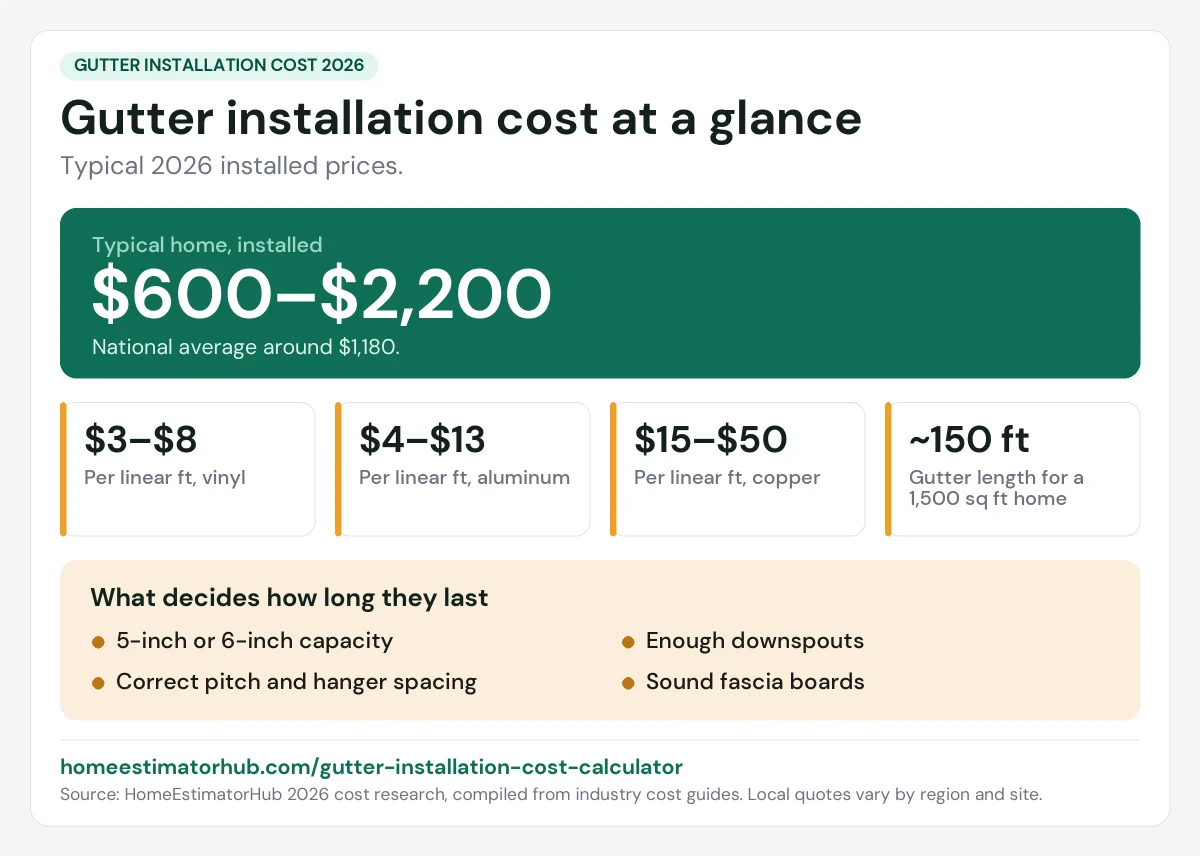
Gutter installation costs $600 to $2,200 for a typical home, or $3 to $50 per linear foot depending on material. Use our free calculator to get an instant estimate by material, style, linear footage and number of stories.
Enter your gutter details
Enter your gutter's linear footage
Enter the total linear feet of gutters needed to calculate your instant estimate.
- Most homes need 150–250 linear feet of gutters
- Aluminum is the most popular material — best value for most budgets
- Seamless installation reduces leaks and is now standard for most professional jobs
- 2-story homes typically add 15-35% to labor cost
What affects gutter installation cost?
- Material — Vinyl is cheapest; copper and zinc cost 3-5x more but can outlast the house.
- Linear footage — The biggest cost driver, directly tied to your home's roofline length.
- Number of stories — Each story above the first adds ladder time and safety equipment cost.
- Seamless vs. sectional — Seamless costs more but significantly reduces leak-prone joints.
- Roofline complexity — Multiple corners, valleys and gables add material and labor time.
- State — Labor costs in California and the Northeast run 20-30% higher than Midwest states.

How much does gutter installation cost in 2026?
Gutter installation costs $600 to $2,200 for a typical home, with a national average around $1,180. On a per-foot basis, expect $3 to $50 per linear foot depending heavily on material — vinyl and aluminum sit at the affordable end, while zinc and copper are premium options. Use our free calculator above for an instant estimate based on your home's linear footage, material and number of stories.
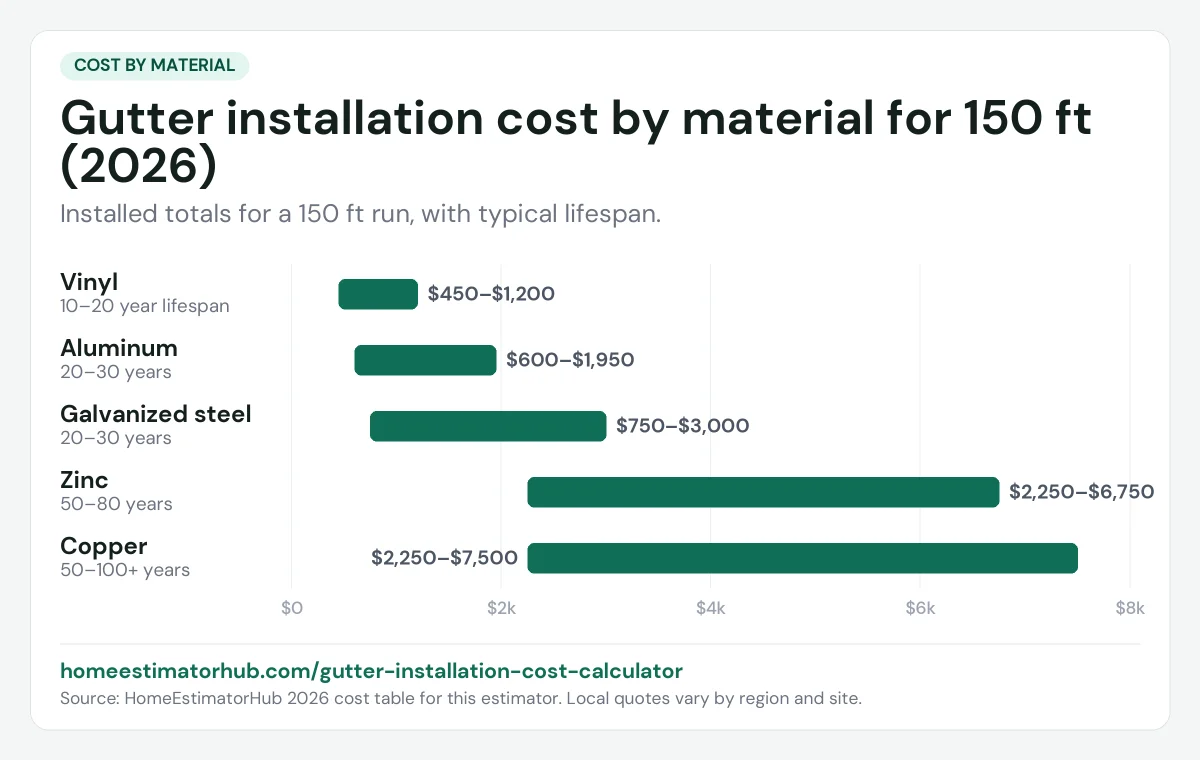
Gutter installation cost calculator — by material
| Material | Cost per linear ft | 150 ft installation | Lifespan |
|---|---|---|---|
| Vinyl | $3–$8 | $450–$1,200 | 10–20 years |
| Aluminum | $4–$13 | $600–$1,950 | 20–30 years |
| Galvanized steel | $5–$20 | $750–$3,000 | 20–30 years |
| Zinc | $15–$45 | $2,250–$6,750 | 50–80 years |
| Copper | $15–$50 | $2,250–$7,500 | 50–100+ years |
K-style vs. half-round gutters
K-style gutters — flat-backed with a decorative front profile resembling crown molding — are the standard choice for most homes. They hold more water per linear foot than half-round gutters and are generally easier and cheaper to install. Half-round gutters have a rounded, historic aesthetic often chosen for older or higher-end homes, but typically add $1 to $2 per linear foot due to more specialized installation requirements.
Seamless vs. sectional gutters
This is the biggest installation-method decision, and it affects both cost and long-term performance.
| Factor | Sectional | Seamless |
|---|---|---|
| Cost | 20–30% less | Standard for most pros today |
| Leak risk | Higher — joints degrade over time | Lower — no joints along straight runs |
| DIY feasibility | Feasible for single-story homes | Requires professional roll-forming equipment |
| Maintenance | More frequent resealing needed | Minimal beyond regular cleaning |
Nearly all professional gutter installers use seamless systems today because the leak-reduction benefit is well established — on a typical 150-foot job, the seamless premium is often only $150–$400 total, which is why our calculator uses seamless as the default assumption for its per-foot rates.
How many linear feet of gutter do I need?
Linear footage roughly follows your home's footprint perimeter, not its total square footage (a 2-story home has less roofline per square foot than a 1-story home of the same size). As a rough starting point:
| Home size | Approximate linear feet |
|---|---|
| 1,500 sq ft | ~150 ft |
| 2,000 sq ft | ~180 ft |
| 2,500 sq ft | ~210 ft |
| 3,000+ sq ft | 250+ ft |
These are estimates — an irregular roofline with multiple gables or dormers can need more footage than a simple rectangular footprint of the same square footage.
Does homeowners insurance cover gutter replacement?
Generally, only if the damage results from a sudden, covered peril — a storm, falling tree branch, or similar event. Normal wear and tear, age-related deterioration, or gutters that simply weren't maintained aren't covered under a standard policy. If a storm damaged your gutters, document it with photos immediately and contact your insurer before starting repairs.
Five inch or six inch is not a cosmetic choice
Most quotes default to 5-inch because it is what most homes have. Whether that is right for your roof is a capacity question, and getting it wrong is the most expensive mistake available on a gutter job.
A 5-inch gutter holds roughly 1.2 gallons of water per foot. A 6-inch holds around 2.0 — close to 67 percent more — and pairs with larger 3×4 inch downspouts rather than 2×3 inch.
| 5-inch | 6-inch | |
|---|---|---|
| Capacity per foot | About 1.2 gallons | About 2.0 gallons |
| Typical downspout | 2×3 inch | 3×4 inch |
| Suits fascia | 1×6 inch | 1×8 or 1×10 inch |
| Best for | Moderate rainfall, smaller roof areas | Heavy rainfall, steep or large roof planes, heavy tree load |
Two things push you toward 6-inch regardless of what is already up there: a large or steep roof plane concentrating water into one run, and a climate with intense short downpours rather than steady drizzle. Roof area feeding the run matters more than the length of the run itself.
Downspouts do half the work
A gutter that cannot drain is just a trough. The general guidance is one downspout for roughly every 40 feet of run, plus additional outlets wherever the gutter changes direction at a corner.
Undersized or too-few downspouts produce the same symptoms as an undersized gutter — water sheeting over the front edge in heavy rain — which is why replacing gutters without adding outlets sometimes fails to fix the original complaint.
Where the water goes after the downspout matters just as much. Discharging at the base of the wall puts it straight back against the foundation, which is the problem gutters exist to prevent.
Pitch and hanger spacing: the install details that decide lifespan
- Pitch. Generally around 1/16 to 1/8 inch of fall per foot toward the outlet. Too little and water stands in the trough; too much and it is visible from the ground.
- Hanger spacing. Commonly every 24 to 36 inches for aluminum K-style. Tighten toward 24 inches for 6-inch gutters, and in any climate where ice or wet debris loads the trough.
- Fascia condition. Hangers are only as good as the timber they screw into. Rotten fascia has to be replaced first, and a quote that ignores visibly soft fascia is a quote that will fail.
What undersized gutters actually cost
The saving from choosing 5-inch on a house that needed 6-inch is typically erased by the first fascia repair, which commonly runs into four figures. Before that bill arrives you will usually see the warning signs: water spilling over the front edge during heavy rain, staining down the siding, washed-out planting beneath the run, and splashback eroding soil at the foundation.
That last one is the expensive path. Water repeatedly delivered to the base of the wall is how gutter problems turn into basement problems — our basement waterproofing calculator prices that side of it, and the gutter guards guide covers whether protection is worth adding while the crew is already there.
Frequently asked questions
How do I estimate gutter installation cost?
Measure or estimate your home's linear footage of roofline, choose a material, and factor in your number of stories and gutter style. Our calculator combines all of these automatically — as a rule of thumb, budget $4 to $13 per linear foot for standard aluminum gutters.
What is the average cost of gutter installation?
The national average is around $1,180, with most homeowners paying between $600 and $2,200 for a complete installation using standard aluminum gutters.
Are seamless gutters worth the extra cost?
For most homes, yes. Seamless gutters cost 20-30% more than sectional but significantly reduce the leak-prone joints that develop over time, and the premium on a typical job is often just a few hundred dollars.
How long do gutters last?
Vinyl gutters last 10-20 years, aluminum 20-30 years, galvanized steel 20-30 years, and zinc or copper 50-100+ years with proper maintenance. Regular cleaning significantly extends any material's lifespan.
Sources & standards
Primary references behind the standards, code requirements and safety guidance cited on this page. Cost ranges shown here are HomeEstimatorHub estimates, not contractor quotes — see how these are calculated, and always confirm against written bids and your local building department.
More free estimators
Explore more home cost estimators
Free cost estimators for every home improvement project — updated for 2026, no signup required.
Disclaimer: All gutter installation cost estimates are for informational purposes only based on average 2026 US contractor rates. Actual costs vary based on roofline complexity, fascia condition, accessibility and contractor availability. Always obtain multiple quotes from licensed gutter installers before proceeding with any project.