
Outdoor & landscaping estimator · Updated September 2026
Retaining Wall Cost Calculator
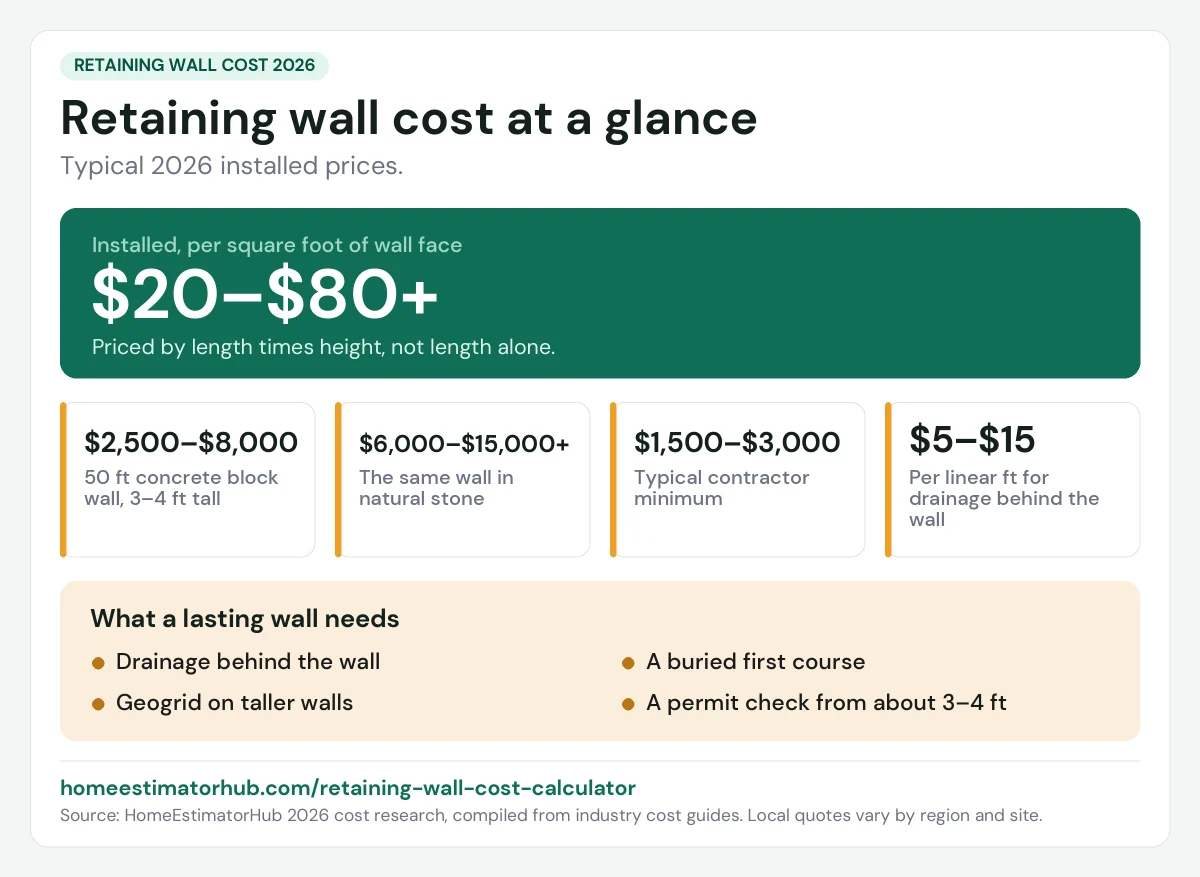
Retaining walls cost $20 to $80+ per square foot of wall face installed, depending heavily on material and height. Use our free calculator to get an instant estimate by material, wall length and height — including whether your wall likely needs a permit.
Enter your retaining wall details
Enter your wall's length and height
Enter both dimensions to calculate your instant cost estimate.
- Cost is priced per square foot of wall face — length × height
- Most jurisdictions require a permit for walls over 3-4 feet
- Walls over 4 feet typically need a structural engineer's stamp
- Proper drainage is the #1 factor in preventing wall failure
What affects retaining wall cost?
- Height — The single biggest factor. Lateral soil pressure increases with the square of height, not linearly.
- Material — Timber is cheapest but shortest-lived; natural stone and poured concrete cost more but last decades longer.
- Drainage — Walls without proper drainage fail 3-5x faster regardless of material.
- Permits & engineering — Required above ~4 ft in most areas, adding real but essential cost.
- Wall shape — Curved walls cost 20-40% more due to specialized cutting and labor.
- State — California and coastal states run 15-25% above average; the Midwest runs 10-15% below.

How much does a retaining wall cost in 2026?
Retaining walls cost $20 to $80+ per square foot of wall face installed, priced by length × height, not linear footage alone. A typical 50-foot-long, 3-4 foot tall concrete block wall runs $2,500 to $8,000, while the same size in natural stone can run $6,000 to $15,000 or more. Most contractors have a $1,500-$3,000 minimum project charge. Use our free calculator above for an instant estimate based on your specific wall dimensions and material.
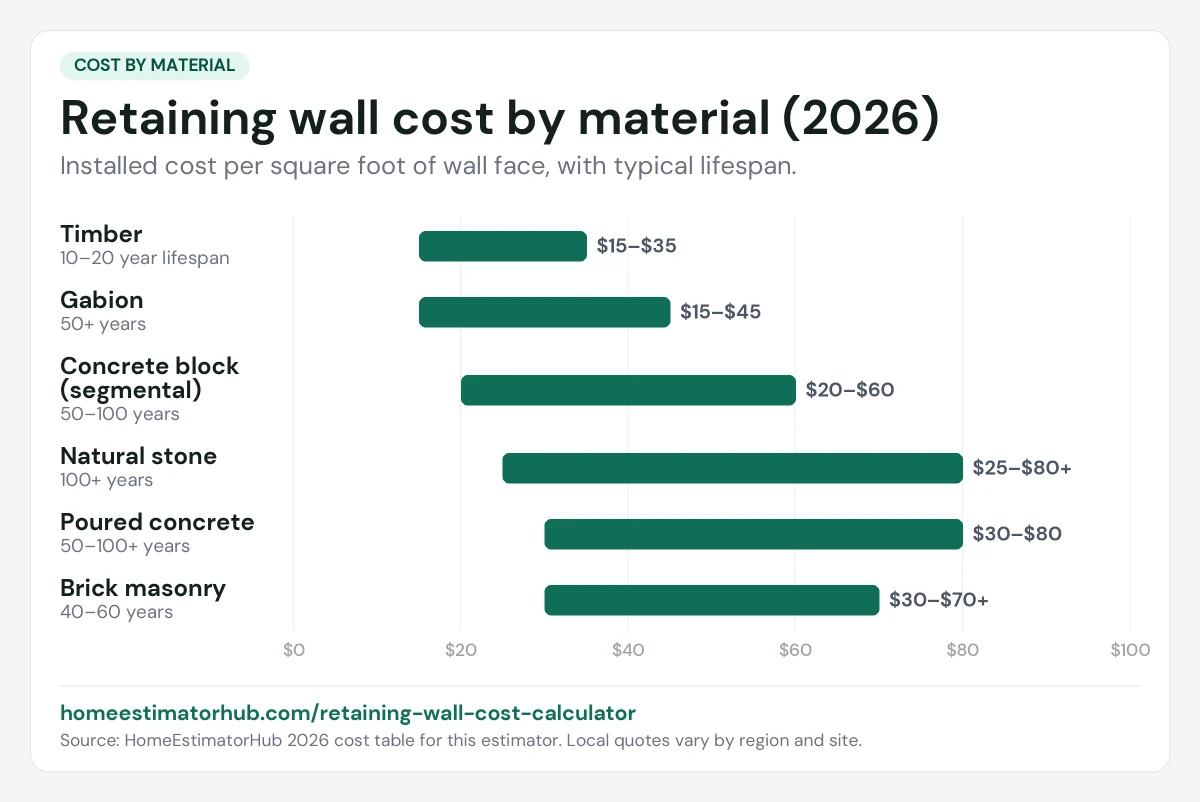
Retaining wall cost calculator — by material
| Material | Cost per sq ft | Lifespan |
|---|---|---|
| Timber | $15–$35 | 10–20 years |
| Gabion | $15–$45 | 50+ years |
| Concrete block (segmental) | $20–$60 | 50–100 years |
| Poured concrete | $30–$80 | 50–100+ years |
| Natural stone | $25–$80+ | 100+ years |
| Brick masonry | $30–$70+ | 40–60 years |
Segmental concrete block (brands like Allan Block, Versa-Lok, and Belgard) is the most common residential choice — it's engineered specifically for homeowner installation, requires no mortar, and is designed to lean back into the slope at the correct angle automatically as you stack it.
Why wall height matters more than you'd expect
Height isn't just a linear multiplier on cost — the physics behind it explains why. Lateral soil pressure against a retaining wall increases with the square of the wall's height, not proportionally. A wall twice as tall doesn't face twice the pressure — it faces roughly four times the pressure, which is why cost per square foot climbs sharply as height increases, not just the total area.
| Height | Typical project type | Permit likely? |
|---|---|---|
| Under 3 ft | DIY-friendly, simple footing | Usually not required |
| 3–4 ft | Standard residential wall | Often required |
| 4–6 ft | Requires engineering & geogrid reinforcement | Required in most areas |
| 6+ ft | Major structural project | Always required |
Do I need a permit for my retaining wall?
In most jurisdictions, yes — once your wall exceeds 3 to 4 feet in height, measured from the bottom of the footing to the top of the wall. Some areas set the threshold as low as 2 feet, or require a permit for any wall near a property line, slope, or drainage easement, regardless of height. Walls over 4 feet typically also require a structural engineer's stamped drawings, which run $500 to $3,500 depending on complexity. These requirements exist because retaining wall failures are genuinely dangerous — the added cost is what prevents a wall from collapsing under the soil and water pressure behind it. Always confirm requirements with your local building department before starting, since rules vary significantly by city and county.
Why drainage matters more than material choice
Hydrostatic pressure — water building up behind the wall with nowhere to go — is the leading cause of retaining wall failure, regardless of what material the wall is built from. Proper drainage means a layer of gravel backfill directly behind the wall, a drainage pipe (French drain) at the base, and weep holes in the wall face every 6 to 8 feet. Walls built without adequate drainage fail three to five times faster than properly drained walls of the same material. This is why drainage is checked by default in our calculator above — skipping it to save a few hundred dollars upfront is one of the most common and costly mistakes in retaining wall projects.
Is a retaining wall a DIY project?
For walls under 3 feet without a surcharge load (like a driveway or structure above them), yes — interlocking segmental concrete block systems are specifically engineered for homeowner installation and require no mortar. Timber is also DIY-friendly at this height. Once you cross into the 4-foot-plus range, or if the wall supports a driveway, patio, or structure, professional installation with proper engineering becomes essential — the consequences of an undersized or poorly built wall at that scale are a genuine safety issue, not just an aesthetic one.
What the wall is actually holding
A retaining wall is a structure resisting a load, and the load is larger than it looks. Soil behind a wall pushes outward with a force that increases with depth, and saturated soil pushes considerably harder than dry soil because water adds weight and pressure of its own.
What turns a routine wall into an engineered one is usually surcharge — any additional load sitting on the ground the wall retains:
- A driveway or parking area above the wall, where vehicle loads transfer into the soil mass.
- A building foundation, pool or other structure within the zone behind the wall.
- A second wall above it, since tiered walls can interact rather than acting independently.
- A slope continuing upward behind the wall instead of leveling off.
Any of those changes the calculation, which is why a contractor asking what sits above the wall is doing the job properly rather than padding the quote.
Most of a good wall is buried
Retaining walls are built from the bottom down as much as from the ground up, and the parts you cannot see are what keep them standing:
| Element | Purpose | Typical cost impact |
|---|---|---|
| Excavated, compacted base | Uniform bearing so the wall does not settle unevenly | Built into the per-foot rate |
| Buried first course | Resists the wall sliding forward at its base | Material you pay for and never see |
| Drainage — gravel backfill, perforated pipe, weep outlets | Stops water pressure building behind the wall | About $5–$15 per linear foot |
| Geogrid reinforcement | Ties the wall back into the soil mass on taller walls | About $3.50–$6 per sq ft |
Geogrid is the one that explains why a tall wall costs so much more than a short one. It is layered back into the hillside as the wall rises, which means excavating well beyond the wall line — so the job is far wider than the finished face suggests.
Overall pricing runs roughly $20 to $120 per square foot of wall face, commonly $35 to $65, and height drives it hard: a mid-range block wall runs around $25 per square foot at 2 feet, about $40 at 6 feet and about $55 at 10 feet. Note that the area itself grows with height as well, so the total climbs on both axes at once.
Two short walls often beat one tall one
Where the site allows it, terracing — two lower walls with a planted bench between them — can cost less than a single tall wall, because each wall may stay below the height that triggers engineering, geogrid and deeper excavation. Walls over about four feet typically require engineering and permits, commonly adding $2,000 to $5,000.
The important caveat: terracing only works if the walls are far enough apart to act independently. Stacked too closely, the upper wall becomes a surcharge on the lower one and both need designing as a system — which removes the saving entirely. That spacing judgment is exactly what an engineer is for, and on any wall retaining a structure, a driveway or a slope, it is not a decision to make from a rule of thumb.
Whatever the height, do not let drainage be the line that gets value-engineered out. Hydrostatic pressure behind a blocked wall is the most common reason retaining walls lean, bulge and fail — our french drain installation calculator covers the drainage side, and if a fence is going on top of the wall, our fence installation cost estimator should be read alongside, since post footings behind a wall are their own design question.
Frequently asked questions
How do I estimate retaining wall cost?
Measure your wall's length and height in feet, multiply them to get the wall face area in square feet, then multiply by your chosen material's cost per square foot. Our calculator does this automatically — as a rule of thumb, budget $20 to $60 per square foot for concrete block, the most common residential choice.
What is the cheapest retaining wall material?
Timber is typically the cheapest at $15 to $35 per square foot, but it only lasts 10 to 20 years. Concrete block offers the best value overall — a similar starting price point with a 50 to 100 year lifespan.
How much does a 50-foot retaining wall cost?
A standard 50-foot-long, 3 to 4 foot tall concrete block wall typically costs $2,500 to $8,000. The same length in natural stone runs $6,000 to $15,000 or more, and cost increases significantly if the wall is taller than 4 feet.
Do I need an engineer for my retaining wall?
Most jurisdictions require a structural engineer's stamped drawings for walls over 4 feet tall. Some areas require it at lower heights, especially near property lines, slopes, or if the wall supports a driveway or structure. Always check with your local building department.
Sources & standards
Primary references behind the standards, code requirements and safety guidance cited on this page. Cost ranges shown here are HomeEstimatorHub estimates, not contractor quotes — see how these are calculated, and always confirm against written bids and your local building department.
More free estimators
Explore more home cost estimators
Free cost estimators for every home improvement project — updated for 2026, no signup required.
Disclaimer: All retaining wall cost estimates are for informational purposes only based on average 2026 US contractor rates. Actual costs vary significantly based on soil conditions, site access, drainage needs and local labor rates. Permit and engineering requirements vary by jurisdiction — always confirm with your local building department before starting any retaining wall project. Always obtain multiple quotes from licensed contractors before proceeding.