
Restoration & recovery estimator · Updated September 2026
Fire Damage Restoration Cost Calculator
Fire damage restoration costs $4 to $7 per square foot for cleanup, smoke and soot remediation, and selective repairs — not counting major structural reconstruction. A typical moderate-severity project on a 2,000 sq ft home runs $8,000 to $18,000. Use our free calculator to get an instant estimate based on your severity level, soot type, and affected area.
Enter your fire damage details
Enter your affected square footage
Enter the area affected by smoke, soot, or fire to calculate your instant estimate.
- Restoration should begin within 24-48 hours to prevent soot from permanently etching surfaces
- Oily soot from grease fires costs more to remove than dry soot from wood or paper
- Most homeowners insurance policies cover fire damage restoration
- Air duct cleaning is recommended after any fire, even in unaffected rooms
What affects fire damage restoration cost?
- Severity — Structural damage drives cost up significantly beyond cleanup alone.
- Soot type — Oily soot from grease fires costs more to remove than dry soot.
- Affected area — Larger homes and wider smoke spread increase total cost.
- Response time — Acting within 24-48 hours prevents soot from permanently etching surfaces.
- HVAC involvement — Smoke recirculates through ductwork, affecting even undamaged rooms.
- State — Labor costs in California and the Northeast run 20-30% above the national average.

How much does fire damage restoration cost in 2026?
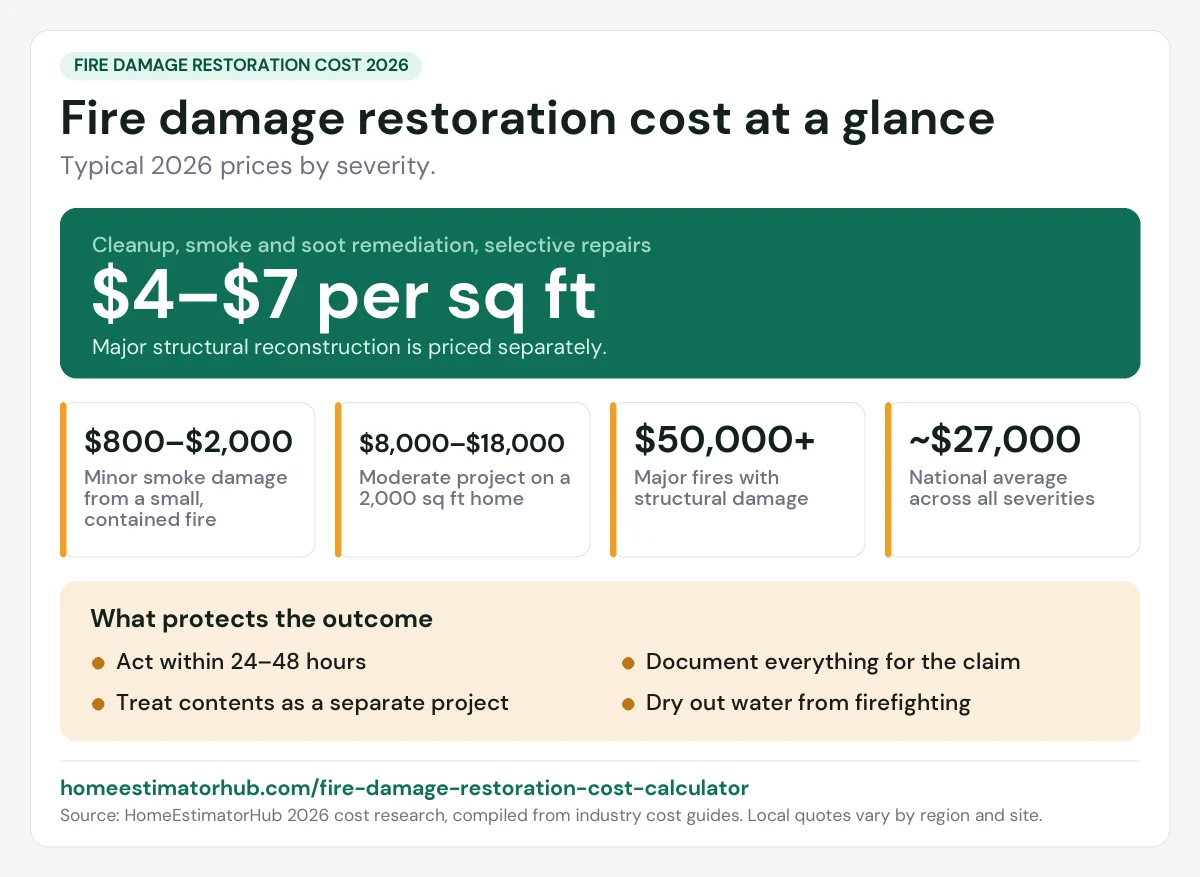
Fire damage restoration costs $4 to $7 per square foot for cleanup, smoke and soot remediation, and selective repairs — not including major structural reconstruction, which is priced separately. A typical moderate-severity project on a 2,000 sq ft home runs $8,000 to $18,000. Minor smoke damage from a small, contained fire can cost as little as $800 to $2,000, while major fires involving structural damage can exceed $50,000 once framing, electrical, and load-bearing repairs are added. The national average across all severities, including cases requiring rebuild, lands around $27,000.
Why a small kitchen fire can cost more to clean than a bigger one elsewhere in the house
This is genuinely counterintuitive, and it's specific to the soot-removal portion of a restoration project rather than the total project cost. Soot from a typical wood or paper fire is "dry" and lifts relatively cleanly, with removal costing $400 to $700 in most cases. Soot from a grease or oil fire — the kind that starts in a kitchen — is "oily," and it behaves completely differently: rather than lifting off, it smears across surfaces, making it significantly harder and more time-consuming to remove. Oily soot cleanup commonly runs $1,000 or more, even for a smaller affected area, purely because of that smearing property. If your fire started in the kitchen, budget for the oilier, more expensive soot category regardless of how contained the fire itself was.
What actually goes into a fire restoration project
- Soot removal — $325 to $4,500+, depending on soot type and affected area.
- Air duct cleaning — $250 to $700, recommended after essentially any fire, since your HVAC system recirculates smoke and soot particles throughout the home, including rooms that weren't directly affected by the fire itself.
- Odor removal — ozone treatment ($175-$950), thermal fogging ($200-$600), or standard furniture and textile deodorizing ($200-$1,000). Smoke odor doesn't simply fade on its own; it's absorbed into porous materials and needs active treatment.
- Water extraction — firefighting efforts routinely leave standing or absorbed water behind, which needs its own mitigation separate from the fire and smoke damage itself.
Why acting within 24-48 hours matters
Soot is acidic, and the longer it sits on a surface, the more likely it is to permanently etch or stain — what could be a cleaning job in the first day or two can become a full material replacement if left for a week. The same urgency applies to any water left behind by firefighting efforts: left unaddressed, it spreads and can create a second, separate water damage problem — including the risk of the more severe black water classification if it's contaminated by sewage or plumbing damage, which our water damage categories guide covers in more detail. Getting a restoration company started within the first two days is one of the highest-leverage decisions in the entire recovery process.
Does insurance cover this?
Generally yes, and more consistently than several other perils covered on this site. Most standard homeowners insurance policies cover fire damage restoration, including cleanup, repairs, and temporary living expenses while your home is unlivable. That said, coverage limits, deductibles, and specific policy terms vary meaningfully, so it's worth reviewing your policy directly rather than assuming full coverage. Document every damaged item and its replacement cost as you go — this makes the claims process considerably smoother. An emergency pack-out service, which removes and safely stores salvageable belongings during restoration, is frequently covered by insurance and worth asking your adjuster about directly.
What does fire damage restoration actually cost for your home?
If the fire started with an electrical issue, our electrical panel upgrade cost calculator covers what it costs to address the underlying electrical problem alongside restoration. For firefighting-related water damage specifically, our water damage restoration cost calculator covers that separately by category and class.
Three kinds of damage, one event
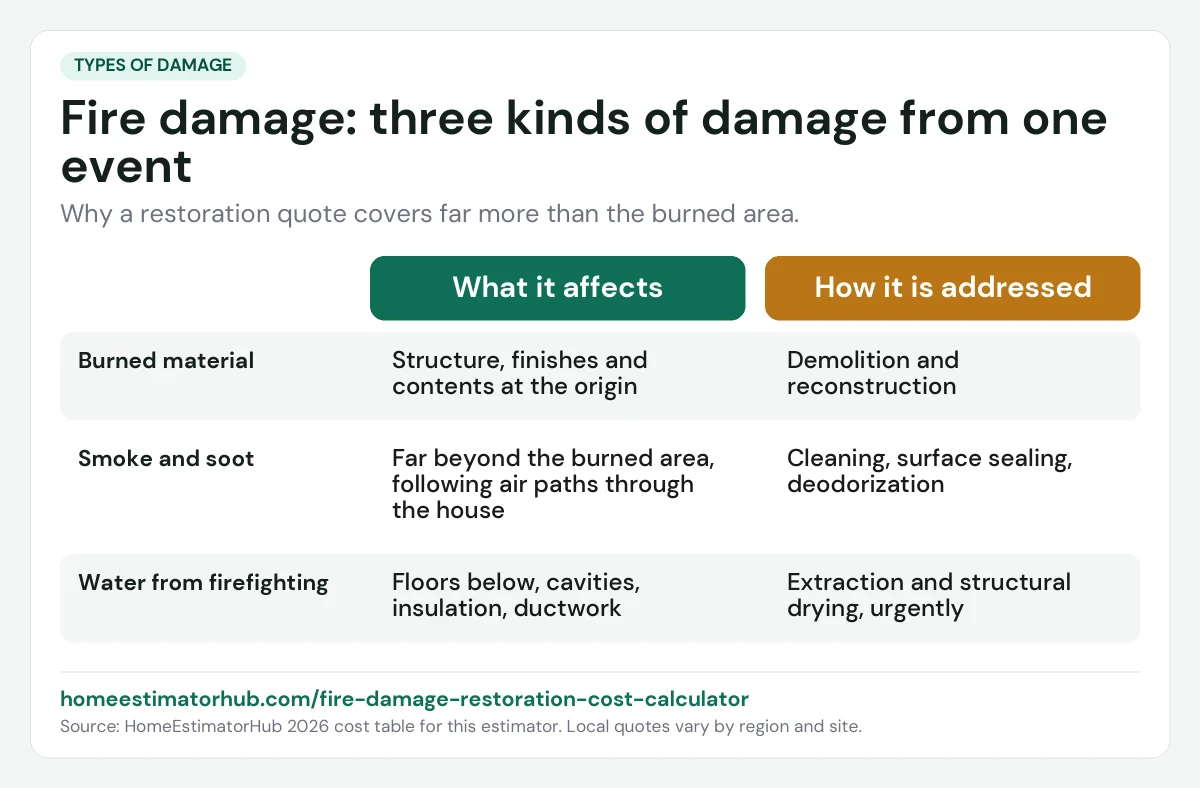
A fire produces three separate problems, and a restoration scope that addresses only the obvious one leaves the house unfinished:
| Damage type | What it affects | How it is addressed |
|---|---|---|
| Thermal — burned material | Structure, finishes, contents at the origin | Demolition and reconstruction |
| Smoke and soot | Far beyond the burned area, following air paths through the whole house | Cleaning, surface sealing, deodorization |
| Water from suppression | Floors below, cavities, insulation, ductwork | Extraction and structural drying, urgently |
The third is the one people overlook while focused on the fire itself. Water used to extinguish a fire behaves like any other flood, and wet cavities left undried become a mold problem within days — our water damage restoration cost calculator and mold remediation cost calculator cover those components, which are frequently part of the same claim.
On overall figures, remediation scope commonly runs $4 to $7 per square foot, averaging near $5.50, covering soot and smoke cleanup, deodorization, water extraction and selective repairs. Structural reconstruction is priced separately — drywall alone adds roughly $1.50 to $3 per square foot, with roofing, electrical and other systems on top. Whole projects average around $27,500, with most falling between $3,100 and $52,000.
Contents are a separate project from the building
Restoration firms treat the structure and your belongings as two workstreams. Contents are typically inventoried and removed to an off-site facility — a pack-out — where they are cleaned, deodorized and stored while the building is repaired.
Two things matter to you in that process. First, the inventory is the basis of your contents claim, so it needs to be detailed and you should have a copy. Second, some categories — electronics, documents, textiles, artwork — go to specialists rather than through general cleaning, and those are separate line items you should see identified rather than bundled.
Smoke cleanup itself commonly runs $200 to $1,200 per room, with professional smoke work over a larger area typically $2,000 to $10,000 and soot removal spanning $2,000 to $15,000. Ozone treatment for odor, where used, is around $400 to $800 on its own.
Documentation is what protects the claim
Fire is a covered peril on standard homeowners policies, and restoration is generally covered up to your limits less the deductible. What varies is how smoothly the claim goes, and that comes down to records:
- Photograph everything before anything is moved, once it is safe to enter. Wide shots of each room, then detail.
- Keep receipts for additional living expenses. Most policies cover the cost of living elsewhere while the home is uninhabitable, but only against documentation.
- Get the scope in writing from the restoration firm, and make sure your adjuster has the same document.
- Do not dispose of damaged items until they have been inventoried, even obviously ruined ones.
- Keep the fire department report, which establishes cause and date for the file.
You are entitled to choose your own restoration contractor rather than accepting the first firm to arrive, and getting a second scope is reasonable on a large loss. At the far end, when the cost to repair approaches the insured value, the carrier may declare a total loss and settle rather than restore — a different process with different paperwork. If the roof was opened during the fire or by the fire service, our roof replacement cost estimator covers that part of the reconstruction.
Frequently asked questions
How much does fire damage restoration cost per square foot?
$4 to $7 per square foot for cleanup, smoke and soot remediation, and selective repairs, not including major structural reconstruction, which is priced separately based on the extent of the rebuild needed.
Why does oily soot cost more to clean than dry soot?
Oily soot, produced by grease or oil fires, smears across surfaces rather than lifting cleanly, making removal significantly more labor-intensive. It commonly costs $1,000 or more to remove, versus $400 to $700 for dry soot from a typical wood or paper fire.
How quickly does fire restoration need to start?
Within 24 to 48 hours ideally. Soot is acidic and can permanently etch or stain surfaces the longer it's left untreated, and water from firefighting efforts can spread and cause additional damage if not addressed quickly.
Does homeowners insurance cover fire damage restoration?
Most standard policies do, including cleanup, repairs, and temporary living expenses. Coverage limits and deductibles vary by policy, so it's worth reviewing your specific plan and documenting all damaged items during the claims process.
Sources & standards
Primary references behind the standards, code requirements and safety guidance cited on this page. Cost ranges shown here are HomeEstimatorHub estimates, not contractor quotes — see how these are calculated, and always confirm against written bids and your local building department.
More free estimators
Explore more home cost estimators
Free cost estimators for every home improvement project — updated for 2026, no signup required.
Disclaimer: All fire damage restoration cost estimates are for informational purposes only based on average 2026 US restoration contractor rates. Actual costs vary significantly based on fire severity, structural damage, and local labor rates. Always contact your insurance provider immediately after a fire and obtain quotes from licensed, IICRC-certified restoration professionals before proceeding.