
Home›Guides›Outdoor & Structures
Outdoor & Structures
Wood vs. Composite Decking: Which Is Worth the Extra Cost?
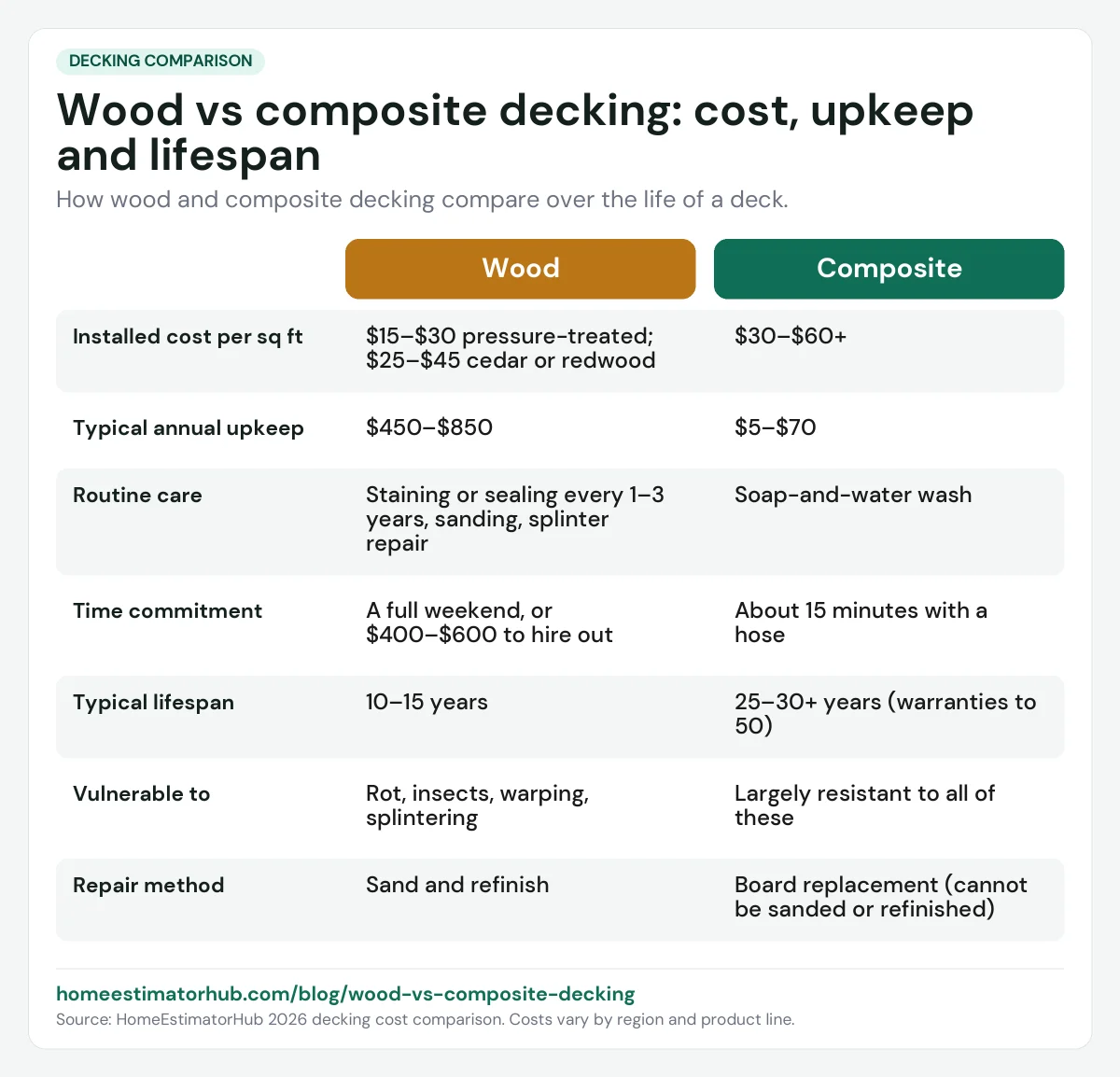
Composite costs roughly 2 to 4 times more than pressure-treated wood upfront, but the math flips within about 6 to 10 years of ownership. Wood needs $450 to $850 a year in staining, sealing, and repairs, while composite needs just $5 to $70 for occasional cleaning — and once you factor in wood's 10 to 15 year lifespan against composite's 25 to 30+ years, composite is usually the cheaper deck by year 10, not the pricier one. Which is actually worth it for you depends on how long you're keeping the deck, not just what it costs to build.

The short version
- Wood wins clearly on day one. $15–$30 per sq ft for pressure-treated against $30–$60+ for composite.
- The crossover lands around years 6–10. Past that point composite is the cheaper deck, not the pricier one.
- Maintenance is the whole story. $450–$850 a year for wood against $5–$70 for composite — plus 20–30 hours of your own time.
- Composite cannot be refinished. Damage means replacing boards, and you lose the option to change the color later.

Upfront cost: wood wins, clearly
| Material | Installed cost per sq ft |
|---|---|
| Pressure-treated wood | $15–$30 |
| Cedar / redwood | $25–$45 |
| Composite | $30–$60+ |
Composite material alone can cost 2 to 4 times more than pressure-treated wood for the same square footage. If upfront budget is your only constraint, wood is the clear winner — this is exactly why it remains the most common decking material for new builds. But upfront cost is only half the financial picture, and it's the half most homeowners stop at.
The crossover point: where the math flips
This is the number that doesn't show up in most decking sales pitches. Once you factor in ongoing maintenance, industry cost benchmarks put the total-cost-of-ownership crossover — the point where cumulative wood costs exceed the higher composite investment — at roughly year 6 to 8 for pressure-treated pine and year 8 to 10 for cedar. After that point, composite is the cheaper deck, and the gap widens every year that follows.
What that looks like in real numbers: by year 9 or 10, a wood deck's cumulative maintenance costs commonly push its total cost $4,000 or more above a comparable composite deck. Stretch the comparison to 20 years, and the gap can reach $6,000 to $9,000 — before even factoring in that most wood decks need a full rebuild somewhere in the 10-15 year range, while a composite deck installed at the same time is often still original and still under warranty.
Annual maintenance: the real cost difference
| Task | Wood | Composite |
|---|---|---|
| Typical annual cost | $450–$850 | $5–$70 |
| Routine care | Staining/sealing every 1–3 years, sanding, splinter repair | Soap-and-water wash |
| Time commitment | A full weekend, or $400–$600 to hire out | About 15 minutes with a hose |
Beyond the dollar figures, composite saves an estimated 20 to 30 hours of maintenance labor per year for a typical 300 sq ft deck compared to wood — time most homeowners don't factor into "cost" at all, but genuinely give up every summer with a wood deck.
Lifespan and durability
| Factor | Wood | Composite |
|---|---|---|
| Typical lifespan | 10–15 years | 25–30+ years (warranties to 50) |
| Vulnerable to | Rot, insects, warping, splintering | Largely resistant to all of the above |
| Repair method | Sand and refinish | Board replacement (can't be sanded/refinished) |
Composite's durability advantage is real and independently verified — Consumer Reports testing consistently shows composite outlasting wood by a wide margin under normal outdoor exposure. That said, composite isn't maintenance-free forever; it just shifts the maintenance profile rather than eliminating it entirely.
What you give up with composite
The comparison isn't one-sided, and it's worth being honest about the trade-offs:
- You lose the ability to change the color. Wood can be stained, painted, or refinished multiple times over its life. Most composite manufactured after 2010 is engineered to hold its original color permanently and can't be effectively stained or painted.
- It can get hot underfoot. Dark-colored composite boards in direct summer sun run noticeably hotter than wood.
- Damage is less forgiving. A scratched or gouged wood board can often be sanded down. Composite typically requires full board replacement for the same kind of damage.
- The feel is different. Modern composite mimics wood grain convincingly, but it doesn't have identical texture or give underfoot to a discerning user.
Does either material affect resale value more?
Both materials deliver broadly comparable resale returns, commonly cited in the 60% to 83% range for deck additions generally. The more meaningful resale distinction isn't the percentage — it's what each material signals to a buyer. A newer composite deck signals low future maintenance costs, which some buyers actively value; an older wood deck, even a well-maintained one, can read as a future expense to a buyer doing mental math on upkeep.
Which should you actually choose?
- Lowest upfront cost, or selling within 3-5 years — pressure-treated wood usually still makes financial sense, since you won't own it long enough to hit the maintenance crossover point, and resale recoup percentages are comparable.
- Staying long-term, or maintenance is a genuine burden for you — composite wins clearly once you account for total cost of ownership past year 6-10, not just the sticker price.
- Want the authentic look and feel, and don't mind the upkeep — wood remains the only material that delivers that, and can be refinished repeatedly to keep it looking new.
Whichever direction you lean, keeping a wood deck clean is the single biggest lever on its actual lifespan — regular cleaning prevents the mold and moisture buildup that accelerates rot. Our pressure washing cost calculator covers what professional deck cleaning typically costs if you'd rather not spend the weekend on it yourself.
What does a new deck actually cost?
Total project cost depends heavily on size, material, railing, and framing complexity — not just the per-square-foot decking material rate discussed above. Our deck construction cost estimator covers both wood and composite options and gives you an instant, itemized estimate for your specific project.
Frequently asked questions
Is composite decking really cheaper than wood in the long run?
Yes, typically after about 6 to 10 years of ownership. Composite costs 2 to 4 times more upfront, but wood's annual maintenance of $450 to $850 versus composite's $5 to $70 means the total cost crosses over within that window, and the gap widens every year after.
How long does a wood deck last compared to composite?
Pressure-treated wood typically lasts 10 to 15 years with regular maintenance. Composite decking typically lasts 25 to 30 years or more, with some manufacturer warranties extending to 50 years.
Can composite decking be stained or repainted?
Generally no. Most composite decking manufactured after 2010 is engineered to hold its original color permanently and doesn't accept stain or paint effectively, unlike wood, which can be refinished multiple times.
Which decking material has better resale value?
Both materials deliver broadly comparable resale returns, commonly in the 60% to 83% range. Composite may appeal more to buyers specifically looking to avoid future maintenance costs.
Put a number on it
Estimate pressure washing by surface and area — driveway, siding, deck, roof, fence or gutters —…
Open the Pressure Washing Cost Calculator →Sources & standards
This guide is general information, not professional advice. Building codes, permit requirements and safety rules are set locally and change over time — your building department and a licensed professional are the authorities for your property. Cost figures are HomeEstimatorHub estimates, not quotes — see how they are calculated.
Keep reading
More guides in Outdoor & Structures.
Price it
Estimators for the work this guide describes.