
Home›Guides›Outdoor & Structures
Outdoor & Structures
Wood vs. Vinyl vs. Chain Link: Which Fence Lasts Longest?
On pure lifespan, vinyl typically wins — 20 to 35 years with virtually no maintenance, versus 15 to 30 years for chain link and 10 to 25 years for wood. But "lasts longest" and "costs least over time" aren't the same question: chain link is the cheapest to install by 40% to 60%, yet its shorter lifespan can make it the most expensive option over a 30-year span once replacement is factored in, while vinyl and vinyl-coated chain link often land close to each other in true 30-year cost. The right material depends less on which lasts longest and more on what you actually need the fence to do.

The short version
- Chain link is 40–60% cheaper upfront. And on a long rural boundary that difference compounds quickly.
- Cheapest upfront is not cheapest over 30 years. Standard galvanized chain link has the shortest realistic lifespan of the three.
- Only two of the three give privacy. Solid wood and vinyl block sightlines. Standard chain link does not, whatever you weave through it.
- Coastal exposure changes the numbers. Within a mile of saltwater, galvanized chain link can rust visibly in 5–7 years against 15–20 inland.
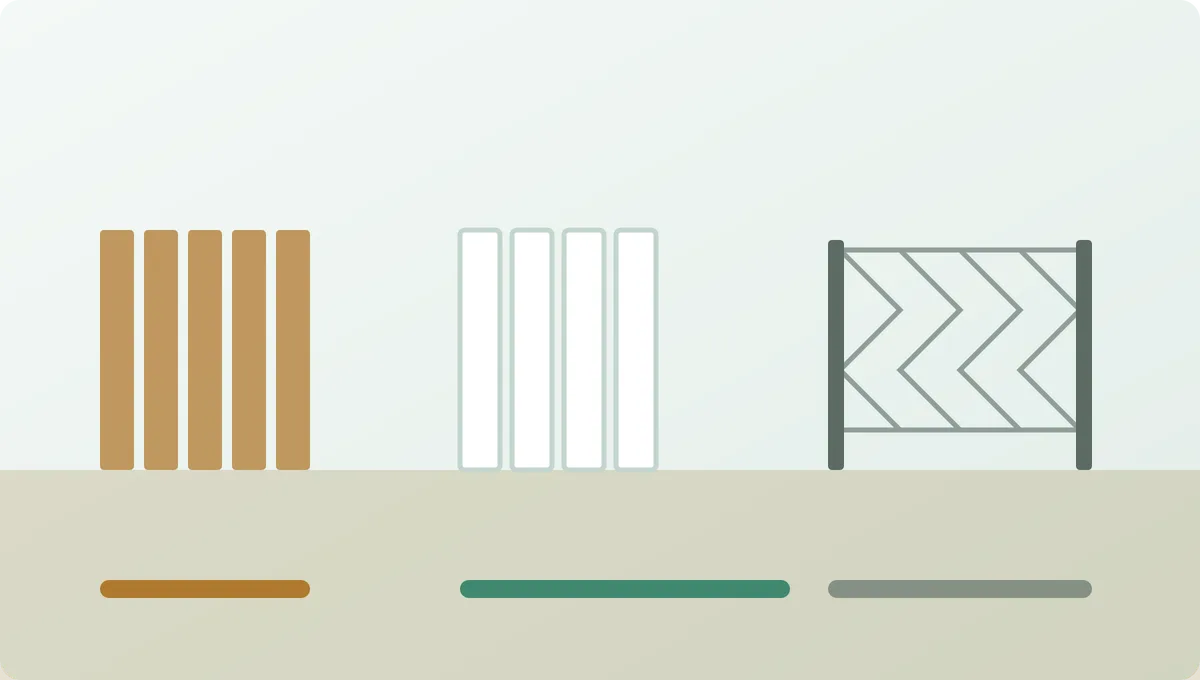
Upfront cost
| Material | Cost per linear ft installed | Typical 150 ft backyard |
|---|---|---|
| Chain link (galvanized) | $10–$40 | $1,500–$3,000 |
| Wood (pressure-treated pine to cedar) | $15–$60 | $2,250–$4,500 |
| Vinyl | $20–$60 | $3,000–$9,000 |
Chain link's upfront advantage is real and substantial — it typically runs 40% to 60% cheaper than wood or vinyl for the same linear footage, which compounds fast on larger properties.
Lifespan
| Material | Typical lifespan | Maintenance |
|---|---|---|
| Wood | 10–25 years | Stain/seal every 2–3 years, board repairs |
| Chain link (galvanized) | 15–20 years | Minimal — occasional rust spot treatment |
| Chain link (vinyl-coated) | 20–25+ years | Minimal |
| Vinyl | 20–35 years | Hose and soap only |
Climate changes these numbers significantly. Within about a mile of saltwater, standard galvanized chain link can show visible rust in as little as 5 to 7 years, compared to 15 to 20 years inland — coastal installations generally need vinyl-coated, aluminized, or stainless steel chain link to hold up. Humid climates accelerate wood rot, and poor maintenance can cut a wood fence's lifespan by 30% to 50%. Vinyl has a lesser-known cold-climate advantage: it flexes rather than cracks in freezing temperatures, which is why it tends to perform particularly well through harsh winters.
The 30-year cost twist: cheapest upfront isn't cheapest overall
This is the insight most fence comparisons skip. Because standard galvanized chain link has the shortest realistic lifespan of the three materials, it can actually end up as the most expensive option on a 30-year timeline once you factor in a full replacement partway through — despite having the lowest sticker price today. Vinyl and vinyl-coated chain link, by contrast, often land remarkably close to each other in true 30-year cost, since both avoid a mid-life replacement and neither requires ongoing staining or sealing. Wood sits in between: its lower upfront cost than vinyl is gradually eroded by staining, sealing, and board replacement over the years, and by year 30 it commonly costs more in total than vinyl once all of that maintenance is added up.
Privacy: only two of these three actually deliver it
This is a practical filter worth applying before cost even enters the conversation. A solid wood or vinyl privacy fence blocks essentially 100% of sightlines. Standard chain link blocks close to 0% — it's fundamentally see-through by design. Adding privacy slats or screening fabric closes some of that gap, but even with add-ons, chain link typically only achieves 70% to 85% visual screening, not full privacy — and those add-ons eat into the cost advantage that made chain link attractive in the first place. If full privacy is a real requirement, wood or vinyl is the only honest answer; chain link with upgrades is a partial compromise, not an equivalent substitute.
Security is where chain link actually wins
Counterintuitively, chain link performs well on pure security, even though it looks the least imposing of the three. The woven steel mesh resists cutting without heavy-duty tools, and because the structure is open rather than solid, there's no blind spot for an intruder to hide behind while attempting entry — which also makes chain link pair well with security cameras and motion-sensor lighting, since sightlines stay clear in both directions. If your priority is containment and visibility rather than privacy or curb appeal, chain link is a legitimately strong functional choice, not just a budget compromise.
Check your HOA before you decide
Many homeowners associations restrict or outright prohibit chain link, particularly in front yards and sometimes in backyards as well. Violating an HOA fencing rule can mean a costly forced removal and reinstallation after the fact. Before committing to any material, confirm your specific HOA's fencing rules and your local jurisdiction's permit requirements — many areas require a permit for fences over 4 to 6 feet tall, and corner lots often carry additional visibility restrictions that limit fence height near the street.
Which should you actually choose?
- Choose chain link if — budget is the top priority, privacy isn't required, or you're fencing a utility area, dog run, or large rural boundary where appearance matters less than function and security.
- Choose vinyl if — you want full privacy with the lowest realistic long-term cost and maintenance, and you're staying in the home long enough to benefit from its longer lifespan.
- Choose wood if — you want the classic, natural look and are genuinely willing to keep up with staining and sealing, or your neighborhood's aesthetic expectations favor it at resale.
If your fence is going around a pool, note that most jurisdictions require a compliant safety fence regardless of which material you choose — our pool installation cost estimator is worth pricing alongside this project if that's your situation.
What does a fence actually cost for your property?
Total cost depends on linear footage, height, terrain, and gate count as much as material choice. Our fence installation cost estimator covers wood, vinyl, chain link, and other materials, with an instant estimate based on your specific project.
Frequently asked questions
Which fence material lasts the longest?
Vinyl typically lasts the longest among the three main budget-to-mid options, at 20 to 35 years with virtually no maintenance. Vinyl-coated chain link can come close at 20 to 25+ years, while wood typically lasts 10 to 25 years depending on climate and maintenance.
Is chain link really cheaper than vinyl over time?
Not always. While chain link costs 40% to 60% less upfront, its shorter lifespan can require a full replacement before vinyl needs one at all, which can make standard galvanized chain link the more expensive option over a 30-year span.
Does chain link fencing provide any privacy?
Very little on its own — close to 0% visual screening. Adding privacy slats or screening fabric can improve that to roughly 70% to 85%, but it still doesn't match the full privacy of a solid wood or vinyl fence.
Can I install chain link fencing near saltwater?
Standard galvanized chain link corrodes much faster near saltwater, sometimes showing rust within 5 to 7 years versus 15 to 20 years inland. Vinyl-coated, aluminized, or stainless steel chain link options hold up significantly better in coastal environments.
Put a number on it
Estimate a pool by size, type and material. In-ground concrete, fiberglass, vinyl liner and above-ground compared…
Open the Pool Installation Cost Estimator →Sources & standards
This guide is general information, not professional advice. Building codes, permit requirements and safety rules are set locally and change over time — your building department and a licensed professional are the authorities for your property. Cost figures are HomeEstimatorHub estimates, not quotes — see how they are calculated.
Keep reading
More guides in Outdoor & Structures.
Price it
Estimators for the work this guide describes.