
Home›Guides›Outdoor & Structures
Outdoor & Structures
Concrete vs. Paver Patio: Cost and Durability Compared
Concrete costs 40% to 50% less upfront — typically $4 to $15 per square foot versus $6 to $30 for pavers — and installs faster. But a national study tracking 1,247 patio installations over 5 years found that upfront cost makes up only 71% of a concrete patio's total 10-year expense, versus 62% for pavers — meaning concrete's cheaper price tag hides proportionally more cost waiting in maintenance and repairs down the line. The core reason: concrete is a rigid slab that cracks when the ground moves, while pavers flex individually with it.

The short version
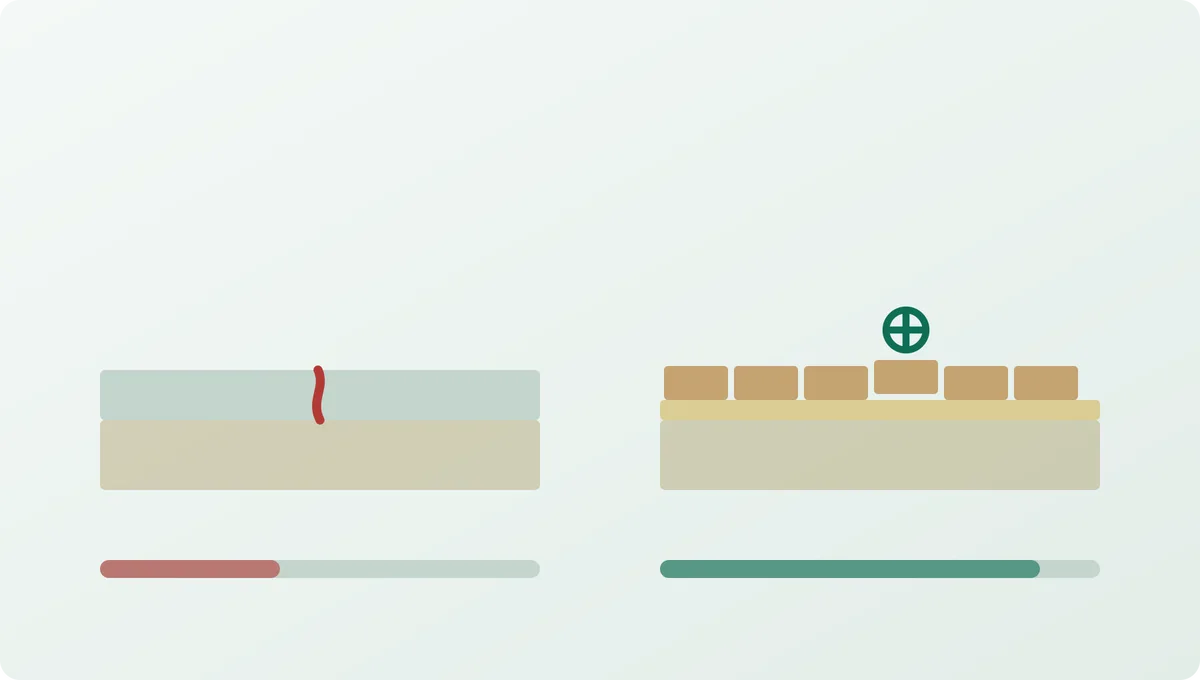
- Concrete is one rigid slab, so it cracks. Pavers move independently, which is why ground movement damages them far less.
- Repairs are the real difference. A lifted paver is an afternoon and leaves no trace. A concrete patch is visible more or less permanently.
- Pavers last longer. 30–50 years properly installed, against 25–30 for concrete — which often cracks within the first 5–10.
- Upfront gap is real but narrows. Around $3,000–$5,000 on a 300 sq ft patio, before you account for what each costs to maintain.
Upfront cost
| Material | Cost per sq ft installed |
|---|---|
| Concrete | $4–$15 (decorative/stamped pushes higher) |
| Pavers | $6–$30 |
On a typical 300 sq ft patio, the gap between a basic concrete slab and a mid-range paver installation commonly lands at $3,000 to $5,000. That difference is real — but as the next section shows, it narrows considerably once you look past the installation invoice.
Why concrete cracks and pavers don't (as much)
This is the mechanical reason behind almost every other difference on this page. Poured concrete is a rigid, monolithic slab. When the ground beneath it freezes and expands, or simply settles over time, the slab has nowhere to flex — it cracks. Once a crack forms, water gets into it, freezes, and makes the crack worse with every winter that follows. Pavers work completely differently: they're individual units set on a flexible base of compacted gravel and sand. When the ground moves, the pavers move with it — shifting slightly, then settling back into place, largely without cracking. Pavers also test out at roughly four times the compressive strength of a poured concrete slab, which is part of why they handle heavy loads and ground movement more gracefully over time.
The hidden-cost study most patio comparisons don't cite
This is the most useful number in this entire comparison, and it rarely makes it into typical cost guides. A cost-tracking study covering 1,247 residential patio installations over five years found that the initial installation price accounts for only 71% of a concrete patio's total ownership cost, compared to 62% for pavers. In plain terms: concrete's lower sticker price represents a smaller share of what you'll actually spend on it over time — the remaining 29% shows up gradually as maintenance, sealing, and crack repair that most people don't budget for at the time of installation. Pavers front-load more of their true cost into the number you see upfront, which is part of why the two materials' total costs end up closer together than the initial quote suggests.
Repairs: the difference is night and day
This is where the two materials diverge most in daily practicality. A cracked concrete patio can be patched, but the patch rarely matches the surrounding surface perfectly — repairs are visible, often permanently. Larger cracks require cutting out and replacing entire sections, and stains from oil, rust, or organic matter tend to penetrate concrete and become effectively permanent without aggressive treatment like acid washing or grinding, which can damage the finish further. Pavers handle damage completely differently: lift the affected paver, adjust the base material if needed, drop in a replacement, and sweep joint sand back into place. If you kept a few matching spares, the repair is essentially invisible. This same advantage applies to future changes — adding a fire pit, or accessing a utility line running underneath the patio, means lifting pavers, doing the work, and replacing them with no visible trace. The equivalent job on concrete means cutting, patching, and a visible seam that never quite blends in.
Lifespan
| Material | Typical lifespan | When problems typically start |
|---|---|---|
| Concrete | 25–30 years | Cracks often develop within 5–10 years |
| Pavers | 30–50 years, properly installed | Minor joint sand/settling maintenance, not structural failure |
Design flexibility and DIY feasibility
Pavers offer far more design flexibility — a wide range of materials, sizes, colors, and patterns that installers can arrange into virtually any shape. Poured concrete is more limited: it can be stamped with decorative patterns or tinted before pouring at extra cost, but color applied after installation tends to fade and need reapplication over time. Counterintuitively, pavers are also the more DIY-forgiving option, since a placement mistake can simply be lifted and redone. Concrete rewards speed and skill during the pour itself — once it's down, mistakes are effectively permanent, which raises the stakes for anyone attempting it without experience.
Which should you actually choose?
- Choose concrete if — you need a simple utility patio (an AC pad, a small side-yard surface), budget is the primary constraint, or you want the fastest possible installation.
- Choose pavers if — the patio is a real entertaining space, you're in a freeze-thaw climate where ground movement is a genuine concern, you want the option to reconfigure or add features later without visible patching, or you're thinking in terms of total cost of ownership rather than just the installation invoice.
Whichever you choose, if the patio surrounds a pool or connects to other hardscaping, it's worth pricing those pieces together — our pool installation cost estimator and retaining wall cost calculator cover related structures that often get planned alongside a patio project.
What will your patio actually cost?
Exact cost depends on size, finish level, and site preparation needs. Our concrete patio cost estimator gives you an instant, itemized estimate for a concrete project specifically.
Frequently asked questions
Is a paver patio really worth the extra cost over concrete?
Often yes for long-term ownership. While concrete costs 40% to 50% less upfront, a national cost-tracking study found concrete's total 10-year ownership cost includes proportionally more hidden maintenance and repair expense than pavers, narrowing the real-world cost gap.
Why does concrete crack more than pavers?
Concrete is a rigid, monolithic slab that has nowhere to flex when the ground freezes, expands, or settles, so it cracks. Pavers are individual units on a flexible gravel and sand base that move with the ground and settle back into place.
Can you repair a cracked concrete patio invisibly?
Not usually. Concrete patches rarely match the surrounding surface perfectly, and larger cracks often require cutting out and replacing entire sections. Paver repairs are typically invisible, since individual pavers can be lifted and replaced.
Is a paver or concrete patio better for resale value?
Both can add value when properly installed and maintained, but paver installations are frequently cited as commanding higher resale value due to their appearance and durability, and are often an expected feature in higher-end homes.
Put a number on it
Estimate a pool by size, type and material. In-ground concrete, fiberglass, vinyl liner and above-ground compared…
Open the Pool Installation Cost Estimator →Sources & standards
This guide is general information, not professional advice. Building codes, permit requirements and safety rules are set locally and change over time — your building department and a licensed professional are the authorities for your property. Cost figures are HomeEstimatorHub estimates, not quotes — see how they are calculated.
Keep reading
More guides in Outdoor & Structures.
Price it
Estimators for the work this guide describes.