
Home repair estimator · Updated September 2026
Crawl Space Encapsulation Cost Calculator
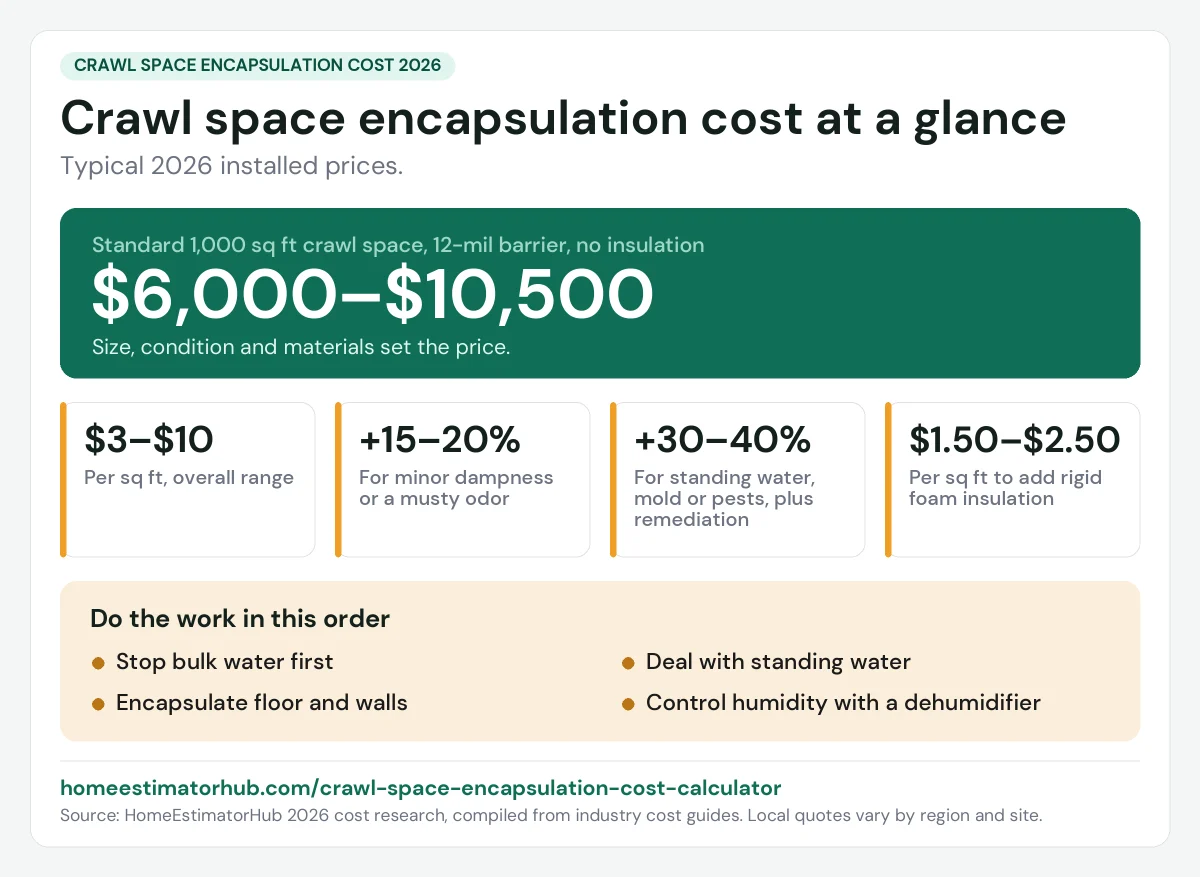
Crawl space encapsulation costs $3 to $10 per square foot, or roughly $3,500 to $27,000 total, depending on size, condition and materials. Use our free calculator to get an instant estimate by size, crawl space condition, vapor barrier, insulation and US state.
Enter your crawl space details
Enter your crawl space square footage
Enter the total area of your crawl space to calculate your instant encapsulation cost.
- Most 1,000 sq ft crawl spaces cost $6,000–$10,500 for standard encapsulation
- Standing water, mold or pest damage can raise costs by 30–40% or more
- Labor typically makes up 50–70% of the total project cost
- Spray foam insulation costs more upfront but performs best long-term
What affects crawl space encapsulation cost?
- Size — The primary cost driver. Larger crawl spaces need more vapor barrier, insulation and labor.
- Condition — Standing water, mold or pest damage must be addressed first, adding 30–40%+ to the project.
- Vapor barrier thickness — 20-mil heavy-duty barriers cost more than 6-mil budget options but last longer.
- Insulation type — Closed-cell spray foam costs roughly 3x more than fiberglass batt but seals air better.
- Access — Tight crawl spaces under 24 inches slow labor down and raise installation cost.
- State — Labor costs in California and the Northeast run 25–30% higher than Midwest and Southern states.

How much does crawl space encapsulation cost in 2026?
The average cost of crawl space encapsulation is $3 to $10 per square foot, or $3,500 to $27,000 total, depending on size, condition and materials. A standard 1,000 sq ft crawl space with a 12-mil vapor barrier and no insulation costs between $6,000 and $10,500 on average. Use our free crawl space encapsulation cost calculator above to get an instant, personalized estimate based on your size, condition and US state.
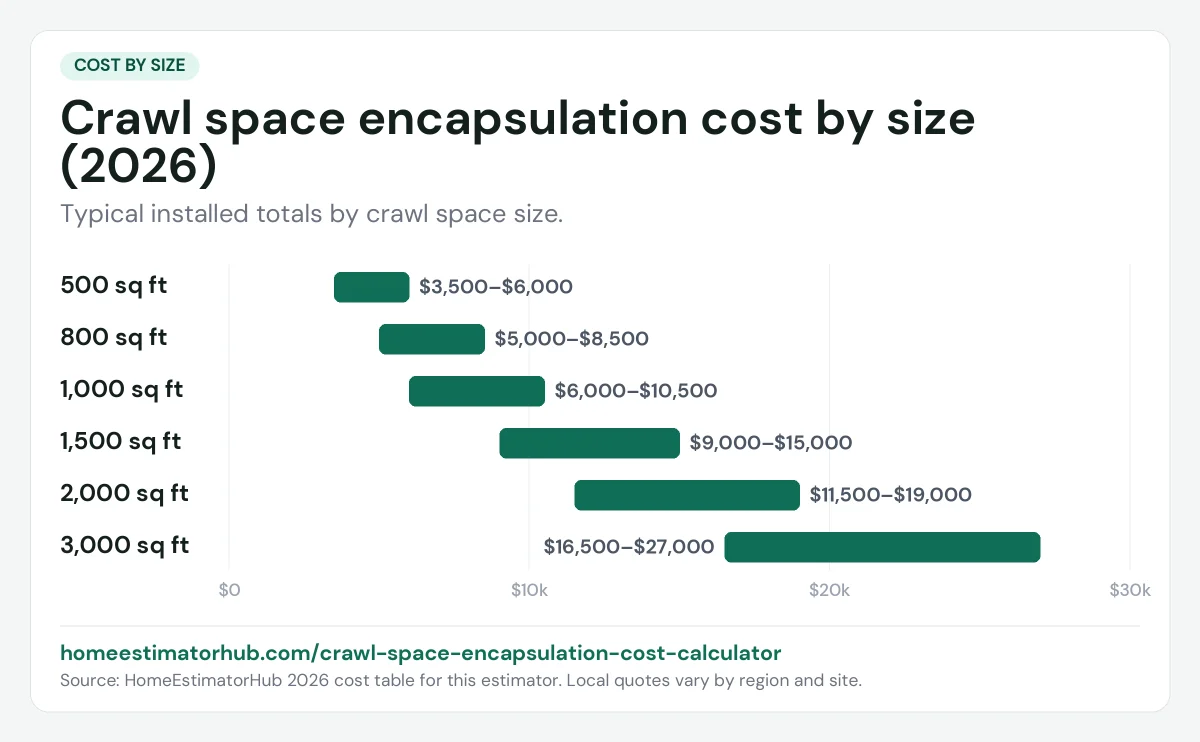
Crawl space encapsulation cost calculator — by size
Our crawl space encapsulation cost calculator updates your estimate in real time as you select size, condition, vapor barrier, insulation and add-ons. The calculator applies state-specific labor multipliers and adjusts for rural, suburban and major metro markets.
| Crawl space size | Estimated cost |
|---|---|
| 500 sq ft | $3,500–$6,000 |
| 800 sq ft | $5,000–$8,500 |
| 1,000 sq ft | $6,000–$10,500 |
| 1,500 sq ft | $9,000–$15,000 |
| 2,000 sq ft | $11,500–$19,000 |
| 3,000 sq ft | $16,500–$27,000 |
Crawl space encapsulation cost by condition
Crawl space condition is one of the biggest cost factors, often bigger than size alone. A dry, problem-free crawl space costs significantly less to encapsulate than one with standing water, mold or pest damage that must be remediated first.
| Condition | What it means | Cost impact |
|---|---|---|
| Good | Dry, no visible issues | Baseline pricing |
| Moderate | Minor dampness or musty odor | +15–20% over good condition |
| Poor | Standing water, mold or pest damage | +30–40%+, plus separate remediation costs of $500–$5,000 or more |
Vapor barrier thickness — cost comparison
Vapor barriers are rated in mil thickness — the higher the mil rating, the more durable and puncture-resistant the barrier. Most contractors recommend at least 12-mil for residential crawl spaces, reserving 20-mil heavy-duty barriers for rocky floors or chronic moisture problems.
| Vapor barrier | Best for | Relative cost |
|---|---|---|
| 6-mil (budget) | Dry climates, light-duty use | Lowest |
| 12-mil (standard) | Most residential crawl spaces | Standard |
| 20-mil (heavy-duty) | Rocky floors, chronic moisture, radon control | Highest |
Crawl space insulation cost comparison
Insulation is optional with encapsulation but recommended for energy efficiency, especially in colder climates. Closed-cell spray foam costs the most upfront but seals air leaks better than batt or board insulation and won't sag or absorb moisture over time.
| Insulation type | Cost per sq ft | Notes |
|---|---|---|
| None | $0 | Vapor barrier only, no thermal benefit |
| Fiberglass batt | $1.00–$1.50 | Lowest cost, can sag or absorb moisture over time |
| Rigid foam board | $1.50–$2.50 | Moisture-resistant, holds shape well |
| Closed-cell spray foam | $3.00–$4.50 | Best air seal and R-value, highest cost |
Is crawl space encapsulation worth it?
For most homeowners, yes. Crawl space encapsulation prevents moisture damage, mold growth and pest problems while improving indoor air quality and energy efficiency. Most homeowners recover their investment within 7 to 10 years through lower energy bills, fewer repairs and a higher resale value — buyers commonly view encapsulation as a sign of good home maintenance.
What encapsulation is actually solving
A vented crawl space under a heated house is not a neutral empty gap. Air moves upward through a building, and the air it draws in to replace what leaves out of the roof comes from the lowest point — which in these houses is a dirt floor. Whatever is in that air arrives in the living space above.
Encapsulation is a humidity control project first. Bare soil releases moisture continuously, and when humid outside air meets cooler surfaces under the floor, it condenses on joists, ductwork and insulation. Sustained high moisture in the wood is what allows mold and decay fungi to establish, and it is why a musty smell in a ground-floor room so often traces to a space nobody has looked at in years.
The symptoms that point here are consistent: cupping hardwood floors above, cold floors in winter, high indoor humidity in summer, insulation hanging loose from the joists, and that smell. If growth is already established, remediation comes before sealing — our mold remediation cost calculator covers that step.
The order of operations decides whether it works
Sealing a crawl space that is still taking on water is a way to build a sealed container with water in it. The sequence matters more than the specification:
- 1. Stop bulk water first. Regrade so the ground falls away from the house, extend downspouts well clear of the wall, and fix any plumbing leaks. This step is often cheap and occasionally solves the whole problem.
- 2. Deal with standing water. If water still enters, a perimeter drain and sump is the answer — interior crawl space drainage commonly runs $800 to $3,000. Our french drain installation calculator prices the exterior alternative.
- 3. Clear and clean. Debris, failed insulation and any contaminated material comes out.
- 4. Then encapsulate. Liner on the floor and up the walls, seams sealed, vents closed.
- 5. Control the remaining humidity with a dedicated dehumidifier, commonly around $1,900 installed for a unit built for the job.
That last item is where partial jobs fail. A liner stops soil moisture, but it does nothing about humidity already in the air or introduced when the hatch opens. Adding dehumidification and drainage moves a job toward the top of the $3 to $10 per square foot range on this page, and a 1,500 square foot crawl space typically comes out at $9,000 to $15,000.
The dehumidifier also needs somewhere to send the water it collects — a gravity drain, a condensate pump or the sump. A unit draining into a bucket nobody empties is a unit that shuts off.
Sealing the vents changes the building, so check the appliances
Closing crawl space vents converts the space from outdoors to a semi-conditioned part of the house. That is the point, but it has one safety consequence worth raising before work starts.
If any combustion appliance sits in the crawl space or draws its air from there — a gas water heater, a furnace, anything with an atmospheric flue — it needs a verified combustion air supply once the space is sealed. Reducing available air to a naturally drafting appliance risks backdrafting, which puts combustion products including carbon monoxide into the house. A competent contractor raises this without being asked; if yours does not, raise it yourself.
Two related points: sealing a crawl space alters how soil gases move into the building, so if you have never tested for radon, do it before and after — our radon mitigation cost calculator covers the remedy if levels come back high. And keep an access route into the space. Encapsulation is not a reason to stop inspecting it; it is the reason inspecting it becomes easy.
Frequently asked questions
How accurate is this crawl space encapsulation cost calculator?
There is no validated accuracy figure for this estimator, and we will not invent one. Its rates come from published 2026 cost data and are maintained by hand, but they have not been measured against a body of real quotes. Access difficulty and hidden damage can change the final price. Treat the result as a planning figure and the range as the realistic spread, then get at least 3 quotes from crawl space specialists in your area.
How do I estimate crawl space encapsulation cost?
To estimate crawl space encapsulation cost, measure your total square footage, assess the condition (dry, damp, or standing water/mold), choose a vapor barrier thickness and insulation type, then add any extras like a dehumidifier or sump pump. Our calculator does this automatically — as a rule of thumb, budget $3 to $10 per square foot.
What's included in crawl space encapsulation?
A typical crawl space encapsulation includes cleaning and light debris removal, sealing the floor and walls with a vapor barrier, sealing existing foundation vents, and taping all seams. Insulation, dehumidifiers, sump pumps and mold remediation are common add-ons priced separately.
Do I need a permit for crawl space encapsulation?
In many US jurisdictions, yes — particularly if a sump pump, dehumidifier wiring, or significant structural work is involved. Permit costs typically range from $200 to $650 depending on your municipality. Always check with your local building department before beginning work.
How long does crawl space encapsulation take?
Most residential crawl space encapsulation projects take 1 to 4 days, depending on size, access difficulty and whether repairs like mold remediation or drainage work are needed first. Larger or more complex projects with extensive prep work can take longer.
Sources & standards
Primary references behind the standards, code requirements and safety guidance cited on this page. Cost ranges shown here are HomeEstimatorHub estimates, not contractor quotes — see how these are calculated, and always confirm against written bids and your local building department.
More free estimators
Explore more home cost estimators
Free cost estimators for every home improvement project — updated for 2026, no signup required.
Disclaimer: All crawl space encapsulation cost estimates are for informational purposes only based on average 2026 US contractor rates. Actual costs vary based on crawl space condition, access difficulty, local material pricing, permit requirements and contractor availability. Always obtain multiple quotes from licensed contractors before proceeding with any project.