
Outdoor & foundation estimator · Updated September 2026
Concrete Slab Cost Calculator
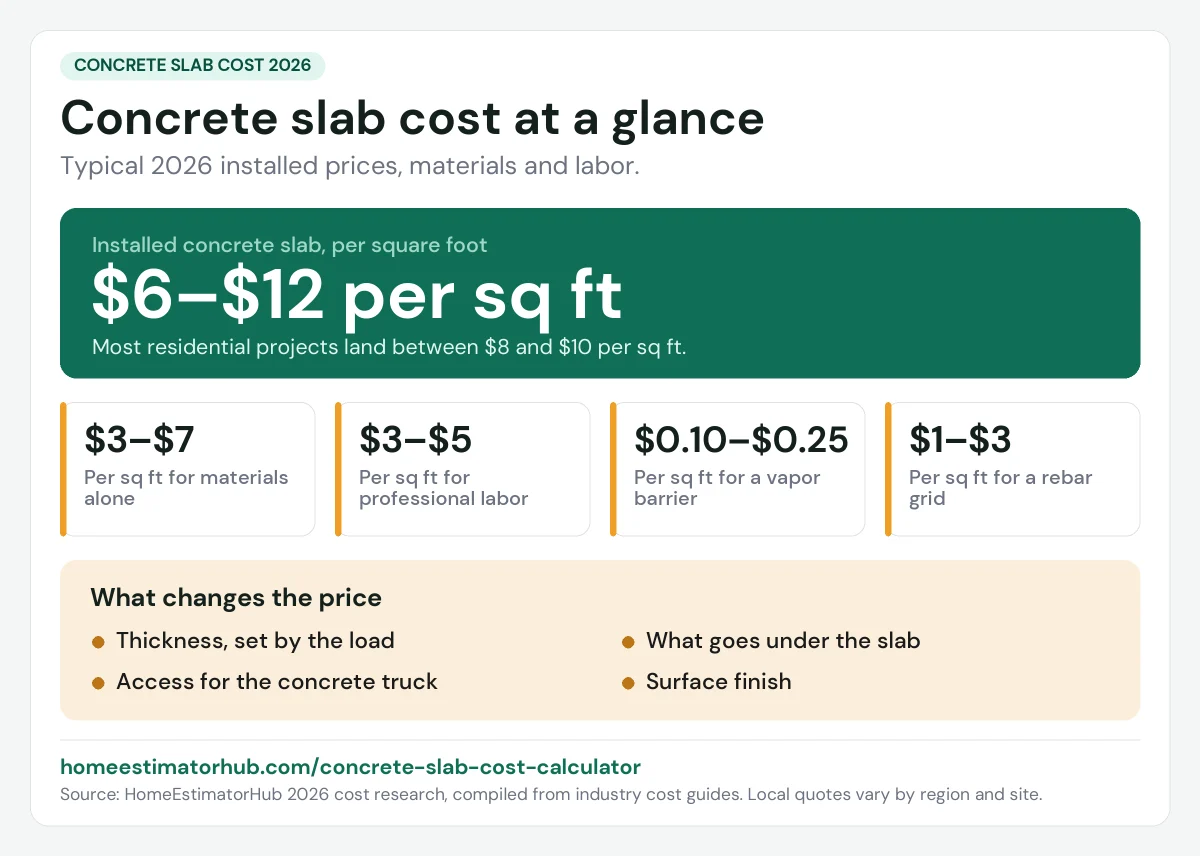
A concrete slab costs $6 to $12 per square foot installed in 2026, depending on project type, thickness and finish. Use our free calculator to get an instant estimate for a patio, driveway, garage floor, shed pad or house foundation slab.
Enter your slab details
Enter your slab's square footage
Enter the total area of your concrete slab to calculate your instant cost estimate.
- Most concrete slabs cost $6–$12 per sq ft installed
- A 2,000 sq ft house foundation slab typically costs $12,000–$28,000
- Going from 4" to 6" thickness adds roughly $1–$1.30 per sq ft
- Stamped or decorative finishes can roughly double the base cost
What affects concrete slab cost?
- Project type — Structural slabs like foundations cost more than patios or walkways of the same size.
- Thickness — Each added inch increases material volume and cost per square foot.
- Reinforcement — Steel rebar costs more than wire mesh but is recommended for foundations and heavy loads.
- Finish — Stamped, stained or exposed aggregate finishes cost significantly more than a standard broom finish.
- Site conditions — Demolition of an old slab or extra grading for soft soil adds to the total.
- State — Labor costs in California and the Northeast run 25–30% higher than Midwest and Southern states.

How much does a concrete slab cost in 2026?
A concrete slab costs $6 to $12 per square foot installed in 2026, with most residential projects landing between $8 and $10 per square foot. Materials alone run $3 to $7 per square foot, while professional labor adds another $3 to $5 per square foot. Use our free concrete slab cost calculator above to get an instant estimate based on your project type, thickness, finish and US state.
Concrete slab cost calculator — by project type
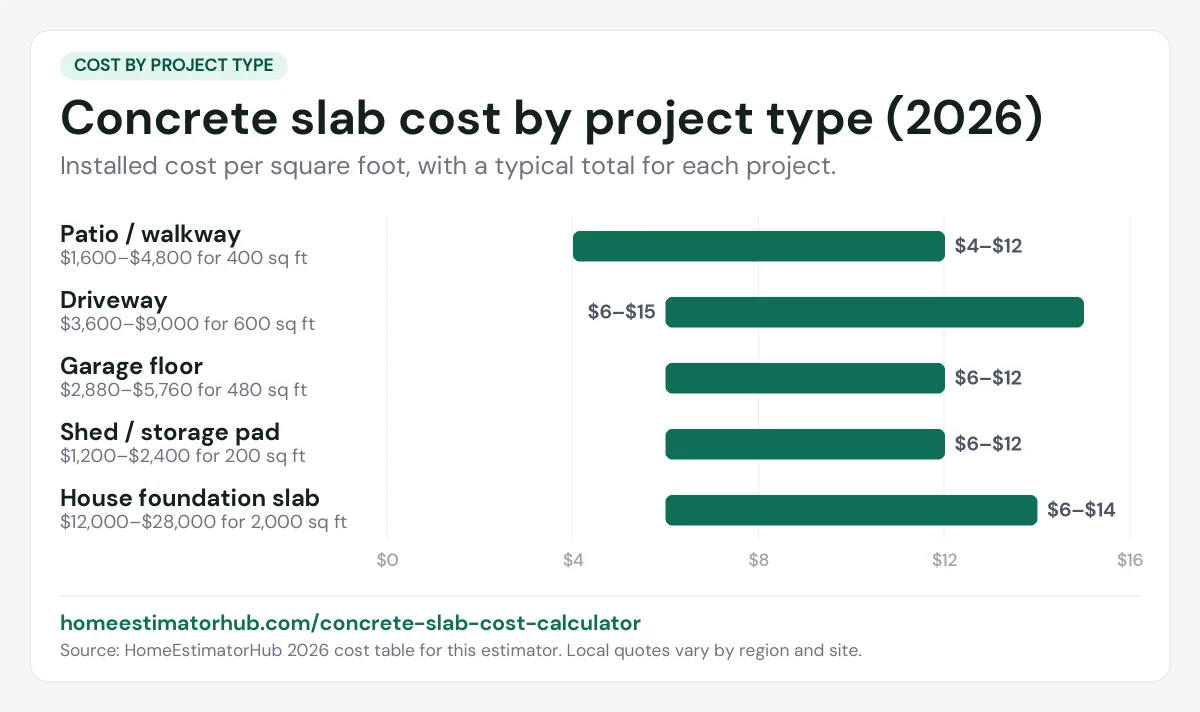
Concrete slab pricing varies by project type because each has different thickness requirements, reinforcement needs and finishing complexity. Structural slabs like house foundations cost more per square foot than a simple patio of the same size.
| Project type | Cost per sq ft | Typical total cost |
|---|---|---|
| Patio / walkway | $4–$12 | $1,600–$4,800 (400 sq ft) |
| Driveway | $6–$15 | $3,600–$9,000 (600 sq ft) |
| Garage floor | $6–$12 | $2,880–$5,760 (480 sq ft) |
| Shed / storage pad | $6–$12 | $1,200–$2,400 (200 sq ft) |
| House foundation slab | $6–$14 | $12,000–$28,000 (2,000 sq ft) |
Cost to pour a 2,000 sq ft concrete slab foundation
A 2,000 sq ft concrete slab foundation typically costs $12,000 to $28,000 in 2026, or roughly $6 to $14 per square foot installed. House foundation slabs are usually poured 6 inches thick with steel rebar reinforcement, a vapor barrier, and often foam insulation to meet residential building codes. This range holds steady from 2025 into 2026 with only modest price increases — labor and ready-mix delivery costs account for most of the year-over-year change. Enter 2,000 in the calculator above and select "House foundation slab" to get a state-specific estimate for your project.
How to estimate the cost of a concrete slab
To estimate the cost of a concrete slab, multiply your square footage by the per-square-foot rate for your project type, then add any upgrades for thickness, reinforcement, finish, and site work. As a simple rule of thumb: square footage × $8 (national average) = a reasonable baseline estimate for a standard 4-inch broom-finished slab. From there, add roughly $1 per square foot for each additional inch of thickness, 10–25% for rebar or wire mesh reinforcement, and $3–$8 per square foot for a stamped or decorative finish.
Concrete slab cost by thickness
| Thickness | Best for | Cost impact |
|---|---|---|
| 4 inch | Patios, walkways, standard driveways | Baseline |
| 5 inch | Light vehicle traffic, RV pads | +$0.50–$0.65/sq ft |
| 6 inch | Garage floors, foundations, heavy vehicles | +$1.00–$1.30/sq ft |
What sits under the slab — and what it adds
The concrete itself is rarely the part of a quote that varies much between bidders. What moves the number is everything underneath the pour and everything done to the surface after it.
| Layer or item | Typical added cost | When it is needed |
|---|---|---|
| Compacted gravel subbase | Built into most quotes | Always — drainage and even bearing |
| Polyethylene vapor barrier | $0.10–$0.25 per sq ft | Any slab under a finished floor, basement or garage |
| Welded wire mesh | Modest | Crack control on light-duty slabs |
| Rebar grid (#3 to #4 bar) | $1–$3 per sq ft | Driveways, garages, foundations, expansive soil |
| Thickened edge or footing | Varies with depth | Anywhere the slab carries a wall |
| Excavation and grading | Varies with the site | Sloped lots, poor drainage, fill removal |
The vapor barrier is the cheapest line on that list and the most expensive one to skip. Concrete wicks ground moisture, and a slab poured without a barrier under a finished floor will keep feeding damp into whatever gets laid on top of it — which is why flooring manufacturers void warranties over it.
Four inches or six? The answer is load, not area
Thickness is decided by what will sit on the slab, not by how big it is:
- Four inches is the residential standard for patios, walkways and light-duty shed floors.
- Five to six inches is expected for driveways, garage floors and structural foundations, where vehicle or building loads need the extra mass.
Going from four inches to six on the same footprint increases concrete volume by roughly 50%, and that volume is what you pay for. Each additional inch adds somewhere around $0.50 to $0.65 per square foot in material, so stepping a 100 square foot pour from four to six inches adds roughly $100 to $130 before the small labor increase for handling a heavier pour.
Overbuilding is money spent for nothing; underbuilding cracks under the first vehicle. Neither error is cheap to correct once the concrete has set.
Control joints, cracking, and what counts as a defect
Concrete shrinks as it cures, and shrinking concrete cracks. Control joints do not prevent that — they decide where it happens, by giving the slab a deliberately weakened line to crack along below the surface.
Two details govern whether they work. Joints are normally cut within about a day of the pour, before shrinkage stresses have built up, and a common rule of thumb spaces them at two to three times the slab thickness in inches, converted to feet — roughly 8 to 12 feet apart on a four-inch slab.
Knowing that changes how you read a new slab. A fine crack that follows a sawn joint is the joint doing its job. A hairline crack elsewhere on the surface is usually cosmetic shrinkage. What is not normal is a crack where one side sits higher than the other, or one that keeps opening across a season — that points at movement underneath rather than in the concrete, and our foundation repair cost calculator covers what that costs to chase down.
Access and finish: the two swing factors
Two conditions can move a quote well outside the usual $6 to $12 per square foot band. The first is access: if a truck cannot get a chute to the forms, concrete has to be pumped or barrowed, and both add cost that has nothing to do with the slab itself. The second is surface finish — a broom finish is the baseline, while stamping, coloring or polishing is a separate trade priced on its own terms. If a slab is the first step toward a larger project, the home addition cost estimator puts it in context.
Frequently asked questions
How do you estimate the cost of a concrete slab?
Multiply your slab's square footage by the average cost per square foot for your project type ($6–$14 depending on use), then add for thickness upgrades, reinforcement, decorative finishes, and any site prep like demolition or grading. Our calculator does this automatically based on your selections.
How much does it cost to pour a 2,000 sq ft concrete slab foundation?
A 2,000 sq ft concrete slab foundation typically costs $12,000 to $28,000, or about $6 to $14 per square foot installed, including standard rebar reinforcement and a vapor barrier. The exact cost depends on your state, site conditions, and whether foam insulation is required by local code.
What is the average cost per square foot for a concrete slab?
The national average cost for a concrete slab is $6 to $12 per square foot installed, with most residential projects landing between $8 and $10 per square foot for a standard 4-inch broom-finished slab.
Does a thicker concrete slab cost more?
Yes. Each additional inch of thickness increases the amount of concrete needed, adding roughly $0.50 to $0.65 per square foot in material cost per inch. Labor costs increase only slightly since the same crew forms and finishes the same footprint regardless of thickness.
Do I need a permit to pour a concrete slab?
Most cities don't require a permit for a small patio slab poured at grade, but driveways typically need one since they connect to a public right-of-way, and any slab tied to a footing or foundation almost always requires a permit and inspection. Always check with your local building department first.
Sources & standards
Primary references behind the standards, code requirements and safety guidance cited on this page. Cost ranges shown here are HomeEstimatorHub estimates, not contractor quotes — see how these are calculated, and always confirm against written bids and your local building department.
More free estimators
Explore more home cost estimators
Free cost estimators for every home improvement project — updated for 2026, no signup required.
Disclaimer: All concrete slab cost estimates are for informational purposes only based on average 2026 US contractor rates. Actual costs vary based on site conditions, local material pricing, permit requirements and contractor availability. Always obtain multiple quotes from licensed concrete contractors before proceeding with any project.